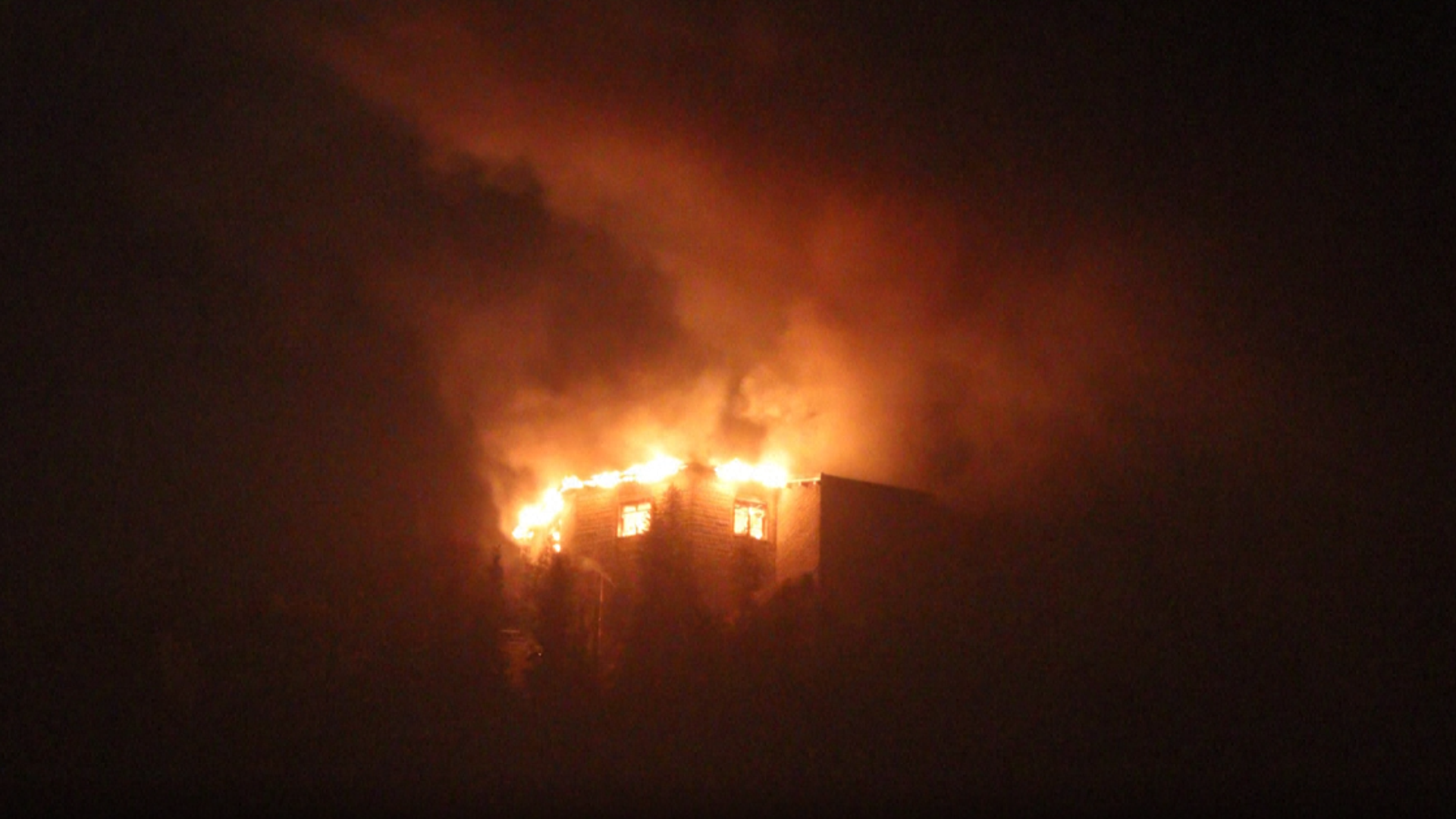
The arrest of a suspect following a fire at the Kehlsteinhaus—commonly known as the Eagle's Nest—exposes a structural vulnerability common to high-symbolism, low-fortification historical assets. Standard news coverage treats an arson event at a World War II landmark as an isolated criminal incident. A rigorous operational assessment reveals it as the predictable outcome of an asymmetric risk profile: locations bearing immense ideological weight often operate with the physical security posture of a rural municipal park.
To understand why an attacker can successfully initiate a fire at one of Europe’s most recognizable historic structures, one must evaluate the site not as a museum, but as an exposed node in a complex geographic, legal, and economic network. The Kehlsteinhaus sits atop a rocky outcrop at 1,834 meters in the Bavarian Alps near Berchtesgaden. Its defense relies almost entirely on natural topography and seasonal weather closures rather than active perimeter hardening. When an individual bypasses standard tourist flows to commit arson, the failure is rarely due to a single broken lock; it is a systemic breakdown across physical access control, cultural preservation mandates, and law enforcement response times.
The Structural Anatomy of the Kehlsteinhaus Vulnerability
Security practitioners evaluate physical assets using the Deter-Detect-Delay-Respond (DDDR) framework. At legacy historical sites repurposed for public tourism, three of these four pillars are structurally compromised by the site's primary commercial and educational mission.
1. Deterrence Failure Through Ideological Magnetism
Conventional deterrence relies on convincing a rational actor that the cost of an attack exceeds the reward. However, sites linked to the Third Reich attract non-rational or ideologically motivated actors whose utility function is inverted. For an extremist seeking notoriety, or an anti-fascist activist attempting symbolic erasure, high-security visibility and public sensitivity increase the perceived value of the target. Standard fencing and signage do not deter actors who view arrest as an acceptable, or even desirable, component of the operational outcome.
2. Detection Gaps in Non-Operational Windows
The Kehlsteinhaus operates seasonally, typically closing between late October and May due to snow and ice hazards on the Kehlsteinstraße. Even during operational months, the facility transitions from a high-density tourist environment during the day to an isolated mountain structure at night. Maintaining continuous human surveillance at 1,834 meters incurs prohibitive labor costs. Automated detection systems—such as thermal imaging, seismic sensors, and perimeter beams—suffer from high false-alarm rates in alpine environments due to extreme weather fluctuations, wildlife, and rockfalls. Operators frequently lower sensor sensitivity to prevent alert fatigue, creating blind spots an intruder can exploit.
3. The Alpine Response Latency Bottleneck
The most critical variable in the Eagle's Nest risk equation is response time. The structure is accessible via a single, steep, 6.5-kilometer mountain road featuring five tunnels and a 124-meter brass elevator carved into the rock. In an emergency, municipal police and fire brigades from Berchtesgaden face an unavoidable vertical transit delay. Even if an intrusion or thermal anomaly is detected instantaneously, the physical gap between detection and intervention allows an arsonist sufficient dwell time to ignite accelerants and retreat down hiking trails before authorities reach the summit.
The Heritage Preservation Paradox
Managing a site like the Kehlsteinhaus requires balancing competing institutional mandates that directly undermine physical security. Unlike a corporate data center or a military installation, a historical monument cannot be hardened without destroying the very asset it seeks to protect.
- Architectural Integrity vs. Fortification: Bavarian heritage protection laws strictly limit structural modifications. Installing blast-resistant glazing, heavy steel fire doors, or extensive external conduit networks for surveillance cameras alters the historical fabric of the 1938 building. Security upgrades must remain visually unobtrusive, which restricts engineers to lower-tier, less durable hardware.
- Public Access vs. Perimeter Control: The site operates as a restaurant and a historical documentation point managed by the Berchtesgadener Land Tourismus GmbH and the Bavarian state. High-volume throughput requires open access routes, unobstructed fire exits, and minimal friction for paying visitors. Every emergency exit mandated by modern fire code doubles as an unguarded ingress/egress vector for a bad actor willing to trigger an alarm.
- Suppression Systems vs. Water Damage: Installing modern, high-pressure sprinkler systems in remote alpine stone structures presents severe engineering challenges. Pipes are vulnerable to freezing during the harsh winter months, and accidental discharge can inflict catastrophic water damage on historic interiors. Consequently, many heritage sites rely on passive fire barriers and localized extinguishers rather than automated active suppression, leaving the structure vulnerable once a fire breaches the surface layer.
The Mechanism of Symbolic Arson and Law Enforcement Attribution
When a fire occurs at a politically sensitive site, law enforcement operates under intense public and political scrutiny to establish intent. Investigative workflows immediately bifurcate into forensic fire investigation and behavioral threat assessment.
Forensically, investigators examine burn patterns, V-shaped charring, and trace residues to determine the point of origin and the presence of hydrocarbon accelerants. Because the Kehlsteinhaus is constructed primarily of heavy granite masonry and reinforced concrete, structural collapse from a localized fire is unlikely. The primary damage vector is smoke permeation, roof timber destruction, and the ruin of interior woodwork—specifically the famous red marble fireplace gifted by Benito Mussolini and the surrounding paneling.
Behavioral attribution presents a more complex analytical challenge. Fires at Nazi-era landmarks generally stem from one of three distinct actor profiles:
- Far-Right Extremists: Actors attempting to create a martyrdom narrative or destroy perceived "desecration" of a site they venerate, often timed around significant historical dates.
- Far-Left or Anti-Fascist Actors: Individuals seeking to physically eradicate remnants of the regime that they believe authorities have overly commercialized or inadequately contextualized.
- Apolitical Thrill-Seekers or Vagrants: Individuals who breach closed or remote structures for shelter, vandalism, or social media clout, inadvertently or casually starting fires without ideological motive.
Police must rely on digital forensics—such as cell tower dumps from the surrounding Berchtesgaden valley, automated license plate readers along the approach roads, and open-source intelligence monitoring—to narrow the suspect pool. In remote alpine terrain, the absence of dense urban CCTV networks forces investigators to lean heavily on telecommunications metadata to identify mobile devices pinging the summit outside operational hours.
Limitations of Current Site Security Models
No security architecture can eliminate risk at a publicly accessible monument without destroying its operational viability. Current mitigation strategies face hard operational ceilings:
- The Cost-Benefit Ceiling: The revenue generated by seasonal tourism and restaurant operations does not scale to fund 24/7 armed tactical guard forces. State subsidies cover baseline maintenance and historical documentation, leaving security budgets perpetually constrained.
- The Displacement Effect: Hardening the summit structure simply shifts the vulnerability to softer targets along the approach infrastructure. The Kehlsteinstraße, the tunnel portals, the bus turnaround, and the lower documentation center (Dokumentation Obersalzberg) remain exposed. An attacker blocked from the summit can easily target the transit bottlenecks, achieving similar media disruption with lower physical effort.
- Legal Constraints on Surveillance: Strict German and European Union data protection regulations (GDPR) govern the deployment of wide-area video surveillance and biometric tracking in public spaces. Security operators cannot deploy dragnet facial recognition or continuous tracking across public hiking trails leading to the Kehlstein peak without facing severe legal challenges.
Tactical Realignment for Heritage Asset Protection
To prevent repeat incidents without turning historical landmarks into fortified bunkers, site operators and regional authorities must shift from passive perimeter defense to predictive, layered containment.
First, operators must decouple fire detection from human visual verification. Thermal-optical dual-spectrum cameras should be mounted on existing exterior lighting fixtures to monitor the roof perimeter and entry points. These systems detect abnormal heat signatures before open flames develop, buying critical minutes against the alpine transit delay.
Second, authorities must implement automated chemical fire suppression using high-pressure water mist or inert gas systems in high-value interior zones, such as the main dining room and the fireplace gallery. Water mist systems require a fraction of the water volume of traditional sprinklers, minimizing freeze risks in alpine pipes and preventing collateral water damage to historic stone and wood.
Third, law enforcement should establish automated geofencing protocols in coordination with regional telecommunications providers. Rather than relying on physical patrols along treacherous mountain trails after hours, police can utilize pre-authorized alerting mechanisms triggered by unauthorized mobile device handshakes at the summit relay between 22:00 and 06:00, converting the site's geographic isolation from a response liability into an inescapable containment zone.