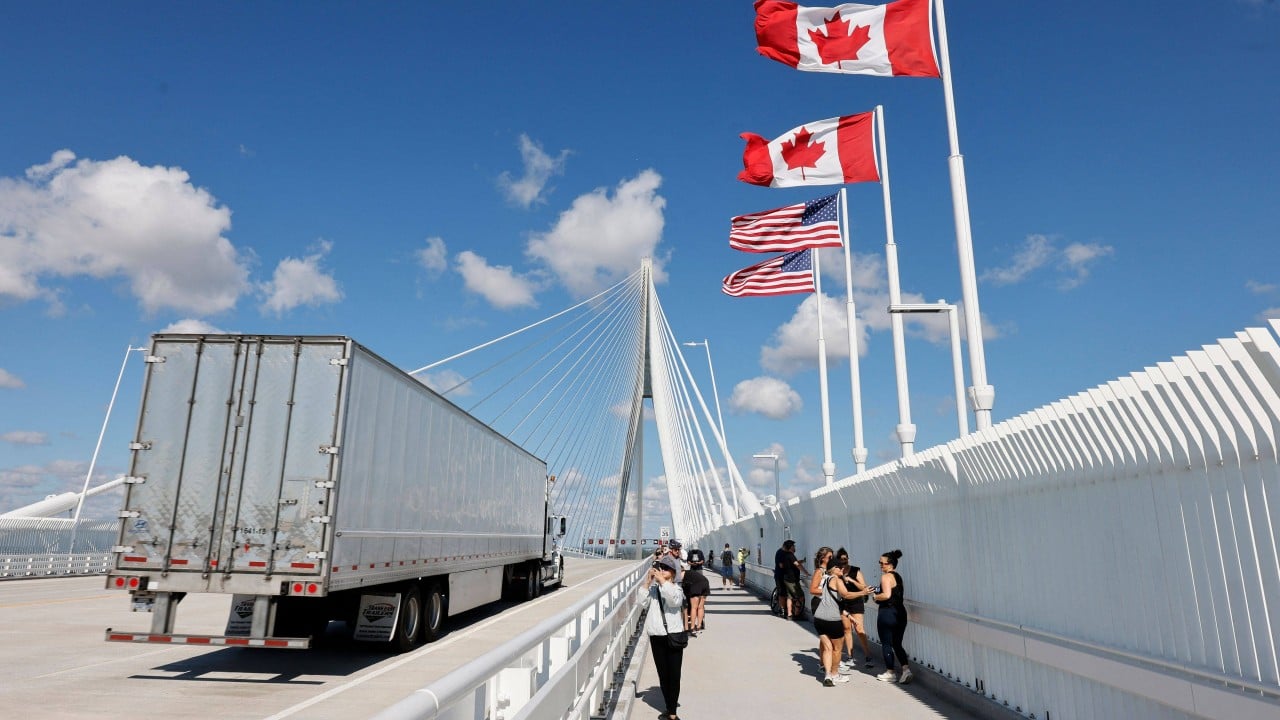
Sovereign trade disputes function as zero-sum games operating under asymmetric cost functions. When the United States administration invoked Section 338 of the Tariff Act of 1930 alongside broad retaliatory duties against Canadian imports, conventional economic commentary framed the conflict through a lens of raw market scale. The standard premise holds that because the United States economy exceeds Canada’s by a factor of thirteen and absorbs roughly two-thirds of Canadian merchandise exports while exporting a much smaller fraction of its own GDP northward, Washington possesses absolute leverage. This macro-level view mistakes aggregate size for tactical execution.
Sustained trade negotiations are not determined by total GDP, but by structural elasticity, supply chain substitutability, and localized political vulnerability. By deploying precise, dollar-for-dollar counter-tariffs targeted at specific U.S. industrial and agricultural sectors, Ottawa demonstrated that economic defense does not require matching an opponent's aggregate mass. It requires imposing concentrated political pain where legislative margins are razor-thin. If you enjoyed this piece, you should look at: this related article.
The Mechanics of Structural Interdependence
The traditional vulnerability thesis assumes that a smaller economy dependent on a larger trade partner will inevitably capitulate under pressure. This framework ignores the microeconomics of integrated manufacturing networks. North American supply chains—particularly within automotive production, energy grids, and specialized metals—were optimized over decades for cost efficiency, not redundancy.
When tariffs are levied on intermediate goods, the cost structure ripples backward onto domestic producers before foreign competitors feel the full impact. For instance, imposing a 25 percent duty on steel and aluminum or specialized automotive components does not simply punish exporters; it instantly taxes domestic assembly plants that rely on cross-border inputs. American automakers relying on integrated components faced immediate cost pressures, forcing industry executives to lobby against policies that degraded their own margin stability. For another angle on this event, check out the latest update from Financial Times.
This creates a dual-channel transmission mechanism:
- The Cost-Push Channel: Tariffs raise input costs for downstream manufacturing, generating domestic inflation and compressing corporate margins inside the imposing country.
- The Political-Concentration Channel: Retaliatory measures can be engineered to hit specific congressional districts or electoral strongholds, converting diffuse macroeconomic friction into acute political liability for incumbent legislators.
Redefining the Conflict Through Legal and Economic Theory
A critical inflection point in the 2025-2026 trade conflict occurred when Washington shifted its rhetorical and legal justification from standard reciprocity to discrimination under Section 338. Reciprocity implies an iterative loop: one party imposes a duty, the second responds, and both parties absorb standard deadweight loss. Discrimination, conversely, asserts that a trading partner is penalizing U.S. commerce relative to third-party nations.
This legal pivot alters the bargaining horizon. Litigation through the United States-Mexico-Canada Agreement (USMCA) panels or World Trade Organization frameworks typically operates on protracted timelines, often spanning years. When a government bypasses traditional dispute resolution in favor of executive tariff declarations, the targeted nation faces a binary choice: capitulate immediately or deploy rapid, proportional economic friction to alter the opponent's domestic political calculus.
Canada’s response strategy departed from historical precedent by refusing to treat the tariffs as a permanent new baseline. Instead of absorbing the shock through currency devaluation or broad macroeconomic subsidies, Ottawa executed synchronized counter-tariffs against high-visibility U.S. goods, including agricultural equipment, alcohol, and manufactured items. This targeted approach exploits the reality that modern trade policy is vulnerable to localized interest groups. When specific export sectors in swing states face sudden revenue contraction due to foreign retaliation, those industries mobilize domestic opposition against the originating administration.
The Limits of Diversification and Long-Term Realities
While tactical retaliation can successfully alter short-term negotiating dynamics, it exposes structural fragilities that no amount of diplomatic resolve can instantly resolve. Geographic concentration remains a permanent constraint. Multilateral trade diversification—such as pursuing deeper economic ties with Asian or European markets—cannot replace the immediate logistical velocity of an open land border and integrated pipelines. Major infrastructure assets, port facilities, and resource-transport corridors require years of capital expenditure to reroute.
Furthermore, prolonged uncertainty alters corporate investment behavior. When trade pacts become subject to annual review cycles and unilateral executive actions, multinational enterprises adjust their risk models. Capital expenditure migrates away from cross-border integration toward localized redundancy, permanently raising baseline operational costs for consumers in both nations. The economic fallout manifests not merely in tariff revenue collected at ports, but in forgone capital formation and diminished long-term productivity growth.
Strategic Execution for Asymmetric Defense
To maintain leverage in bilateral trade disputes against a significantly larger hegemon, smaller economies must adhere to strict operational parameters rather than relying on diffuse political appeals.
First, retaliation must be mathematically synchronized to match the opponent's exposure profile while maximizing local legislative friction. Broad-based embargoes dilute impact; surgically targeted duties on politically sensitive exports concentrate the cost where lawmakers feel it most.
Second, legal challenges must proceed concurrently with economic countermeasures. Even if international tribunals or domestic supreme courts operate slowly, maintaining formal legal challenges preserves long-term institutional norms and prevents unilateral executive actions from establishing unvetted precedence.
Third, domestic industrial policy must pivot from crisis management to structural resilience. Subsidizing impacted sectors provides temporary relief, but long-term viability requires lowering internal regulatory barriers, accelerating domestic productivity, and diversifying supply chain dependencies before the next shock materializes. The ultimate defense against economic coercion is an economy robust enough that foreign tariffs inflict greater self-harm than external damage.