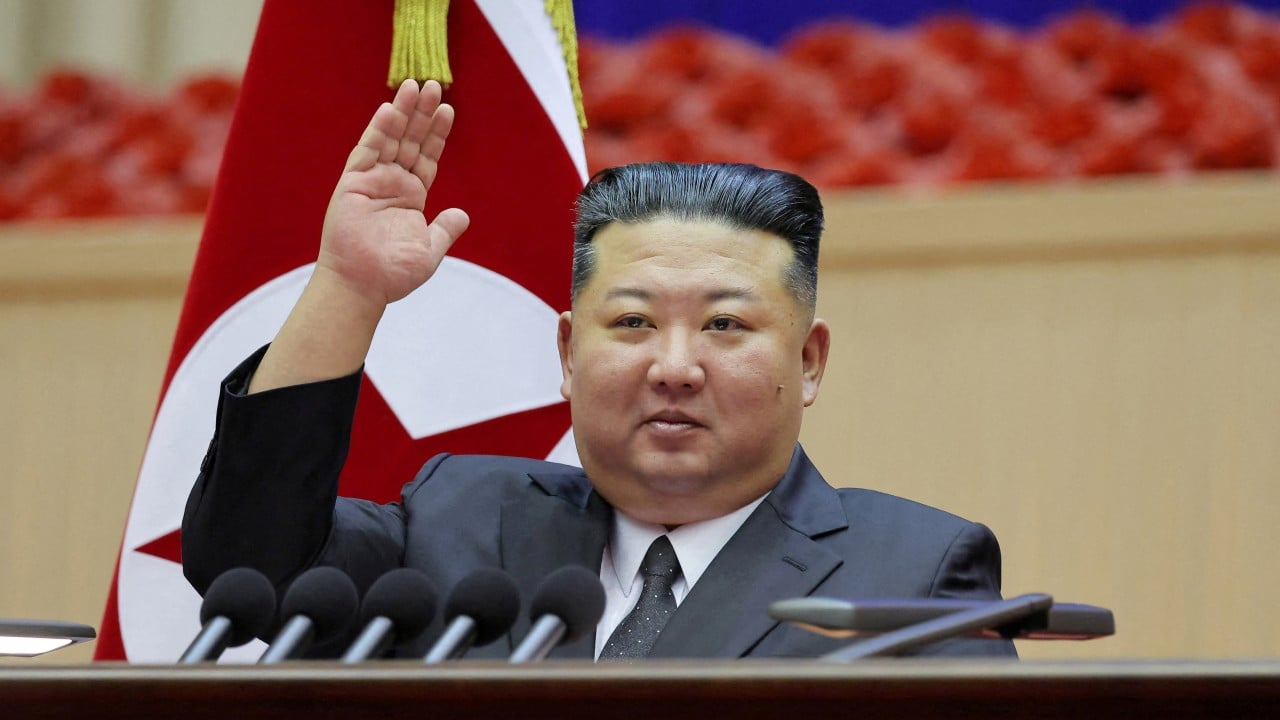
When Kim Jong-un declares an objective to build the "strongest armed forces in the world," standard media coverage treats the statement as hyperbolic domestic propaganda. That reading misses the operational mechanics of the regime. Pyongyang does not measure military supremacy through conventional force parity, global power projection, or expeditionary logistics. Instead, North Korean military doctrine defines supremacy through absolute regime survival via asymmetric deterrence—specifically, the capability to inflict unacceptable strategic costs on any intervening coalition before external forces can neutralize its command-and-control architecture.
To understand the shift in the Korean People’s Army (KPA), analysts must discard Western metrics of military capability, such as carrier strike groups, fifth-generation air superiority, or sustained blue-water naval operations. North Korea operates under severe macroeconomic constraints, international sanctions, and an aging industrial base. Attempting to match the United States or South Korea tank-for-tank or jet-for-jet would guarantee rapid fiscal and material exhaustion. Rather than competing in conventional domains where it holds a permanent structural disadvantage, Pyongyang allocates capital toward high-leverage asymmetric systems designed to fracture alliance cohesion and paralyze regional missile defense networks.
The Structural Constraints of KPA Force Design
Every military doctrine is a direct function of its underlying economic and geographic constraints. For the Democratic People's Republic of Korea (DPRK), three structural realities dictate force structure and procurement priorities:
- Capital Scarcity and Sanctions: With a gross domestic product dwarfed by South Korea's defense budget alone, the DPRK cannot fund broad-spectrum modernization. Capital must be concentrated into narrow, high-yield research and development pipelines, bypassing conventional procurement entirely.
- Geographic Compression: The Korean Peninsula offers minimal strategic depth. Key command nodes, industrial hubs, and launch infrastructure sit within minutes of strike aircraft and precision-guided munitions stationed in South Korea and Japan. Survivability therefore depends on mobility, hardening, and dispersion rather than perimeter defense.
- Technological Asymmetry: Facing adversaries with superior intelligence, surveillance, and reconnaissance (ISR) networks, the KPA cannot rely on static deterrence. Static silos and liquid-fueled missiles requiring hours of fueling on exposed launchpads are functionally obsolete against modern space-based tracking and preemptive strike doctrines.
These constraints explain why the KPA maintains a massive, poorly equipped conventional infantry alongside a rapidly modernizing strategic missile force. The conventional force serves primarily as an internal labor pool, a border policing apparatus, and a tripwire mechanism, while the Strategic Force absorbs the state's premier engineering talent and foreign currency reserves.
The Three Pillars of Pyongyang’s Modernization Strategy
When North Korean leadership speaks of building the world's premier military, the operational execution breaks down into three distinct technical pillars: survivability, penetration, and tactical nuclear integration.
1. Pre-Launch Survivability Through Solid-Fuel Transition
The single most consequential shift in North Korean missile engineering is the systematic replacement of liquid-propellant systems with solid-fuel alternatives across short-, medium-, and intercontinental-range ballistic missiles. Liquid-fueled rockets, such as the older Hwasong-14 and Hwasong-15, require volatile propellants loaded shortly before launch. This fueling window exposes transporter-erector-launchers (TELs) to overhead persistent surveillance, creating a vulnerability to preemptive strikes—the exact scenario envisioned by South Korea's "Kill Chain" doctrine.
Solid-fuel rockets, exemplified by the Hwasong-18 ICBM and the KN-23 series of short-range ballistic missiles, arrive at launch sites pre-fueled and sealed in canisters. Launch preparation time drops from hours to minutes. By compressing the sensor-to-shooter timeline, the KPA shifts the burden of escalation onto the United States and South Korea. If adversaries cannot reliably detect and destroy missiles prior to launch, preemptive conventional counterforce strikes cease to be a viable military option.
2. Defense Saturation and Trajectory Manipulation
A missile force is only a credible deterrent if its warheads can penetrate regional ballistic missile defense (BMD) architectures, including Terminal High Altitude Area Defense (THAAD), Patriot PAC-3 batteries, and Aegis BMD destroyers. North Korea addresses this through two engineering approaches: flight-profile manipulation and salvo saturation.
Systems like the KN-23 and KN-24 utilize quasi-ballistic trajectories. Rather than following a predictable parabolic arc through the upper atmosphere, these missiles fly at depressed altitudes—often below 50 kilometers—and execute pull-up maneuvers during their terminal phase. This flight profile exploits the altitude gap between high-tier interceptors (designed for exoatmospheric or high-endoatmospheric intercepts) and low-tier point defense systems. Simultaneously, the proliferation of solid-fuel TELs and super-large multiple rocket launchers (such as the KN-25) allows the KPA to fire coordinated salvos. Even an interceptor system with a 90 percent single-shot probability of kill fails when confronted with thirty simultaneous incoming warheads targeting a single airbase or port facility.
3. Tactical Nuclear Integration and Ambiguous Thresholds
Historically, Pyongyang framed its nuclear arsenal as a strategic deterrent aimed at the continental United States—a weapon of last resort intended to decouple Washington from Seoul by threatening American cities. Recent doctrinal revisions, codified in North Korean law, lower the nuclear threshold by introducing battlefield or tactical nuclear weapons.
By miniaturizing warheads to fit onto short-range systems like the KN-23, KN-24, KN-25, and cruise missiles (Hwasal-1 and Hwasal-2), the KPA delegates nuclear use to operational-level units. The strategic logic relies on calculated ambiguity. When a battery launches a KN-23, opposing radar operators cannot determine whether the incoming payload is a 500-kilogram conventional high-explosive warhead or a low-yield tactical nuclear device until detonation. This ambiguity forces allied commanders into a paralysis dilemma: treat every tactical launch as a nuclear event and trigger massive retaliation, or absorb the strike and risk losing critical military infrastructure in the opening minutes of a conflict.
Deconstructing the "Strongest Armed Forces" Narrative
Western analysts frequently confuse political rhetoric with military capability, leading to two opposite errors: dismissing North Korean advancements as bluffs, or exaggerating them into an existential conventional threat. Neither assessment holds up under operational scrutiny.
North Korea cannot fight and win a protracted conventional war. Its air force relies heavily on legacy Soviet airframes from the 1960s and 1970s, hampered by severe aviation fuel shortages that restrict pilot flight hours to a fraction of NATO standards. Its naval surface fleet consists largely of coastal patrol craft vulnerable to modern anti-ship missiles and submarines. Its armored divisions lack modern reactive armor, thermal optics, and secure tactical communications. In a sustained conventional engagement, KPA logistics lines would collapse within weeks under allied air interdiction.
Therefore, the phrase "strongest armed forces" must be understood strictly within the framework of coercive bargaining power. In international relations theory, military strength is relative to the specific political objective sought. If the objective is global expeditionary dominance, the KPA ranks low. If the objective is to render the cost of regime change prohibitive for a superpower coalition, then developing a survivable, solid-fuel, multi-tiered nuclear strike capability achieves functional parity for that specific mission.
The Geopolitical Multiplier: External Supply Chains and Technology Transfer
Force modernization does not occur in a vacuum. Sanctions enforcement and supply chain interdiction historically slowed KPA weapons development, forcing engineers to rely on illicit procurement networks and domestic reverse-engineering. However, shifting geopolitical alignments have altered this baseline.
Artillery and ballistic missile transfers from North Korea to Russia have established a transactional corridor that bypasses Western financial and trade controls. While exact terms remain opaque, the operational mechanics of this exchange provide Pyongyang with three critical inputs:
- Empirical Combat Data: KPA ballistic missiles, specifically the KN-23 and KN-24, are undergoing live testing against Western-supplied air defense systems in active combat environments. Data gathered on guidance accuracy, structural integrity, and interceptor evasion feeds directly back into North Korean design bureaus, accelerating iterative engineering cycles that would otherwise require dozens of expensive domestic test launches.
- Hard Currency and Raw Materials: Sustaining a solid-fuel missile program requires specialized chemical precursors, high-grade maraging steel, carbon fiber composites, and microelectronics. Barter arrangements and financial inflows mitigate the impact of United Nations Security Council sanctions, stabilizing the supply chain for the Munitions Industry Department.
- Technical Knowledge Exchange: Access to advanced Russian telemetry, satellite propulsion, and submarine acoustic quieting technologies addresses the exact engineering bottlenecks that have historically plagued North Korea's space launch vehicles and ballistic missile submarines.
Limitations and Vulnerabilities of the KPA Model
Despite rapid progress in missile engineering, North Korea's asymmetric posture contains severe structural vulnerabilities that limit its operational flexibility.
Command, Control, and Communications (C3) Fragility
Pre-delegating tactical nuclear authority to field commanders solves the problem of decapitation strikes against leadership in Pyongyang, but it introduces severe command-and-control risks. Unlike the United States or Russia, North Korea lacks a resilient, multi-layered satellite communications network and airborne command posts. In an active conflict characterized by intense electronic warfare and cyber disruption, field commanders may lose contact with central authority. Without robust Permissive Action Links (PALs) or reliable secondary communication channels, the risk of unauthorized, accidental, or premature nuclear escalation rises sharply.
Industrial Bottlenecks and Quality Control
Transitioning from prototype testing to mass production exposes manufacturing weaknesses. Reports regarding KPA munitions deployed abroad indicate high failure rates, inconsistent propellant quality, and guidance system malfunctions. Scaling up complex solid-fuel rocket motors and precision guidance packages under sanctions requires tight tolerances that North Korea’s aging machine-tool sector struggles to maintain consistently across large production runs.
The Escalation Trap
Asymmetric deterrence relies on the threat of escalation to deter aggression. However, once deterrence fails and conflict begins, North Korea possesses very few off-ramps. Because its conventional forces cannot hold territory against a modern counteroffensive, the KPA doctrine dictates early, massive use of strategic and tactical fires to shock the adversary into a ceasefire. If the opposing coalition absorbs the initial blow and continues operations, Pyongyang exhausts its high-end asymmetric leverage rapidly, leaving the regime exposed to total conventional defeat.
Strategic Implications for Regional Defense Planning
Evaluating North Korea's military trajectory requires separating political theater from engineering reality. The regime is not building a conventional juggernaut; it is constructing a hardened, mobile, nuclear-tipped porcupine designed to survive a first strike and inflict catastrophic regional damage.
For defense planners in Seoul, Tokyo, and Washington, countering this posture requires abandoning reliance on purely reactive missile defense. Intercepting massed salvos of maneuvering, solid-fuel tactical missiles is mathematically and economically unsustainable—the cost-exchange ratio heavily favors the attacker. Strategic adaptation must focus on three concrete shifts:
- Persistent Left-of-Launch Disruption: Shift capital allocation from terminal kinetic interceptors toward persistent space-based ISR, cyber operations, and non-kinetic electronic warfare aimed at corrupting KPA targeting data and disrupting launch telemetry before missiles leave their canisters.
- Hardening and Dispersal of Regional Assets: Reduce the vulnerability of concentrated forward operating bases by dispersing aircraft, fuel depots, and command nodes across smaller, austere airfields, neutralizing the effectiveness of saturation strikes.
- Integrated Deterrence Signaling: Establish clear, unambiguous declaratory policies regarding tactical nuclear use, eliminating the gray-zone ambiguity Pyongyang seeks to exploit between conventional provocation and strategic nuclear war.