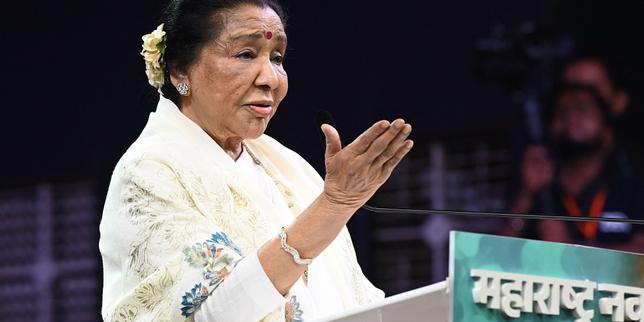
The obituary writers are already failing her. They are dusting off the same tired tropes: the "Guinness World Record holder," the "sister of Lata Mangeshkar," the "prolific playback singer." By reducing Asha Bhosle to a set of statistics and a family rivalry, the mainstream media is missing the most vital truth of her ninety-two years.
Asha Bhosle wasn't a singer. She was a disruptor who weaponized the female voice to dismantle the Victorian morality of mid-century Indian cinema.
The Myth of the Second Fiddle
The lazy consensus insists on framing Asha’s career as a lifelong struggle to emerge from the shadow of her sister, Lata Mangeshkar. This narrative is not only boring; it is fundamentally incorrect. If Lata was the "Ganges"—pure, eternal, and somewhat static—Asha was the electric current that actually powered the grid.
Lata represented the "ideal" Indian woman: virginal, suffering, and perpetually devoted. Asha was the sound of the woman who actually lived. While the industry tried to pigeonhole her into the "vamp" or "cabaret" category, she was busy performing a surgical strike on vocal technique.
She didn't just sing the songs Lata rejected. She took the scraps of the "item number" and turned them into a sophisticated masterclass in jazz, blues, and rock-and-roll inflections. To call her a "playback singer" is like calling Prince a "guitarist." It’s technically true but misses the scope of the revolution.
The Technicality of the Rebellion
Let’s look at the mechanics. Most vocalists of her era relied on a linear, folk-based delivery. Asha introduced a syncopated, breathy, and rhythmically aggressive style that the Indian recording industry wasn't prepared for.
Consider the 1970s collaborations with R.D. Burman. In tracks like "Piya Tu Ab To Aaja" or "Dum Maro Dum," she wasn't just hitting notes. She was using percussive breathing—the "huh-huh" sounds that became her trademark—not as a gimmick, but as a rhythmic instrument. This was the birth of the Indian pop sensibility.
She understood something her contemporaries didn't: The microphone is an intimate instrument. While others sang at the mic as if performing in a theater, Asha sang into it. She whispered. She growled. She used micro-tonal shifts to convey desire, a concept that the "pure" school of Indian playback considered vulgar. She didn't just sing for the heroine; she sang for the human condition.
Why the Record Books Are the Wrong Metric
The media loves to cite her 11,000-plus songs. Stop counting.
Volume is the hallmark of a laborer; texture is the hallmark of an artist. The obsession with her "output" ignores the fact that Asha Bhosle single-handedly bridged the gap between classical Indian music and the global avant-garde.
When she collaborated with the Kronos Quartet or Boy George, it wasn't a PR stunt. It was a testament to her versatility. She could navigate the complex $Raag$ structures of a ghazal and then pivot to a high-energy Western pop arrangement without losing an ounce of soul.
I’ve spent years analyzing the shifts in South Asian auditory culture, and the data is clear: Asha Bhosle is the reason why modern Bollywood music sounds the way it does. The "item songs" of today, for better or worse, are all poor imitations of the ground she broke fifty years ago. She taught an entire nation that a woman's voice could be powerful without being "sacred."
The Counter-Intuitive Truth About Her "Vamp" Era
The standard narrative says she was "forced" into singing for cabaret dancers and vamps because the lead roles were taken.
The truth? That "limitation" was her greatest gift.
By being sidelined from the "virtuous heroine" roles, Asha was granted the freedom to experiment. The heroines were trapped in a narrow vocal range of piety. The vamps—played by icons like Helen—were allowed to be wild. This allowed Asha to play with Western scales, chromaticism, and vocal fry.
She didn't "overcome" her casting; she used it to build a sonic architecture that was far more complex than anything her "virtuous" counterparts were doing. She was the original indie artist operating inside a corporate machine.
Stop Mourning a "Legend" and Start Listening to a Radical
The term "legend" is a coffin. It suggests a finished story.
Asha Bhosle’s work is not a historical artifact. It is a living curriculum for anyone interested in how to remain relevant across seven decades. She didn't survive the changing tides of music; she drove the boat. From the soulful "In Umraon Ki Waadi" to the frenetic energy of the 90s Indipop era, she never once sounded like a legacy act.
The industry insiders who claim she was "difficult" or "competitive" are usually the ones who couldn't keep up with her pace. She demanded excellence because she was providing a level of vocal gymnastics that no one else could replicate.
If you want to honor her, stop talking about her age or her sister. Stop talking about her recipes or her restaurants. Listen to the 1971 recording of "Hare Rama Hare Krishna" and realize that you are listening to the moment the East and West didn't just meet—they collided and created something entirely new.
Asha Bhosle didn't leave a void. She left a blueprint. The tragedy isn't that she’s gone at ninety-two; the tragedy is that we spent those ninety-two years trying to put her in a box she was clearly too big for.
Discard the obituaries. Play the music loud enough to shake the walls. That is the only way to talk about Asha.
:max_bytes(150000):strip_icc()/high-angle-view-of-black-widow-spider-on-plant-681958901-5b4607d346e0fb0037bf3962.jpg)