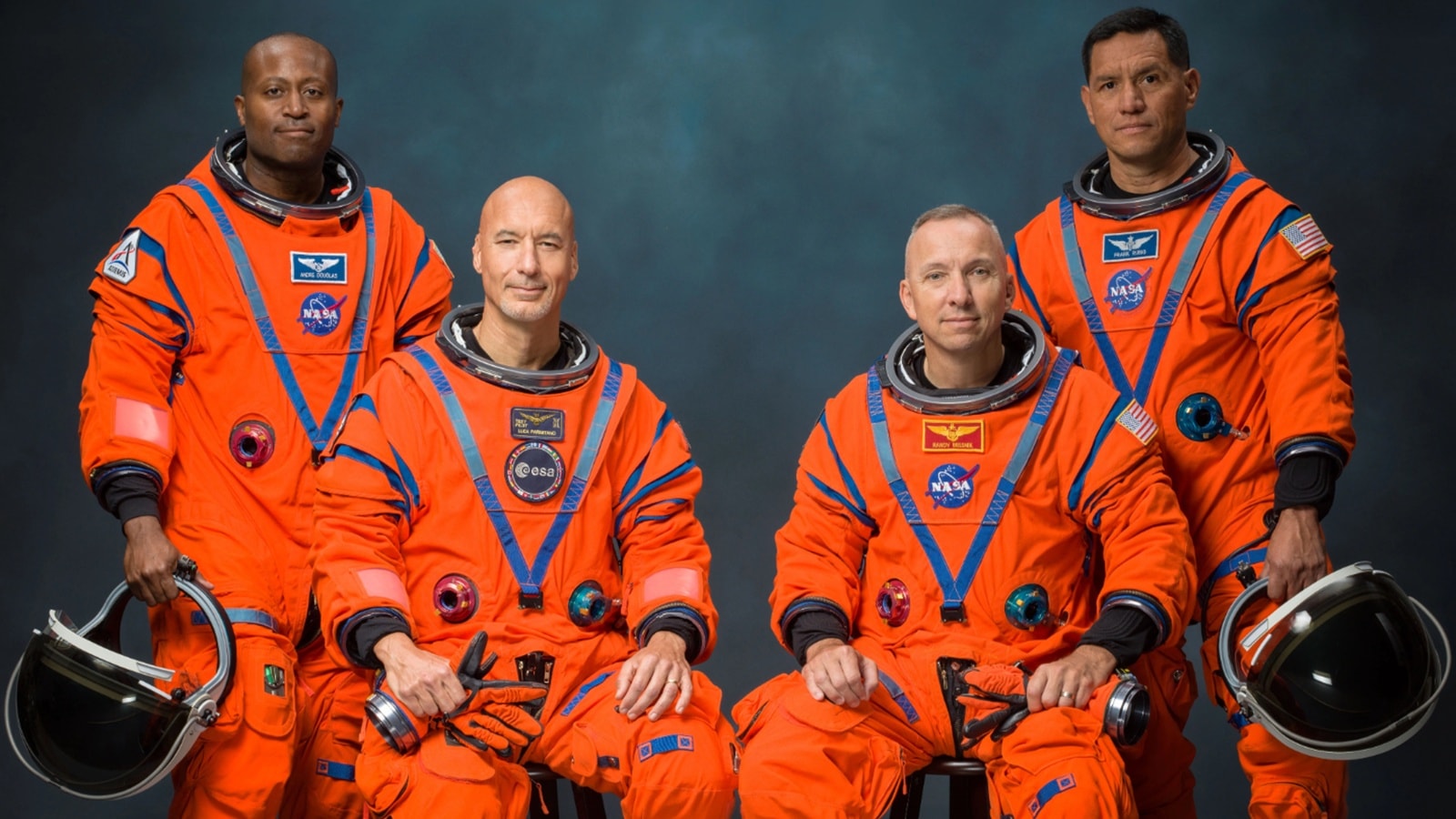
NASA just dropped the official crew lineup for Artemis III, and if you're expecting a dramatic television broadcast of boots crunching into pristine lunar dust, you're going to be disappointed.
The space agency named Randy Bresnik as commander, Luca Parmitano from the European Space Agency as pilot, and Andre Douglas and Frank Rubio as mission specialists. Bob Hines will secure the backup spot. It is a powerhouse crew packed with elite military test pilots, an engineer who recently served as an Artemis II backup, and a guy who holds the American record for the longest single continuous stay in space.
But here is the catch. These four astronauts aren't actually going to the Moon.
Instead of flying a quarter-million miles into deep space, the Artemis III crew will spend roughly two weeks stuck in low Earth orbit. They're staying close to home because NASA quietly overhauled its entire strategy, transforming what was supposed to be humanity's triumphant return to the lunar surface into a grueling, high-stakes orbital hardware test. If you want to understand why this shift happened, you have to look at the massive technical bottlenecks and commercial rocket explosions happening behind the scenes.
The Appalling Complexity of the New Low Earth Orbit Dance
When NASA Administrator Jared Isaacman announced the crew on Tuesday, June 9, 2026, the messaging leaned heavily on international collaboration and the dawn of a new golden age. Look past the optimism, though, and you find a mission profile that looks incredibly experimental.
NASA basically copied the playbooks of the Apollo 9 mission from 1969. The goal here isn't exploration. It's survival and verification.
The Space Launch System rocket will push the crew inside their Orion capsule straight into Earth orbit. Once they get up there, the real chaos begins. Instead of a straightforward flight, the crew has to execute a series of highly choreographed rendezvous and docking maneuvers with test versions of two entirely different commercial human landing systems.
- SpaceX is putting forward a specialized lunar variant of its massive Starship vehicle.
- Blue Origin is working on a crewed version of its Blue Moon lander.
The astronauts have to dock with these giant automated vehicles, crawl inside them, test their life-support networks, check the software interfaces, and confirm that the propulsion systems don't fail when integrated with Orion. They might even test out Axiom Space's new AxEMU spacesuits while floating in orbit.
It is an incredibly messy way to run a space program. Why do it this way? Because the commercial partners simply aren't ready to land on the Moon yet, and NASA is burning through time.
The Industrial Gridlock Forcing NASA's Hand
The original plan slated Artemis III as the big lunar landing event. That dream died due to harsh industrial realities. Both SpaceX and Blue Origin are lagging behind the insane launch cadences required to pull off a modern lunar landing.
To send a single Starship lander to the Moon, SpaceX has to launch multiple propellant tankers in rapid succession just to fill up the lander's tanks in orbit before it can even leave for the Moon. The infrastructure isn't there yet.
Worse, the commercial space race just suffered a brutal reality check. Blue Origin's massive New Glenn rocket recently suffered a catastrophic failure when it exploded during a routine engine-firing test on a Florida launch pad. The explosion lit up the night sky and shook local houses, highlighting exactly how volatile these unproven heavy-lift rockets remain.
While NASA's Jeremy Parsons publicly downplayed the incident as a "learning opportunity," the top brass is clearly sweating the timeline. By keeping Artemis III in Earth orbit for a 2027 launch, NASA buys its commercial partners another year or two to figure out their engineering issues without completely halting the momentum of the broader program.
The agency is also cutting corners on its own hardware to keep things moving. NASA confirmed it won't even use its remaining Interim Cryogenic Propulsion Stage for this flight. They're saving that critical upper stage for Artemis IV and replacing it on this mission with a non-propulsive "spacer" that merely mimics the physical size of the component.
Why Frank Rubio and This Particular Crew Matter
The selection of this crew tells you everything about how dangerous NASA expects this orbital test flight to be. They didn't pick rookies. They picked mechanics and survivalists.
Frank Rubio is arguably the most fascinating pick on the roster. He didn't just break the record for the longest single American spaceflight with 371 days in orbit; he did it because his Russian Soyuz spacecraft sprang a coolant leak while docked to the International Space Station. He knows exactly what it feels like to have a spacecraft break down beneath his feet and have to wait out an engineering crisis in a high-radiation environment.
Then you have Andre Douglas, a brilliant systems engineer who knows the internal architecture of the Artemis hardware inside and out. He spent the last few years tracking the development of these systems as the backup for Artemis II. His job isn't just to fly; it's to debug the software and hardware interfaces when the commercial components inevitably clash with NASA's legacy systems.
What Needs to Happen Before the 2027 Launch
If you want to track whether this mission will actually fly on time in late 2027, ignore the PR statements and watch these specific engineering milestones over the next twelve months.
First, engineers at Kennedy Space Center have to physically connect the Orion crew module to its service module this summer. This will be the first time the actual docking hardware flying on Artemis III undergoes physical integration testing.
Second, watch the launch pad rebuilding efforts in Florida. Blue Origin has to completely recover from its recent engine explosion and prove it can reliably fire its heavy-lift engines without blowing up the pad. Simultaneously, SpaceX needs to demonstrate that it can launch its Starship platform with a cadence measured in weeks rather than months.
If those milestones slip past early 2027, the Artemis III flight will inevitably slide into 2028, pushing humanity's actual return to the lunar surface well into the next decade. Keep your eyes on the assembly facility logs in New Orleans and the testing schedules at the Stennis Space Center in Mississippi. That's where this mission will either succeed or quietly fall apart.



:max_bytes(150000):strip_icc():focal(665x0:667x2)/gettyimages-50733149-2000-8b129a2475974982a915418ce92a73d8.jpg)