The sound of a diesel generator is not musical. It is a jagged, rhythmic throat-clearing that rattles the windowpanes and fills the frosty air with the smell of heavy oil. Yet, by the third month of the blackouts, that industrial thrum became the most comforting sound in Kyiv. It meant the soup would stay warm. It meant the pediatric incubator down the street would keep breathing. It meant the dark had lost another round.
We often talk about resilience as if it were a stoic statue, a marble monument that simply stands unchanged while the storm rages around it. It is a clean, academic word. European policy briefs and geopolitical think pieces love to dissect it, treating the survival of a nation like a laboratory experiment in stress testing. They look at grid capacities, import percentages, and logistical supply chains. If you liked this post, you might want to look at: this related article.
But resilience is not marble. It is mud, copper wire, and a stubborn refusal to sit in the dark.
To understand how a society adapts when its entire modern infrastructure is systematically targeted, you have to leave the government press rooms and walk into a makeshift workspace in an underground subway station. There, amid the damp concrete and the rush of displaced air from passing trains, you find twenty-somethings huddled over laptops, their faces illuminated by the blue glow of code that keeps a nation’s banking system alive while the sky above them falls apart. For another look on this development, check out the recent update from TIME.
This is the true anatomy of survival. It is messy, decentralized, and deeply human.
The Mirage of Centralized Power
For a century, the modern world built its pride on centralization. We created massive power plants, towering transmission lines, and monolithic servers designed to distribute energy and information from a single, paternalistic source. It was efficient. It was grand.
It was also terrifyingly fragile.
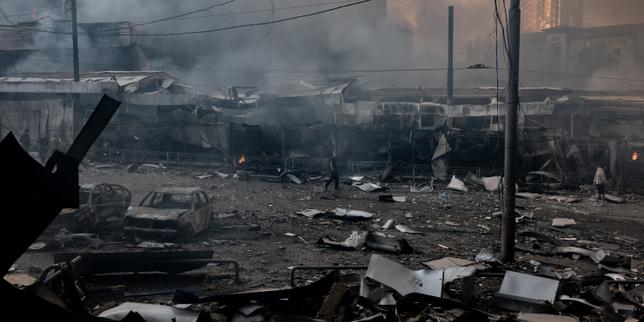
When the missiles began striking the thermal power plants, the vulnerability of this grand design became undeniable. Imagine a spiderweb where cutting three main threads collapses the entire structure. That was the blueprint of twentieth-century infrastructure. A single precision strike could plunge three million people into sub-zero darkness, freezing the water in their pipes and turning high-rise apartment buildings into concrete iceboxes.
The early analytical models suggested a total systemic collapse within weeks. Experts predicted a mass exodus, a breaking point where the sheer physical misery of winter would force a capitulation. The math made sense on paper.
The math forgot to account for the human variable.
What followed was a spontaneous, chaotic masterclass in decentralization. If the big web could be broken, the solution was to spin ten thousand smaller webs. Business owners did not wait for state-sponsored reconstruction teams. A barista at a corner cafe on Khreshchatyk Street bought a small generator, chained it to a lamppost, and taped an extension cord to the sidewalk. She became a communal charging hub. Across the city, grocery stores, pharmacies, and even small bookshops transformed into tiny islands of sovereignty.
Consider the sheer logistical audacity of this shift. Within months, an entire country shifted its energy reliance from massive, state-run utilities to a patchwork quilt of citizen-managed micro-grids. It was inefficient, expensive, and noisy. But it worked. The lesson here extends far beyond the borders of Eastern Europe. It challenges the foundational assumption of the modern West: that security lies in the scale of our institutions. True security, it turns out, lies in the adaptability of our neighborhoods.
The Digital Trench
While the physical grid was being patched with tape and determination, a parallel battle was being fought in the invisible spaces of the ether. A modern state runs on data. If the land registries, tax databases, and citizen identity registries are erased, the state ceases to exist in the modern sense. It becomes a ghost.
In the conventional playbook of warfare, a nation's digital archives are the soft underbelly. They sit in terrestrial server farms, vulnerable to both physical munitions and cyberattacks designed to wipe hard drives clean.
The response to this threat was a quiet, unprecedented migration. In the opening days of the conflict, an emergency legislative shift allowed the entire digital architecture of the state to be moved to the cloud. Centuries of land deeds, birth certificates, and treasury records were scrubbed from physical servers in vulnerable cities and distributed across data centers throughout Europe.
The state became weightless. It existed everywhere and nowhere at once.
This digital diaspora changed the very nature of governance under fire. An citizen whose home was reduced to rubble in the east could still log into a government smartphone application to renew their driver’s license, apply for housing compensation, or register a new business. The bureaucracy did not stop because the bricks fell.
This is where the standard narrative of "endurance" misses the mark. It implies a passive waiting, a holding of one's breath until the danger passes. What happened was the exact opposite: an aggressive, furious acceleration of modernization under the worst possible conditions. The digital infrastructure became a shield, proving that bureaucratic agility can be just as vital as physical armor.
The Psychology of the Fragmented Day
Living through this kind of systemic friction changes the texture of time itself. When power is a luxury that appears for only four hours a day, the abstract concept of efficiency vanishes. It is replaced by a hyper-focused, almost manic choreography of daily life.
You learn to read the rhythm of the grid like a sailor reads the wind.
When the lights flicker on at 2:00 AM, the apartment wakes up. There is no alarm clock, just the sudden, collective sigh of refrigerators humming back to life and washing machines starting their spin cycles. People do not roll over and go back to sleep. They leap out of bed to charge power banks, bake bread, bake tomorrow’s dinner, and download files for work. It is a surreal, midnight choreography performed by millions of people simultaneously.
Then, the silence returns. The dark drops like a curtain. And you go back to sleep, waiting for the next window of light.
This fragmentation creates a distinct psychological scar. It breeds a constant, low-lying urgency, an internal clock that is always ticking down to the next outage. Yet, within that anxiety, a strange kind of collective empathy takes root. When your neighbor’s apartment building has light while yours is dark, you don't feel resentment. You walk across the courtyard with your laptop and your extension cord. They open the door before you even knock.
This is the invisible glue that analytical data fails to capture. You cannot quantify the economic value of a neighbor who leaves their Wi-Fi password unencrypted so the kids on the block can do their homework on the stairwell. You cannot put a statistic on the warmth of a shared thermos of tea in a basement. But these small, unrecorded transactions are precisely what keep the larger machine from grinding to a halt.
The Irony of Vulnerability
There is a profound irony in how Western observers view this struggle. We look at the improvisations—the Starlink terminals strapped to rusted car roofs, the converted car batteries powering dental drills—with a mix of awe and pity. We treat it as a tragic anomaly, a bizarre detour from the comfortable trajectory of twenty-first-century life.
We are looking at it completely backward.
The fragile ones are not those who have learned to live with broken infrastructure. The fragile ones are those of us who assume our infrastructure can never break.
Our comfort has made us weak. We live in cities where a three-hour power outage is treated as a minor apocalypse, a bureaucratic failure that demands an immediate investigation. We have outsourced our survival to distant corporations and automated systems we do not understand and cannot fix. If the grocery store scanners go down, the city starves in a week. If the cellular towers fail, our communities dissolve into isolated, panicked individuals.
The lesson taught by the cold winters of the East is that our total reliance on flawless, centralized systems is a luxury built on shifting sand. The true measure of a society's sophistication is not how high its skyscrapers are, or how fast its 5G networks run. It is how well that society functions when the skyscrapers go dark and the networks vanish.
It is the capacity to look at a broken world and immediately begin rebuilding it with whatever is at hand.
The Uncalculated Yield
Every economic forecast regarding the region focuses on the damage. The numbers are staggering: billions of dollars in destroyed factories, cratered roads, and ruined fields. The charts show steep, terrifying drops in productivity and gross domestic product.
But these charts are blind to the human capital being forged in the furnace of this disruption.
An entire generation of engineers, logistics experts, entrepreneurs, and ordinary citizens has just received an involuntary doctorate in crisis management. They know how to run a supply chain through a war zone. They know how to keep an e-commerce platform online while their office is being powered by a tractor engine. They have learned to strip away the superfluous fluff of corporate bureaucracy and focus entirely on what is functional, immediate, and vital.
When this conflict eventually recedes into history, this collective expertise will not disappear. It will remain as a potent, restless economic force. The people who learned to build a digital state in the middle of a blackout will not find the challenges of peacetime market competition particularly daunting.
The physical landscape can be repaired. Concrete can be poured, wires can be restrung, and turbines can be replaced. But the internal shift—the profound, collective realization that a community can sustain itself through the total disruption of its environment—is permanent.
The twilight settles over the city again, cold and heavy. The streetlights remain dark, their tall metal stalks casting long shadows across the snow. For a moment, the silence is total, an ominous pressure that feels like it might crack the soul.
Then, one by one, the small engines begin to cough. A block away, a generator splutters, catches its breath, and settles into that familiar, rough roar. A storefront window illuminates, casting a bright, yellow rectangle onto the frozen pavement. Inside, someone is pouring coffee. Someone else is opening a laptop. The dark is still there, vast and freezing, but it has lost its power to terrify. It is no longer an insurmountable disaster. It is simply the environment in which they work.