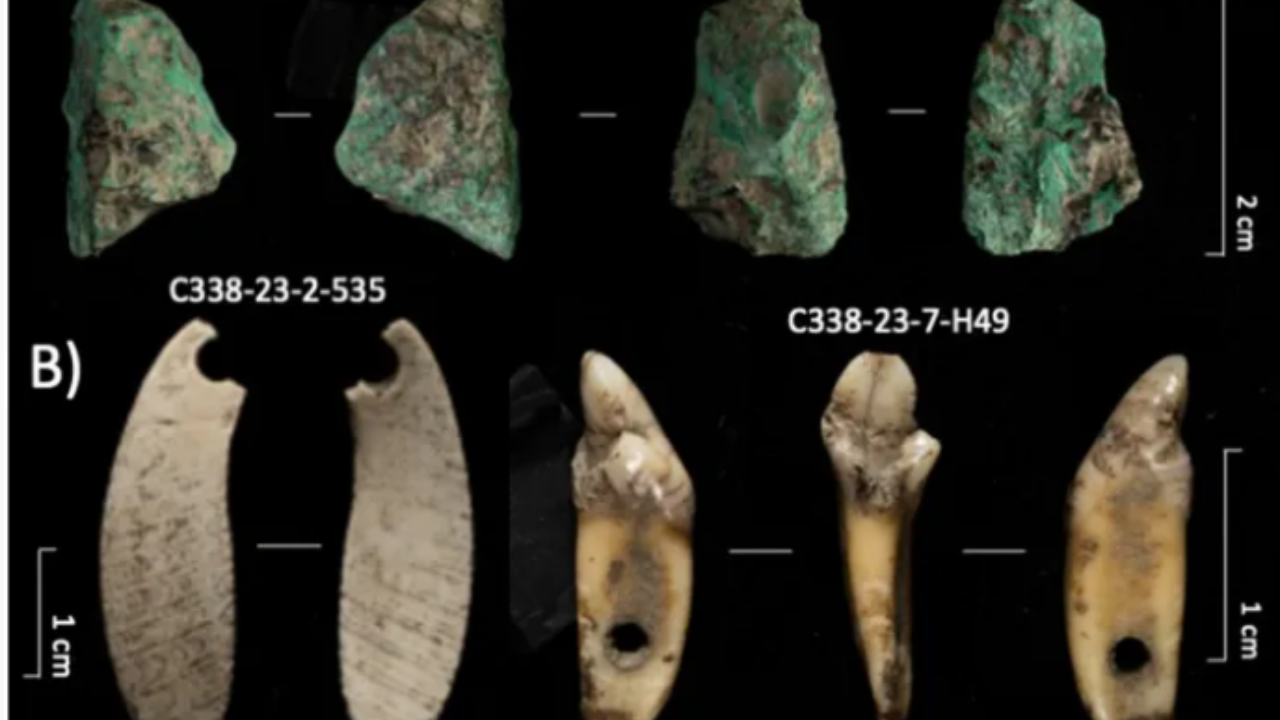
The media loves a good cave mystery. A single child's tooth, some green beads, and suddenly a routine Neolithic dig is transformed into a tragic melodrama or a cosmic puzzle. Headlines scream about "mysterious secrets hidden in mountain caves" as if ancient humans spent their entire lives staging elaborate performance art for future researchers to decode.
It is a comforting narrative. It sells magazine subscriptions. It is also fundamentally wrong.
When mainstream archeology encounters a site like the 5,500-year-old burial caves of the Mediterranean or the Balkans, the default setting is always the same: romanticize, sentimentalize, and over-interpret. A child’s tooth becomes a symbol of an ancient tragedy. Rare green stones become evidence of a mystical ritual or a sprawling, continent-wide trade empire built on spiritual reverence.
Let us drop the romance. What if those "mysterious green stones" were not sacred relics, but the prehistoric equivalent of cheap, mass-produced plastic trinkets? What if that child’s tooth ended up in that cave not because of a grand ceremonial send-off, but due to practical, mundane waste management or opportunistic burial practices?
We need to stop looking at the ancient world through the lens of modern fantasy novels.
The Lazy Consensus of Prehistoric Ritual
Spend enough time analyzing field data and you notice a pattern. Whenever an excavator finds an object they cannot immediately identify as a spoon or a spearhead, they slap the "ritual" label on it. It is the ultimate intellectual cop-out.
The conventional coverage of mid-Holocene cave sites assumes that every artifact was placed with profound, deliberate intent. If a child's tooth is found alongside green stones—often composed of minerals like variscite, malachite, or apatite—the immediate conclusion is that these items held a deep, esoteric meaning.
Consider the mechanics of human behavior. Variscite and similar green minerals are soft. They are easy to carve, easy to drill, and they look nice when polished. In the Neolithic period, having a collection of green stone beads did not inherently mean you were a high priest or part of a sacred lineage. It meant you had access to a local outcrop of soft rock and a few hours of free time.
By elevating every shiny pebble to the status of a "mysterious artifact," we obscure the actual economic realities of the past. Ancient humans were pragmatists. They recycled material. They dropped things. They made mistakes.
Imagine a scenario where a modern dump site is excavated 5,000 years from now. If future researchers find a child’s lost tooth next to a bright green plastic Croc charm, will they conclude that 21st-century humans worshipped a reptilian deity in localized suburban rituals? That is exactly what we do when we over-analyze cave strata without accounting for basic human sloppiness.
The Logistics of the Cave Copy-Paste
Mainstream reports consistently frame caves as exceptional, holy sanctuaries. This completely ignores the geographical reality of the landscape.
In karst regions across Europe, caves are not rare, mystical portals to the underworld. They are everywhere. They are natural shelters, cold storage units, and highly convenient holes in the ground.
- The Microclimate Reality: Caves keep a stable temperature. They protect organic material from the elements. If you need to dispose of a body during a harsh winter when the ground is frozen solid, a cave fissure is not a spiritual choice; it is the only viable option.
- The Accumulation Fallacy: Finding artifacts spanning hundreds of years in a single cave chamber does not mean the site was a continuous center of worship. It means it was a good shelter that multiple unrelated groups stumbled upon over centuries. The stratigraphy is often mixed by burrowing animals, water rushing through fissures, and subsequent human disturbance.
When you look at the raw data from sites like these, the "mystery" dissolves into basic resource management. The child's tooth and the green stones may not have even been deposited at the same time. Assuming they represent a unified narrative is creative writing, not science.
The False Premise of the "Prehistoric Elite"
Another favorite trope of the lazy consensus is using green stones to prove the existence of early, complex trade networks and stratified societies. The logic goes: the stones came from hundreds of miles away, therefore a highly organized elite class controlled luxury trade routes.
This is a massive projection of modern capitalist frameworks onto pastoralist societies.
[Local Outcrop] ----> [Casual Exchange] ----> [Down-the-Line Moving] ----> [Accidental Drop]
      |                                                                           |
(Actual Reality)                                                          (Modern Misinterpretation)
Down-the-line trade requires zero institutional structure. Person A swaps a green pebble to Person B for a piece of flint. Person B walks fifty miles and trades it to Person C for some dried meat. The stone moves across a continent over three generations without a single merchant, tax collector, or elite ruler ever involvement.
Citing the presence of exotic minerals as proof of a sophisticated political landscape is a stretch that data rarely supports. Scholars like Ian Hodder have long pointed out that material culture can circulate through casual, non-institutional social interactions. The stones are evidence of movement, nothing more.
Redefining the Excavation Intent
People frequently look at these archeological discoveries and ask: What did these people believe?
That is the wrong question. It is an unanswerable question designed to generate speculation rather than knowledge.
Instead, we should ask: What were the energetic and material costs of this behavior?
When you shift the framework from psychology to energetics, the interpretation changes completely. Acquiring a local green stone and drilling a hole in it takes very little energy. Leaving a body in a naturally occurring cave takes far less energy than digging a monumental earthwork grave.
The presence of these items in a cave does not signal a society operating at the peak of ritual complexity. It signals a society optimizing for efficiency. They used the landscape available to them, used the prettiest local rocks they could find with minimal effort, and moved on.
The Real Risk of Romanticizing the Past
I have spent years looking at how scientific data gets watered down for public consumption. The danger of the romantic narrative is that it makes our ancestors seem alien. By turning them into mystical beings who spent every waking hour engaged in symbolic ritual, we strip them of their humanity.
Ancient humans were just like us: stressed, practical, and occasionally lazy. They made shortcuts. They used what was at hand.
If we want to actually understand the 5,500-year-old history of our species, we have to stop looking for secrets and start looking at logistics. Stop writing poetry about the child's tooth. Look at the wear patterns. Look at the soil chemistry. Look at the economic reality.
The past is not a riddle waiting to be solved by a treasure hunter. It is a massive data set of survival strategies. And survival is rarely romantic.