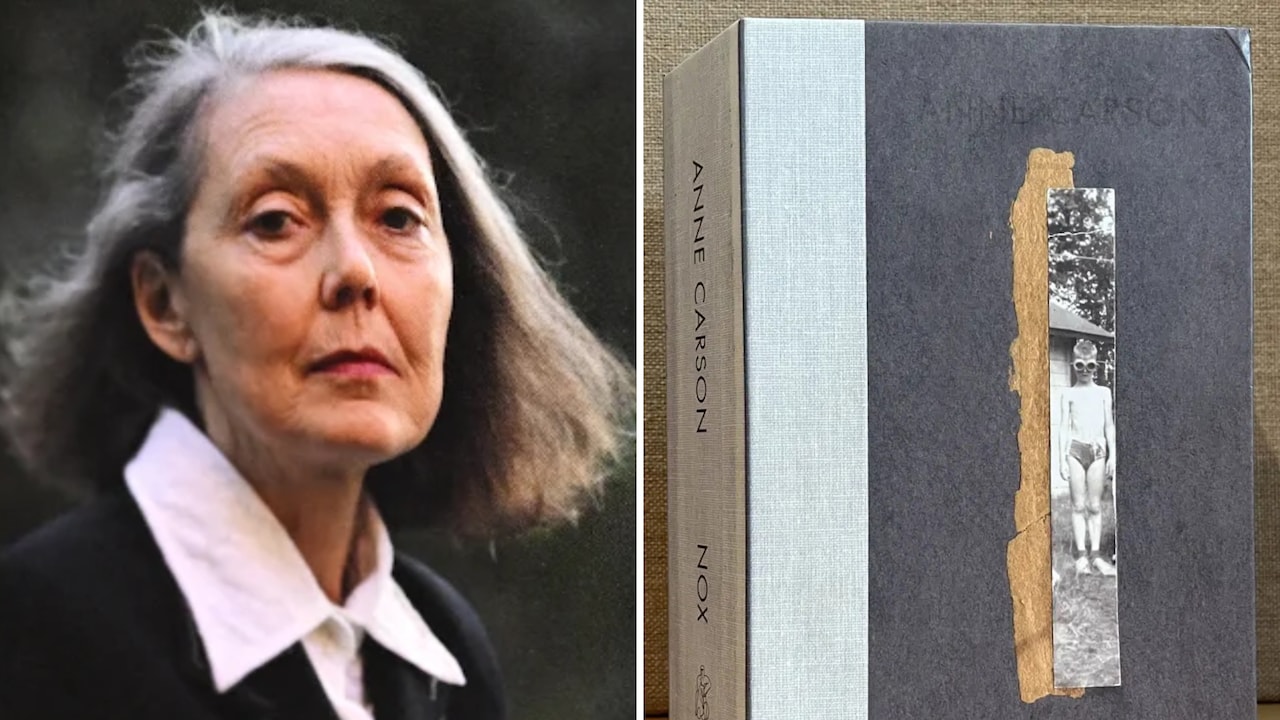
When the Swedish Academy awarded the Nobel Prize in Literature to Anne Carson, readers around the globe immediately started digging back through her brilliant, genre-defying bibliography. Among her most striking works is Nox, an elegy built like a physical box of fragments. Beneath the poetry and the classical references lies a deeply painful family history—one that stretches across continents and includes a little-known chapter involving India.
If you only know Carson through her celebrated translations of ancient Greek or her verse novel Autobiography of Red, opening Nox feels like stepping into an entirely different world. It isn't just a book you read. It's a sculptural artifact you unfold. And at its heart is a missing sibling, a lifetime of silence, and an unexpected trail of years spent living abroad.
The Story Behind Nox and a Life Spent in Exile
To understand why Nox carries such heavy emotional weight, you have to look at the life of Anne Carson's brother, Michael. In the late 1970s, Michael left Canada to avoid facing arrest for drug-related offenses. What followed was an abrupt exit from his family's daily existence that lasted more than two decades.
During those twenty-two years, Michael drifted through Europe and parts of India under false passports, living completely on the margins. He communicated with his relatives back home only a handful of times. For Carson, these rare check-ins arrived as fragmented postcards and cryptic phone calls with no return addresses. He was an elusive figure, existing mostly as a ghost overseas while his family tried to piece together where he might be.
The India connection in this narrative isn't a romanticized travel log. It represents the vast, unbridgeable distance of exile. Michael spent years navigating unfamiliar cities, including spots in Kashmir, leaving behind tiny scraps of paper, stamps, and hotel stationery. When he died in Copenhagen in 2000 at the age of fifty-five, those scattered fragments became the only tangible evidence left of his adult existence.
Why Carson Built a Book Out of a Box
When word of Michael's death reached Carson, she was actually preparing to travel and finally see him again after decades apart. She missed the chance by roughly a week. Faced with this abrupt and final silence, she didn't write a traditional memoir. Instead, she spent years constructing Nox as a handmade, accordion-folded scroll housed inside a rigid box.
The physical design mirrors the chaotic nature of grief and memory. When you open it, the pages stretch out like an accordion, combining black-and-white family photos, stamps, torn letters, and typed dictionary entries. Alongside her own memories, Carson weaves a translation of Poem 101 by the Roman poet Catullus, an ancient elegy written for a brother who also died far from home.
Carson has firmly stated that Nox isn't simply a book about mourning. It is an exploration of how humans try to translate each other's lives when we ultimately speak entirely different languages. Her brother remained a stranger even as she tried to map out his history from the scraps he left behind.
Redefining What Literature Can Do
Carson's Nobel win highlights an author who refuses to stay inside tidy boundaries. Whether she is translating Sappho, rewriting ancient myths into modern verse, or gluing photographs into a handmade box to honor an estranged brother, she treats literature as a living, breathing space.
Nox remains one of her most radical achievements precisely because it acknowledges that some gaps can never be filled. The letters from India, the false passports, the decades of silence, and the final stop in Copenhagen are all part of a puzzle that cannot be solved neatly. By bringing this masterpiece back into the spotlight, the Nobel recognition reminds us that the most powerful writing often begins right in the messy middle of things we cannot fully understand.