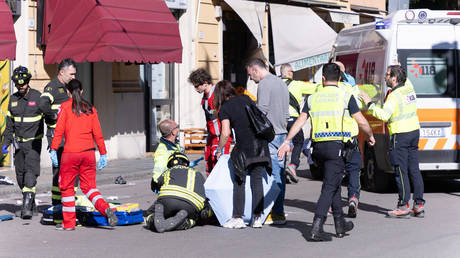
Pedestrian dense commercial zones and civic spaces present high-value targets for vehicle ramming incidents, whether executed as premeditated acts of violence or resulting from acute operator incapacitation. When a kinetic mass weighing between 1.5 to 2.5 metric tons penetrates a pedestrian area, standard reactive emergency protocols fail to prevent initial casualties. Minimizing mass-casualty risks in municipal environments requires shifting from traditional post-incident response models to proactive kinetic energy dissipation frameworks and spatial partitioning.
Analyzing these events requires evaluating the variables that dictate injury severity and the operational breakdown of emergency services. Vague media reporting often obscures the underlying mechanics of these incidents. Evaluating a vehicle ramming event requires a structural framework that examines vector dynamics, triage mechanics, and perimeter architecture.
The Tri-Particle Incident Framework
Every vehicle ramming event is governed by three independent variables that dictate the ultimate casualty count and operational response layout.
[Vector Kinetic Energy] ----> [Spatial Vulnerability] ----> [Emergency Triage Delay]
(Mass × Velocity²)             (Pedestrian Density)          (Active Threat Access)
1. Vector Kinetic Energy
The destructive potential of the vehicle is defined by its mass and velocity at the point of impact. Because kinetic energy scales quadratically with speed ($E_k = \frac{1}{2}mv^2$), a passenger vehicle traveling at 60 km/h possesses four times the lethal potential of a vehicle traveling at 30 km/h. At medium-speed impacts (20–60 km/h), secondary impact trauma occurs as pedestrians are thrown onto the vehicle hood or windshield (Tambuzzi et al., 2021). At high-speed impacts exceeding 60 km/h, victims are launched into the air, leading to severe cranial fractures and traumatic brain injuries upon ground impact (Tambuzzi et al., 2021).
2. Spatial Vulnerability Index
The severity of the casualty rate is directly proportional to the localized population density and the absence of structural barriers. Sidewalks without physical segregation maximize the target profile. Urban corridors with high tourist traffic, outdoor dining, or transit choke points offer no natural escape paths, maximizing the transfer of kinetic energy to human targets.
3. Emergency Triage Obstruction
The third variable is the operational delay between the initial impact and professional medical triage. In active vehicular assault scenarios, first responders face a dual-risk environment: treating severe trauma under the threat of a secondary attack or a continuous driver threat. This creates a functional bottleneck where critical hemorrhaging cannot be addressed until law enforcement neutralizes or secures the vehicle operator.
Kinetic Energy Dissipation and Perimeter Defense
The primary structural failure in urban architecture is relying on psychological barriers—such as paint, low curbs, or plastic pylons—to separate pedestrian zones from vehicular traffic. Preventing unauthorized vehicular incursions requires passive, high-yield kinetic energy dissipation systems.
- Fixed High-Impact Bollards: Deep-foundation, steel-sleeve bollards rated to PAS 68 or ASTM F2656 standards are designed to stop a medium-duty truck traveling at 80 km/h within less than one meter of penetration. These installations transform a vehicle's kinetic energy into structural deformation of the vehicle chassis, protecting pedestrian spaces.
- Segmented Planters and Urban Hardscaping: When permanent deep-foundation bollards are structurally impossible due to underground utility conduits, municipalities must deploy heavy, reinforced concrete architectural elements. Strategic positioning creates staggered entry paths that force low-speed navigation while blocking direct, linear acceleration vectors.
- Automated Retractable Barriers: For managed access points into pedestrian plazas, automated hydraulic bollards provide continuous protection while allowing authorized emergency vehicles to enter via encrypted transponders or remote dispatch override systems.
Emergency Medical Triage in High-Threat Environments
When structural defenses fail and an incursion occurs, the survival rate of critically injured patients depends on the deployment velocity of specialized trauma protocols. Standard emergency medical response models are poorly optimized for the rapid, multi-site trauma characteristic of vehicle rammings.
| Phase | Operational Objective | Tactical Bottleneck | Strategic Solution |
|---|---|---|---|
| Phase 1: Stabilization | Immediate hemorrhage control and airway management. | Active driver threat or vehicle fire hazards. | Integrating Tactical Emergency Casualty Care (TECC) protocols within primary police response units. |
| Phase 2: Sorting & Triage | Categorization via START (Simple Triage and Rapid Treatment) methodology. | Overwhelming volume of severe orthopedic and neurological trauma. | Establishing a forward triage point directly outside the hot zone perimeter. |
| Phase 3: Evacuation | High-velocity distribution to Level 1 trauma centers. | Localized traffic gridlock caused by emergency vehicle convergence. | Pre-planned emergency transit corridors and automated traffic signal preemption. |
The primary medical challenge in these scenarios is the management of blast-like crush injuries and rapid exsanguination from arterial lacerations. Implementing public-access trauma kits containing commercial tourniquets and hemostatic dressings allows uninjured bystanders to provide immediate interventions during the critical minutes before emergency services can safely enter the site.
Upgrading Urban Resiliency
Municipal authorities must move past treating vehicle incursions as isolated traffic anomalies or unpredictable security failures. Road traffic collisions and intentional vehicle usage against pedestrians represent persistent vulnerabilities in dense European and global urban centers (Tambuzzi et al., 2021).
Municipal planning departments must conduct comprehensive spatial vulnerability audits across all high-density pedestrian corridors. These audits should map peak pedestrian flows against vehicle traffic speeds to identify high-risk zones. Incorporating crash-rated hardscaping into urban renewal projects allows cities to systematically eliminate linear acceleration pathways without disrupting public accessibility or commercial vitality. Municipalities must transition from reactive incident management to integrated structural deterrence to safeguard public spaces from vehicular threats.
References
Tambuzzi, S., Rittberg, W., Cattaneo, C., & Collini, F. (2021). An Autopsy-Based Analysis of Fatal Road Traffic Collisions: How the Pattern of Injury Differs with the Type of Vehicle. Trauma Care, 1(3), 162-172. https://doi.org/10.3390/traumacare1030014
Cited by: 11