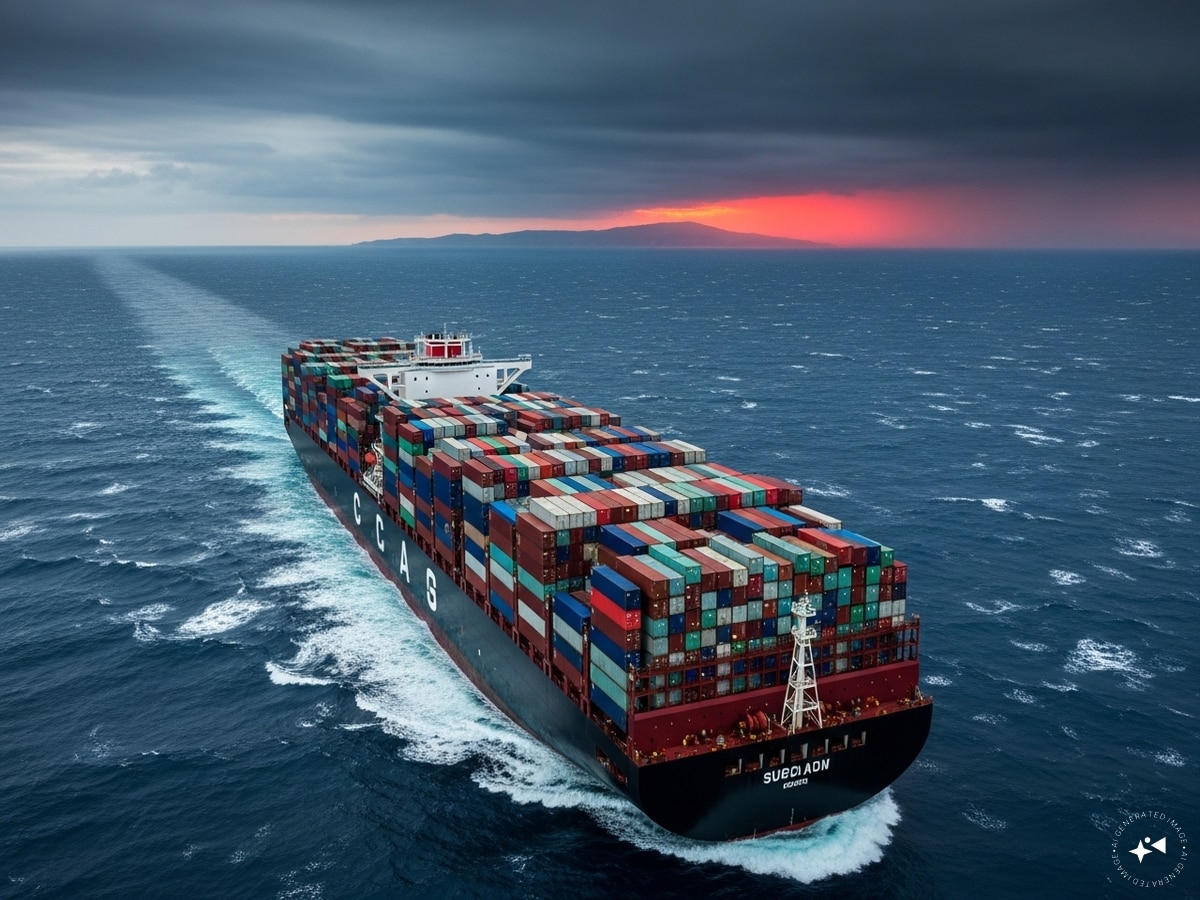
Ocean freight markets do not react to warfare; they react to the structural constriction of capacity. The sharp escalation in Asia-to-US container rates amid conflict involving Iran is not a direct byproduct of military kinetic action, but rather a predictable manifestation of linear supply chain mechanics. When a critical maritime artery is compromised, the global shipping fleet suffers an immediate reduction in effective capacity due to extended transit times. Understanding this surge requires looking past the sensationalism of geopolitical risk premiums and analyzing the precise operational variables: vessel rotation geometry, container velocity imbalances, and the compounding effects of fixed infrastructure bottlenecks.
The Tri-Factor Cost Function of Maritime Disruption
To accurately quantify why Transpacific spot rates spike when conflict occurs thousands of miles away in the Middle East, the crisis must be deconstructed into three distinct, compounding operational mechanisms.
1. The Velocity Deficit (The Cape of Good Hope Diversion)
When threats in the Red Sea force carriers to bypass the Suez Canal, vessels routing from Asia to Europe or the US East Coast are diverted around the Cape of Good Hope. This diversion adds approximately 3,000 to 3,500 nautical miles to a standard round-trip voyage.
At standard operational speeds of 18 to 20 knots, this detour inserts 10 to 14 days of additional transit time per leg. Because a liner service relies on a strict weekly departure schedule to maintain supply chain continuity, a route that previously required 10 vessels now requires 12 or 13 vessels just to move the same weekly volume of twenty-foot equivalent units (TEUs). This absorbing of global vessel capacity creates an immediate, systemic deficit in the total pool of available ships worldwide, asset-starving non-diverted routes like the Transpacific.
2. The Equipment Dislocation Cycle
The primary driver of spot rate volatility is rarely a lack of ships; it is the physical absence of empty boxes where cargo is being generated. The extension of the transit loop around Africa delays the return of empty containers to manufacturing hubs in East Asia.
[Asia Export Hubs] ----(Full Containers)----> [US/Europe Consumers]
        ^                                              |
        |                                              v
   [Box Deficit] <---(Delayed Empty Return)--- [Cape Detour Bottleneck]
When containers spend an extra two to three weeks sitting on water, the equipment injection rate at major ports like Shanghai, Ningbo, and Shenzhen drops below critical thresholds. Exporters enter bidding wars to secure the dwindling supply of available containers, driving spot prices up exponentially on all major outbound corridors simultaneously.
3. Asymmetric Port Congestion
As schedules become unpredictable due to transit extensions, ships no longer arrive at their designated port windows. This leads to "vessel bunching" at major importing nodes. When three or four ultra-large container vessels (ULCVs) arrive at a terminal concurrently instead of spaced across a multi-day window, yard utilization rates breach the critical 80% threshold. Beyond this point, terminal efficiency degrades non-linearly. Container cranes slow down, drayage trucks face extended wait times, and the entire inland logistics network stalls, further locking up equipment and choking supply.
Elasticity and the Mechanics of the Spot Market Rate Spiral
The pricing behavior of transpacific container shipping is governed by extreme short-run inelasticity of both supply and demand. Shipping lines cannot manufacture new vessels in response to a sudden crisis; shipyard lead times are measured in years. Conversely, B2B importers with fixed seasonal retail deadlines or Just-In-Time (JIT) manufacturing dependencies cannot easily substitute ocean freight for alternative modes like air freight due to payload cost constraints.
When effective global asset capacity drops by 10% to 15% due to routing diversions, the supply curve shifts vertically along a highly inelastic demand curve.
The resulting price action is characterized by several distinct tiers of ocean pricing:
- The Base Ocean Freight (Ocean Tariff): The contracted baseline rate, which often becomes unenforceable during macro disruptions as carriers invoke force majeure or space protection clauses.
- The War Risk Premium (WRP): Direct insurance line-item increases levied on hull and machinery policies for vessels transiting sensitive zones. While specific to the Middle East, these costs drain capital from carrier operating budgets, prompting across-the-board structural surcharges.
- Peak Season Surcharges (PSS) and Contingency Adjustment Factors (CAF): Discretionary fees deployed by carriers to ration capacity. These surcharges function as an auction mechanism, prioritizing space for cargo owners willing to pay the highest premium above contract baselines.
This pricing hierarchy explains why spot market indices present an incomplete picture. The headline index might indicate a 50% rate increase, but the actual cash outlay required to move a container from Shenzhen to Los Angeles can double once equipment guarantees and priority loading premiums are factored into the invoice.
The Transpacific Cross-Elasticity Conundrum
A common analytical error is treating trade lanes as isolated silos. The Asia-to-US West Coast (USWC) and Asia-to-US East Coast (USEC) pathways are intrinsically linked to the Asia-Europe theater through asset reallocation.
The maritime network functions as a closed thermodynamic system; energy applied to one sector forces a reaction elsewhere.
+-----------------------------------------------------------------------+
|                       Global Liner Fleet Capacity                     |
+-----------------------------------------------------------------------+
        |                                                       |
        v                                                       v
+-------------------------------+       +-------------------------------+
|       Asia-Europe Route       |       |      Transpacific Route       |
| (Absorbs extra ships due to   |       | (Suffers capacity drain and   |
|   Cape of Good Hope detour)   |       |   cascading rate increases)   |
+-------------------------------+       +-------------------------------+
When Asia-Europe rates skyrocket due to the Suez disruption, carriers systematically reposition vessels away from secondary or even primary Transpacific loops to capture the higher yields available on the disrupted European lanes. This cascading capacity drain reduces the supply of slots on routes heading across the Pacific to the United States.
Simultaneously, US importers who historically favor USEC ports via the Suez Canal or the drought-constrained Panama Canal abruptly pivot their volume to the USWC. This sudden cargo shift creates an artificial demand shock at the ports of Los Angeles and Long Beach. The intermodal infrastructure—specifically railcar availability and inland warehouse capacity in the Inland Empire—is structurally unequipped to absorb a 20% systemic volume migration within a multi-week window without triggering significant bottlenecking.
Limitations of Strategic Mitigations
Shippers facing this environment frequently deploy a standard playbook of counter-strategies, all of which possess hard structural limitations that can worsen the baseline problem if miscalculated.
Contractual Volume Commitments (MQCs)
Importers rely on Minimum Quantity Commitments to guarantee space at locked-in rates. However, during systemic capacity deficits, non-performance clauses become difficult to enforce. Carriers utilize blank sailings (voiding a scheduled port call) to manage vessel distribution, effectively erasing the slot allocations promised to contract holders and forcing them into the volatile spot market.
Carrier Diversification
Distributing volume across multiple ocean alliances (e.g., 2M, Ocean Alliance, THE Alliance) is intended to mitigate single-point-of-failure risk. In a geopolitical crisis, this diversification yields diminishing returns because all alliances face the same macroeconomic constraints: global container deficits and shared terminal congestion.
Shipper-Owned Containers (SOC)
Procuring private container fleets bypasses the carrier equipment bottleneck. The limitation here is the return loop. The shipper assumes the full financial liability and logistical burden of positioning empty boxes back to Asian manufacturing origins on vessels that are already space-constrained, frequently wiping out the initial cost savings.
The Operational Playbook for Transpacific Procurement
Mitigating a geopolitically driven freight surge requires moving away from reactive spot bidding and toward a structural re-engineering of the supply chain velocity model. The following sequence outlines the necessary operational adjustments.
Decouple Inventory Planning from Historical Lead Times
Static safety stock calculations fail when transit variability increases by 40%. Importers must transition to dynamic lead-time modeling, indexing inventory replenishment cycles directly to rolling three-week port congestion data and vessel schedule reliability metrics rather than fixed contractual transit times.
Implement an Asymmetric Gateway Strategy
To minimize exposure to localized port chokepoints, divide North American inbound volume into a fixed 60/30/10 split:
- Allocating 60% to primary USWC nodes (Los Angeles/Long Beach) utilizing On-Dock Rail to bypass local trucking bottlenecks.
- Directing 30% to Pacific Northwest gateways (Seattle/Tacoma or Prince Rupert) to leverage underutilized rail corridors into the Midwest.
- Reserving 10% as a highly fluid spot allocation to be routed dynamically via all-water routes to the Gulf Coast or East Coast, pivoting purely based on real-time yard utilization metrics at the destination ports.
Establish Tier-1 Freight Forwarder Hybrid Agreements
Relying exclusively on direct carrier contracts or pure spot market freight forwarders creates extreme vulnerability. The optimal framework pairs 50% of baseline volume with asset-heavy Ocean Common Carriers under strict multi-year agreements, while insulating the remaining 50% within a panel of Tier-1 non-vessel operating common carriers (NVOCCs) who possess dedicated space allocations across distinct vessel alliances. This structural redundancy guarantees baseline access while providing a vetted path to scale velocity during critical supply contractions.