Public outrage triggered by extreme symbolic displays—such as the appearance of Ku Klux Klan (KKK) costuming during high-visibility public events like Halloween—follows a predictable cycle of social friction, institutional crisis, and rapid media dissemination. Far from being isolated incidents of bad taste, these events function as localized stress tests for public spaces, private businesses, community standards, and modern media ecosystems.
Understanding the mechanics of public provocation requires deconstructing the incentive structures of the actors involved, the structural amplification of modern communication channels, and the systemic failure of preventative governance.
The Three Pillars of Public Symbol Provocation
Extreme public displays relying on hate group iconography operating within celebratory or relaxed environments (e.g., Halloween) function through three distinct structural mechanisms:
Contextual Incongruity: Halloween functions culturally as a period of sanctioned boundary-testing and theatrical norm violation. Provocateurs leverage this social ambiguity to deploy non-sanctioned, highly offensive ideological symbols under the initial cover of "costuming." The friction occurs when the boundary shifts from benign satire or horror to targeted racial intimidate or political extremism.
Asymmetric Attention Capture: A single actor incurring minimal financial or operational cost by wearing offensive symbols can generate massive informational external costs. The economic ratio of effort-to-reach is severely skewed: a low-effort physical display converts instantly into high-value digital engagement for media aggregators and social platforms.
Institutional Dilemma Creation: When such an incident occurs on private premises (such as a commercial venue or workplace) or semi-public spaces (such as municipal streets), it places venue operators and local authorities in an immediate governance trap. Immediate ejection risks verbal or physical escalating conflict; non-intervention is interpreted by observers as implicit institutional endorsement.
The Dissemination Funnel: From Physical Space to Viral Engagement
The lifecycle of public outrage following a hate-symbol incident follows a defined sequence of informational escalations.
Phase 1: Local Capture and Verification
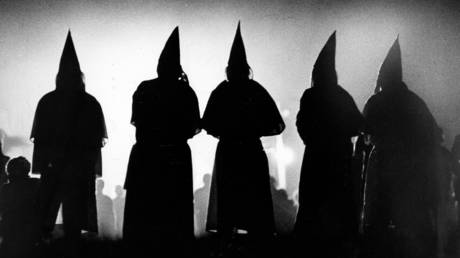
The initial friction occurs entirely in physical space. Onsite observers capture unedited video or photographic documentation. The primary variables determining whether an event transitions from a local confrontation to a national story are visual clarity, unmistakable symbolic identification (such as the distinctive white pointed hood and robes of the KKK), and visible reaction from surrounding bystanders or venue management.
Phase 2: Platform Algorithmic Acceleration
Once uploaded to social video platforms, the content triggers engagement algorithms optimized for high-arousal emotional responses—specifically outrage and moral indignation. The video serves as a catalyst for commentary, quote-shares, and rapid redistribution. During this phase, context is frequently compressed: geographic location, local response, and background details are subordinated to the visual impact of the symbol itself.
Phase 3: Institutional and Corporate Fallout
As digital momentum builds, pressure transfers from the individual actor to associated institutions. This manifests in three distinct operational vectors:
- Employer Identification: Digital networks rapidly identify the individual, leading to public demands for termination of employment to protect corporate brand equity.
- Venue Accountability: Establishments where the incident occurred face immediate boycott threats, review-bombing, and public demands for policy shifts regarding entry standards and security protocols.
- Municipal and Legal Scrutiny: Local authorities and law enforcement face pressure to determine if the act crosses the legal threshold from constitutionally protected expression (under First Amendment protections in the United States) to actionable bias-motivated intimidation, disturbance of the peace, or trespass.
Governance and Risk Mitigation Protocols
Organizations, venue operators, and community managers seeking to mitigate the risk and fallout of extreme symbolic disruptions must move past reactive crisis communications toward structural prevention and operational readiness.
Operational Escalation Framework
Frontline staff and security personnel require explicit, pre-established guidelines regarding hate group iconography. Policies cannot rely on vague standards of "inappropriate attire." Clear operational frameworks must define:
- Specific prohibited symbols and imagery within private or commercial spaces.
- Immediate non-confrontational protocols for requesting the removal of masking or offensive paraphernalia.
- Precise thresholds for executing trespass notices or involving law enforcement.
Strategic Communications Strategy
When an incident occurs within an organization's perimeter, public statements must avoid defensive hedging or generic platitudes. High-authority communication requires:
- Rapid factual establishment of the timeline and location.
- Direct statement of actions taken (e.g., immediate removal from premises, termination of service, or referral to authorities).
- Clear delineation between institutional values and the unauthorized actions of individual patrons or employees.
The persistence of extreme symbolic displays in public spaces highlights the ongoing tension between individual expression, commercial space governance, and the viral dynamics of modern media. Institutions that establish clear operational boundaries and transparent response protocols minimize systemic vulnerability to orchestrated public provocation.