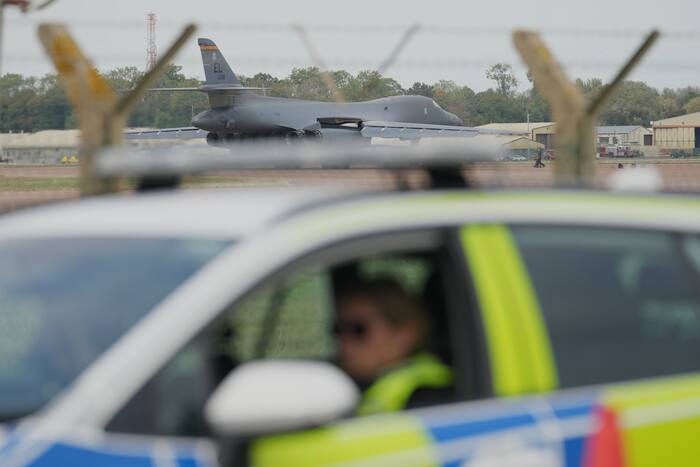
Standard breaking-news coverage of counterterrorism rearrests treats each arrest as an isolated police blotter item rather than an observable event inside a multi-stage intelligence operation. When British authorities rearrested two men on suspicion of assisting Iranian intelligence over a plot tied to RAF Fairford—a Royal Air Force facility used by U.S. forces in Gloucestershire—the headline capture told readers what happened while leaving the underlying operational mechanics untouched. Dissecting a case like this requires separating confirmed legal milestones from investigative hypotheses, mapping the structural bottlenecks between foreign state handlers and local operatives, and evaluating how modern security statutes change the cost of recruitment.
This analysis provides a structured framework for reading intelligence-linked arrests at allied military installations without falling into sensationalism or overclaiming unverified facts. First, it establishes the factual baseline and distinguishes verified procedural steps from open hypotheses. Second, it breaks down the operational anatomy of state-sponsored proxy plots and the friction points that expose them. Third, it examines statutory tools like the United Kingdom's National Security Act and outlines practical defenses and their operational limits.
Facts Versus Hypotheses in Counterterrorism Investigations
Reading arrest and rearrest announcements accurately starts with disciplined epistemic hygiene. In fast-moving national security cases, reporting often blends initial police suspicions, bail decisions, rearrests, subsequent charges, and parallel foreign indictments into a single narrative arc. Analysts need a strict boundary between verified facts and working theories.
Known facts in the RAF Fairford investigation include the initial September 27, 2026 security incident near the Gloucestershire air base, which prompted initial arrests at the scene, followed by the rearrest of two men in October 2026 on suspicion of assisting a foreign intelligence service linked to Iran. Subsequent court and prosecutorial developments also involved charges brought under the UK's National Security Act, alongside broader reporting and U.S. legal actions touching on plots targeting Western interests and military infrastructure.
Educated hypotheses occupy the space between raw arrest grounds and trial verdicts. When police rearrest suspects after an earlier release or initial detention, two analytical possibilities usually explain the pivot:
- Evidentiary convergence: Investigators often correlate digital footprints, financial movements, communications metadata, or physical surveillance gathered after the initial sweep to establish intent or foreign direction rather than mere proximity or disorderly conduct.
- Network linkage: A rearrest can reflect new intelligence connecting local actors to external handlers, couriers, or parallel cells uncovered in domestic or allied inquiries.
Until charges are tested in open court, suspicion of assisting a foreign intelligence service remains a legal allegation rather than proven espionage. Conflating an arrest threshold with a completed or imminent military breach distorts both threat assessment and public understanding.
The Four Pillars of State-Sponsored Proxy Plots
Foreign intelligence services frequently rely on deniable intermediaries, local cutouts, or criminally motivated proxies rather than deploying declared diplomatic officers directly against high-security bases. Deploying overt officers carries high expulsion and surveillance costs; using local assets lowers attribution friction while shifting operational risk onto expendable personnel.
1. Target Selection and Perimeter Asymmetry
Allied air bases such as RAF Fairford combine high strategic visibility with layered physical security. Perimeter fences, sensor arrays, patrols, and controlled access points make direct infiltration difficult, so plots often probe outer perimeters, approach routes, logistics nodes, or adjacent public spaces. The gap between public roads and restricted flight lines creates a natural friction zone where reconnaissance, staging, or low-grade disruption attempts can occur without penetrating hardened core facilities.
2. Recruitment and Tasking Economics
State handlers typically structure tasking around asymmetric compartmentalization. Local recruits rarely need access to classified briefings to be useful; they can be tasked with physical observation, vehicle staging, delivery of materials, or probing security response times. Because handlers often operate remotely or through intermediaries, they can test reliability with low-risk tasks before assigning higher-consequence actions. That structure also protects the broader network: if a street-level operative is detained, exposed links may stop short of senior planners.
3. Command-and-Control Friction
Distance and operational security create a persistent bottleneck for foreign sponsors. Every handoff—whether encrypted messaging, dead drops, financial transfers, or third-party relays—introduces latency and detection risk. Operatives who lack formal intelligence tradecraft frequently leave digital or physical traces: inconsistent travel patterns, hastily acquired vehicles or supplies, or unguarded communications during stress. Counterterrorism investigators exploit these seams because local proxies rarely match the counter-surveillance discipline of career officers.
4. Signaling Value Versus Kinetic Effect
Not every plot against a military base is designed to achieve major kinetic damage. Even an aborted approach, perimeter incident, or disrupted staging effort can serve an information and intimidation objective if publicized or linked to a hostile state. Conversely, an adversary may treat a clumsy local attempt as a low-cost probe to measure reaction times, law enforcement coordination, and public anxiety. Treating every incident as either a masterstroke or pure farce misses the strategic utility of disruption itself.
Cause-and-Effect Chains Standard Coverage Misses
Conventional news summaries usually trace a linear sequence: an incident occurs, police arrest suspects, and later rearrest or charge them. That timeline misses the second-order feedback loops that shape how intelligence agencies and security services adapt.
First, bail and release decisions alter investigative visibility. When suspects are initially detained and later released pending inquiries before being rearrested, investigators trade immediate physical containment for the chance to observe post-incident behavior, communications, or associates. The second limitation of rapid initial arrests is evidentiary: detaining individuals at the scene secures safety immediately, yet building a prosecutable case for foreign intelligence assistance requires stitching together intent, coordination, and external links over time.
Second, cross-border cases create jurisdictional handoffs and evidentiary pacing gaps. When plots or networks touch both UK installations and U.S. interests or legal proceedings, domestic policing priorities, classification rules, and prosecutorial standards do not move on a single clock. Information shared between allies strengthens pattern recognition, but parallel investigations can also mean that a piece of context only becomes clear weeks after an initial local arrest.
Third, public disclosure reshapes tradecraft on both sides. Announcing rearrests or charges signals deterrence and reassures host communities near sensitive bases, yet it also warns co-conspirators that specific channels or methods may be compromised. Security agencies must constantly balance public transparency against the preservation of covert collection sources.
Legal Leverage and Operational Constraints
Modern counterterrorism and national security frameworks—such as the UK's National Security Act—are designed to close gaps left by older espionage laws that required proof of classified document theft or narrow wartime definitions. By criminalizing conduct aimed at assisting a foreign intelligence service or threatening national security interests through preparatory or collaborative acts, prosecutors can address modern hybrid and proxy threats earlier in the operational cycle.
This creates a decisive tactical advantage for investigators: disrupting preparatory stages before an operative reaches a sensitive perimeter or executes a harmful act. Still, stronger statutes do not eliminate evidentiary burdens. Prosecutors still must prove elements beyond a reasonable doubt, protect sensitive intelligence sources in court, and navigate complex digital and international records. Legal tools raise the penalty for proxy participation, but they do not automatically prevent a foreign service from recruiting another disposable intermediary.
Practical Defenses and Their Limits
Securing allied air bases and deterring foreign-backed interference requires coordinating perimeter defense, local law enforcement, and intelligence fusion rather than relying on a single layer. Effective operational practice centers on four steps:
- Harden the outer ring and approach corridors. Treat public roads, lay-bys, and surrounding communities near bases as part of the threat surface, pairing physical barriers and sensors with clear protocols for reporting suspicious vehicles or staging activity.
- Integrate local policing with counterterrorism intelligence. Ensure routine patrols and local police forces can rapidly escalate anomalies—such as unusual reconnaissance or unusual logistical purchases—into counterterrorism workflows without delay.
- Audit supply and communications choke points. Track patterns in vehicle rentals, burner accounts, prepaid logistics, and cross-border facilitation that frequently link amateur or proxy actors to external taskers.
- Calibrate public communications around verified facts. Release timely, accurate updates on arrests and charges to counter rumor cycles while withholding sensitive operational details that could tip off remaining network elements.
No defensive measure is a silver bullet. Perimeter hardening can push activity further outward; surveillance can drive adversaries toward smaller, more isolated cells; and high-profile prosecutions can prompt foreign sponsors to shift toward lower-signature methods or alternative targets.
For defense planners and security leaders managing operations around sensitive allied bases, the decisive move is to treat perimeter incidents and proxy rearrests as continuous telemetry on adversary tradecraft—auditing every seam between local detection, allied intelligence sharing, and rapid legal disruption before a low-level probe escalates into a high-impact breach.