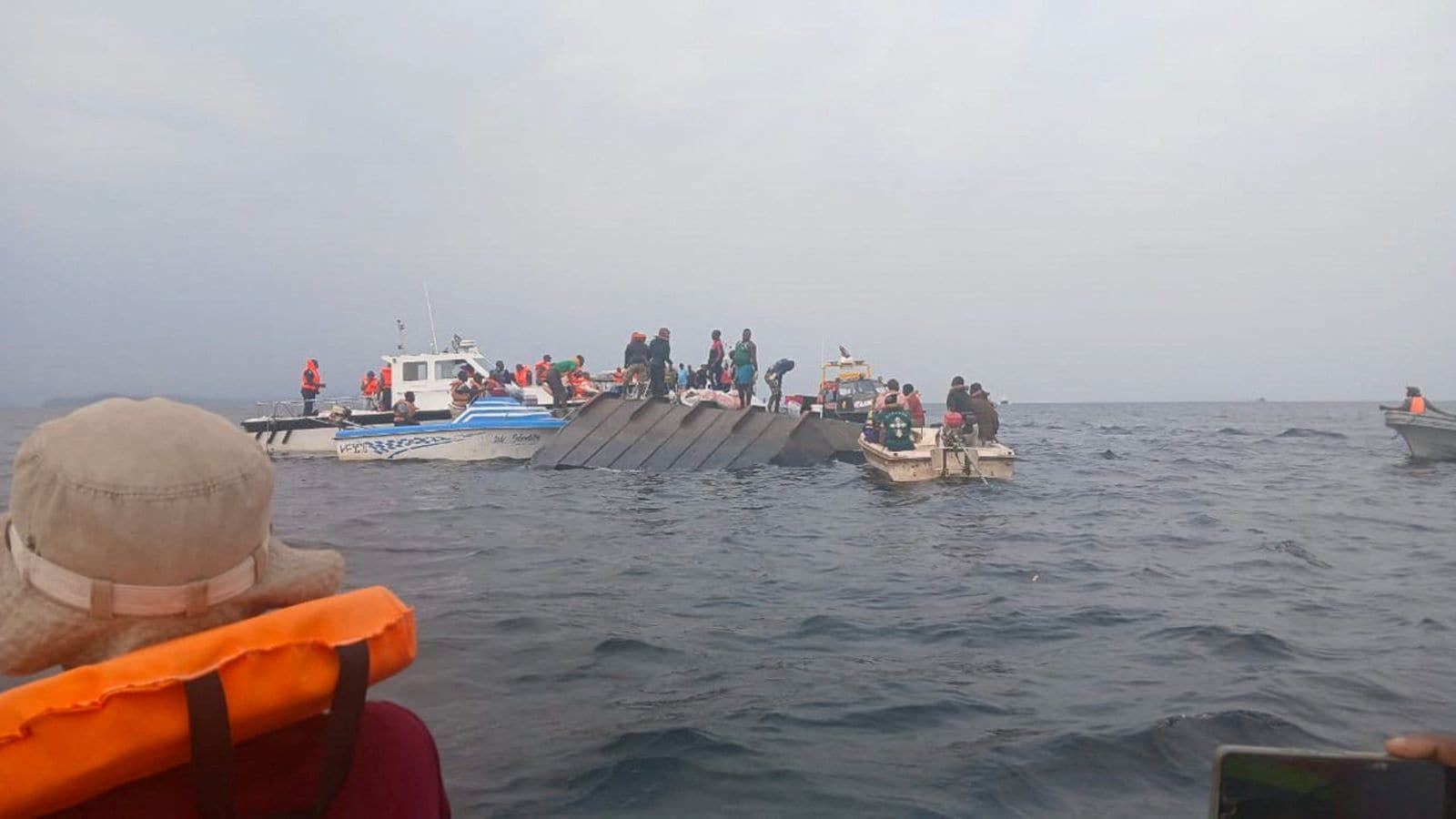
The capsizing of the passenger ferry Mbuya Nehanda on Lake Kariba, which resulted in a death toll of at least 94 individuals, represents a systemic collapse of operational governance rather than an isolated maritime accident. Operated by Zimbabwe's Rural Infrastructure Development Agency, the vessel was certified for a maximum threshold of 90 passengers. Yet, contemporary manifests and subsequent government confirmations indicate that approximately 180 occupants, alongside cargo and mechanical deficits, were on board during severe weather conditions. Deconstructing this disaster requires examining the structural failures across load calculation, risk management, and regulatory enforcement.
The Mechanics of Overload and Hydrostatic Failure
The physics of vessel stability dictate that as payload mass increases, the center of gravity shifts upward, reducing the metacentric height—the distance between the center of gravity and the metacenter. When a vessel operates at double its rated structural capacity, its reserve buoyancy diminishes rapidly.
In the instance of the Lake Kariba disaster, the inclusion of roughly 180 passengers paired with cargo created a compromised freeboard. Freeboard is the distance from the waterline to the upper deck. A reduced freeboard means that external environmental forces, such as wind-driven waves, require significantly less energy to breach the deck perimeter.
Once water breached the gunwales, a secondary destructive mechanism engaged: free surface effect. Uncontained water moving across the deck shifts the center of gravity dynamically toward the low side of the roll, exacerbating the angle of heel and accelerating the capsize sequence. Witnesses noted that the vessel was operating with diminished mechanical propulsion—specifically, running on a single functioning engine—which neutralized the captain's ability to maintain heading into oncoming swells. Without directional thrust, the vessel broached, turning broadside to the wave action, where wave energy could exert maximum rotational torque against the hull.
Institutional Deficits in Fleet Operation and Risk Management
Operational safety in public transit systems relies on redundant checkpoints and definitive stop-work authorities. The Mbuya Nehanda disaster exposes the absence of these controls within state-managed infrastructure operations.
First, manifest integrity was compromised. Public transport data systems failed to account for non-ticketed infants and children, rendering the official ticketing metrics obsolete. When cargo weight and unlisted passengers merge, theoretical load calculations become irrelevant. The systemic failure to reconcile physical headcounts with displacement metrics highlights a critical vulnerability in asset oversight.
Second, the decision-making protocol during adverse weather demonstrated an absence of hierarchical risk mitigation. Meteorological services had issued warnings regarding turbulent conditions on Lake Kariba. Standard operating procedures in commercial maritime environments mandate that weather advisories override schedule adherence. The persistence of the departure sequence despite visible lake turbulence and passenger warnings illustrates an organizational culture biased toward continuity of service over asset preservation and human safety.
The Cost Function of Regulatory Enforcement Gaps
Public infrastructure management in isolated or rural corridors often faces a structural conflict between accessibility and safety enforcement. Lake Kariba serves as a vital economic and social transit link between isolated settlements like Chalala and urban hubs such as Kariba. When alternative land routes are inefficient or impassable, water transport becomes a localized monopoly.
This monopoly creates a distorted risk tolerance among operators and passengers. The economic penalty of delaying a voyage or leaving passengers behind manifests as immediate social friction and lost revenue, whereas the cost of a catastrophic structural failure is externalized onto the passengers. Because regulatory oversight agencies lacked active dockside inspection protocols to intercept over-capacity vessels prior to departure, the system relied entirely on discretionary compliance by the crew. Discretionary compliance in resource-constrained environments consistently fails when economic or social pressures favor overloading.
Strategic Realignment for Inland Waterway Safety
Preventing systemic failures in state-operated inland transport requires a structural overhaul of monitoring and accountability frameworks.
Mandate automated gate-count telemetry at all state-operated piers to physically block boarding when maximum displacement thresholds are reached, removing human discretion from the manifest verification process. Implement hard-stop meteorological integration, wherein regional port authorities automatically suspend operating licenses the moment weather services issue localized gale or high-wind warnings. Decouple operational performance metrics from schedule adherence, prioritizing safety compliance over trip completion frequency in agency evaluations. Establish independent maritime safety boards tasked with unannounced dockside audits of life-saving appliances, bilge functionality, and engine redundancy on all public vessels operating on man-made reservoirs.