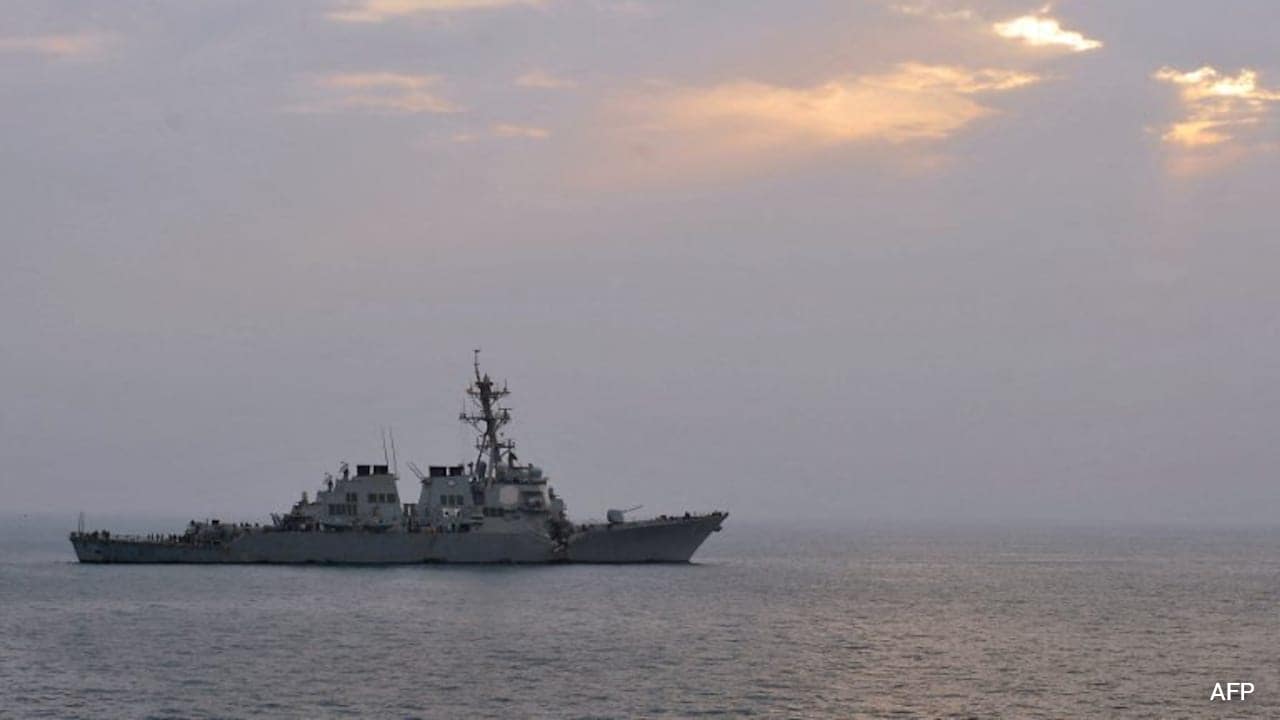
A kinetic projectile strike on a commercial tanker near the Strait of Hormuz is never an isolated maritime accident; it is a calculated shock to the physical and financial architecture of global energy transit. Standard wire reports treat a burning vessel as a localized security incident, focusing on immediate firefighting efforts and vague diplomatic tensions. That framing misses the structural reality. When an asymmetric weapon systems strike hulls in the Gulf of Oman or the approaches to Hormuz, the primary target is not the steel of the ship—it is the actuarial and logistical risk calculus of every vessel operator, insurer, and commodity desk moving hydrocarbons out of the Persian Gulf.
To understand the operational fallout of such an event, analysts must separate the immediate physical damage from the cascading economic mechanisms that govern maritime trade. Because the competitor reference provides only a headline—"Tanker Catches Fire After Projectile Strike Near Strait Of Hormuz: Report"—without an underlying URL or text body, rigorous analysis requires examining the established structural mechanics of a confirmed projectile impact in this specific theater rather than speculating on unverified casualty figures or attribution.
The Chokepoint Vulnerability Matrix
The Strait of Hormuz operates as the single most critical single-point-of-failure in the global hydrocarbon supply chain. Roughly one-fifth of global petroleum liquids consumption—approximately 20 to 21 million barrels per day—transits this narrow waterway between Oman and Iran. At its narrowest point, the strait spans 21 nautical miles, but commercial shipping is restricted to two-mile-wide Traffic Separation Schemes (TSS) for inbound and outbound transit, separated by a two-mile buffer zone.
This geographic compression creates three distinct operational vulnerabilities:
- Kinematic Predictability: Very Large Crude Carriers (VLCCs) and product tankers cannot execute evasive maneuvers within a two-mile transit lane without risking grounding or collision. Their speed, heading, and draft are fixed variables, turning multi-million-dollar commercial assets into predictable targets for coastal defense cruise missiles, uncrewed surface vessels (USVs), or loitering munitions.
- Draft and Hull Exposure: A fully laden VLCC draws upwards of 20 meters of water and carries up to two million barrels of crude. While double-hull construction mandated by the International Maritime Organization (IMO) prevents catastrophic structural failure from minor impacts, high-explosive warheads or shaped charges designed to penetrate naval armor will breach outer and inner plates. When the projectile ignites volatile cargo vapors or bunker fuel, the resulting thermal event overwhelms standard onboard suppression systems.
- Salvage Bottlenecks: Extinguishing a hydrocarbon fire on a drifting tanker near a narrow shipping lane requires specialized ocean-going salvage tugs equipped with high-capacity foam monitors. Deploying these assets into an active threat zone creates a secondary layer of risk, delaying towage and extending the duration of lane obstruction.
Kinetic Impact Mechanics and Vessel Survivability
When a projectile strikes a commercial tanker, the physical outcome depends entirely on the warhead type, impact elevation, and cargo state. Unlike warships built with armored citadels, compartmentalized damage control, and redundant fire mains, merchant vessels are optimized for cargo volume and fuel efficiency.
Ballistic vs. Loitering Munition Profiles
Anti-ship cruise missiles (ASCMs) strike near the waterline at high subsonic or supersonic speeds, delivering massive kinetic energy alongside a high-explosive payload. A waterline hit floods engine rooms or pump rooms, immediately stripping the vessel of propulsion and electrical generation. Without main power, the ship loses its primary firefighting pumps, leaving the crew reliant on emergency diesel generators that often fail under extreme heat or shock.
Loitering munitions and one-way attack drones carry smaller payloads—typically 20 to 50 kilograms of high explosive—and strike upper superstructures or deck piping. While less likely to sink a vessel outright, a strike on the manifold or cargo deck ruptures pressurized lines, igniting flash fires that destroy bridge electronics, communications arrays, and crew quarters.
Cargo Volatility Dynamics
The state of the tanker's holds dictates the severity of the post-impact fire:
- Laden Crude Carriers: Full tanks contain minimal oxygen, reducing the immediate risk of a catastrophic vapor explosion, though punctured tanks feed sustained, intense pool fires on the water surface.
- Product Tankers: Vessels carrying refined fuels—such as naphtha, gasoline, or jet fuel—operate with higher vapor pressures. A spark from shrapnel penetration triggers rapid deflagration.
- Ballast Condition: Empty tankers returning to Gulf loading terminals present the highest explosion risk if their inert gas systems are compromised. Normally, tankers pump treated exhaust gas into empty holds to keep oxygen levels below 8 percent. If a projectile ruptures deck seals and introduces ambient air alongside a heat source, the resulting vapor-air mixture detonates.
The Transmission Mechanism to Global Markets
A burning tanker near Hormuz triggers immediate price repricing across physical and paper energy markets, even when zero barrels of oil are permanently lost to the sea. The transmission occurs through four sequential channels.
1. War Risk Insurance Repricing
The London insurance market, specifically the Joint War Committee (JWC) of the Lloyd's Market Association, designates the Persian Gulf and adjacent waters as a Listed Area. Under normal conditions, shipowners pay a baseline annual war risk premium. Following a confirmed projectile strike, underwriters immediately revoke blanket coverage and institute Additional War Risk Premiums (AWRP) calculated per seven-day transit window.
These premiums scale rapidly as a percentage of the vessel's hull and machinery value. On a $100 million VLCC, a spike in AWRP from 0.05 percent to 0.50 percent adds $450,000 in direct cost to a single round-trip voyage. Charterers absorb these costs through war risk clauses in standard charterparty agreements, directly inflating the landed cost of crude in Asian and European refineries.
2. Freight Rate Volatility and Fleet Contraction
Maritime logistics operates on tight capacity margins. When a kinetic strike occurs, risk-averse owners pause fixtures into the Persian Gulf, instructing vessels to loiter in the Arabian Sea outside the strike envelope. This voluntary withholding shrinks the available spot supply of tankers overnight.
The Baltic Dirty Tanker Index (BDTI) and specific routes like TD3C (Middle East Gulf to China) respond through non-linear rate spikes. Fewer ships willing to enter the strait forces charterers to bid aggressively for remaining tonnage, driving Worldscale rates upward. If owners route vessels away from the region entirely, global ton-mile demand tightens, raising freight costs even on unrelated Atlantic basin routes.
3. Physical Supply Re-routing Constraints
Buyers facing elevated transit risk look immediately for pipeline bypasses, only to hit hard physical capacity ceilings. Saudi Arabia's East-West Pipeline (Petroline) moves crude from Abqaiq to the Red Sea port of Yanbu, with a nameplate capacity of roughly 5 million barrels per day. The United Arab Emirates operates the Habshan-Fujairah pipeline, bypassing Hormuz to deliver up to 1.5 million barrels per day directly to the Gulf of Oman.
Combined, these pipelines bypass less than a third of the total volume transiting Hormuz. Furthermore, spare capacity on these lines is heavily constrained by existing contractual commitments and Red Sea security threats at the Bab el-Mandeb chokepoint. The market cannot route around Hormuz at scale; it must pay the risk premium to pass through it.
4. Futures Curve Backwardation
In paper markets, Brent and WTI crude futures react within seconds of confirmed maritime incident reports. Algorithmic trading desks parse wire keywords and drive front-month contracts higher relative to deferred months, steepening the market's backwardation. This structure signals acute near-term physical tightness. Refiners accelerate physical restocking to hedge against a prolonged blockade, pulling forward demand and reinforcing the spot price spike.
Operational Countermeasures and Their Hard Limits
Naval coalitions and commercial operators deploy layered defenses to mitigate projectile threats in the Gulf of Oman and Strait of Hormuz, yet every countermeasure carries strict operational limitations.
- Naval Escort Convoys: Multinational task forces, including the International Maritime Security Construct (IMSC), provide surface warfare patrols and airborne intelligence, surveillance, and reconnaissance (ISR). However, destroyer-class warships cannot escort every merchant vessel simultaneously. There are simply too many daily transits and too few air-defense hulls to maintain continuous point-defense umbrellas over individual tankers.
- Automatic Identification System (AIS) Darkening: Many captains disable AIS transponders when transiting high-threat zones to deny targeting data to adversaries. This tactic degrades situational awareness for commercial collision avoidance while offering minimal protection against adversaries utilizing coastal radar, electro-optical sensors, or spotter vessels.
- Citadel Hardening and Routing Adjustments: Crews train to retreat into reinforced interior compartments during an attack while ship routing shifts closer to Omani territorial waters to maximize distance from northern launch sites. While citadels protect human life from small arms and shrapnel, they do nothing to preserve propulsion or prevent cargo fires following an anti-ship missile impact.
Strategic Execution for Maritime and Energy Stakeholders
Organizations exposed to Persian Gulf maritime transit cannot rely on reactive news monitoring to manage kinetic disruption. Risk teams must execute three immediate operational adjustments whenever a confirmed strike occurs near Hormuz:
- Audit Charterparty War Risk Clauses: Legal and chartering desks must verify exact notice periods and cost-allocation triggers for Additional War Risk Premiums before fixing spot tonnage, ensuring clauses explicitly define port-of-refuge deviation rights if threat levels escalate mid-voyage.
- Lock Forward Freight Agreements (FFAs): Energy traders moving physical cargoes out of Ras Tanura, Basra, or Fujairah should hedge freight exposure immediately upon incident verification using TD3C paper contracts, capturing rate stability before physical spot owners pull tonnage from the market.
- Establish Real-Time AIS and Satellite Anomaly Feeds: Operations centers must bypass delayed wire reporting by integrating synthetic aperture radar (SAR) satellite tasking and thermal anomaly detection (such as NASA FIRMS data) directly into fleet tracking dashboards to confirm vessel fires and drift trajectories hours before official maritime advisories issue.