The survival of an Israeli government depends not on raw national vote totals, but on the mechanics of a fragmented parliament where small factions exert asymmetric leverage. With the Knesset moving toward dissolution and elections slated as early as September, political risk analysts must look past standard polling data to evaluate the structural variables governing the upcoming contest. The fundamental conflict is binary—the preservation or termination of Benjamin Netanyahu’s premiership—but the operational execution of this choice rests on a complex, data-driven mathematical game.
To understand the trajectory of this election, the landscape must be evaluated through a precise tri-pillar framework: coalition threshold math, security-voter alignment shifts, and the mechanics of veto-player leverage.
The Mathematical Constraint: The 3.25 Percent Electoral Threshold
Israel operates under a single nationwide district proportional representation system. The first systemic bottleneck for any political bloc is the electoral threshold, currently set at 3.25% of the total valid votes cast. Any party falling below this mark yields zero parliamentary seats, and its accumulated votes are permanently discarded from the bloc's total. This mathematical rule dictates the viability of both the pro-Netanyahu and anti-Netanyahu factions.
Total Valid Votes Cast -> [ 3.25% Threshold Gate ] -> Attains Seats (Minimum 4 Knesset Seats)
                                                   -> Fails Gate (Zero Seats, Votes Discarded)
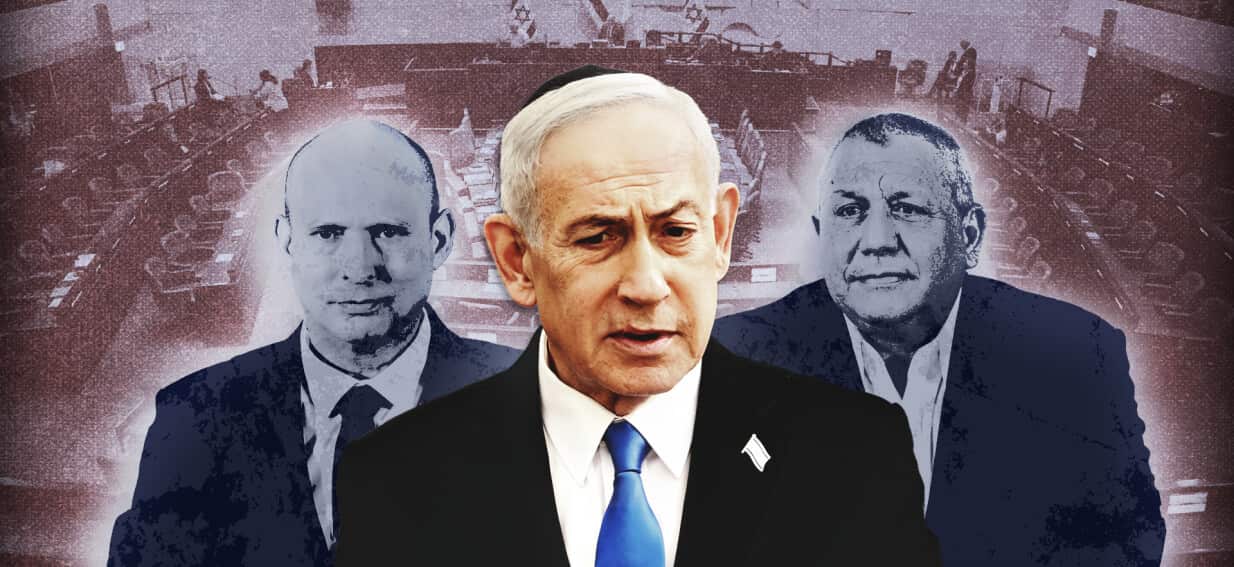
The anti-Netanyahu bloc suffers from structural fragmentation, creating a distinct systemic risk. The recent merger of Naftali Bennett and Yair Lapid’s parties into a unified entity named "Together," alongside Gadi Eisenkot’s leadership of the Yashar party, represents a tactical consolidation designed to insulate opposition votes from threshold failure.
By contrast, the pro-Netanyahu bloc relies on a highly disciplined, non-overlapping array of Ultra-Orthodox and hard-right nationalist factions. In past cycles, the failure of a single micro-faction to clear the 3.25% line has swung control of the 120-seat Knesset. The primary variable determining structural viability in September is not the shifting preference of the median voter, but the efficiency of vote-pooling mechanisms within each bloc.
The Security-Voter Function: Realignment Under Regional Escalation
The strategic alignment of the Israeli electorate operates as a function of perceived security utility. The events following October 7, 2023, alongside the subsequent regional conflicts involving Iran and Lebanon, have rewritten the electoral incentive structure.
Standard political theory suggests that protracted security crises trigger a rally-around-the-flag effect, benefiting the incumbent executive. However, empirical tracking reveals a bifurcation in voter psychology:
- The Competence Deficit: A segment of center-right voters identifies the structural intelligence and defense failures of October 7 as a failure of the incumbent administration, detaching their security voting preference from Netanyahu.
- The Escalation Premium: Conversely, ongoing friction—such as recent retaliatory actions in Lebanon and shifting control dynamics within Gaza—strengthens the hard-right narrative that a transition of power during an active multi-front conflict introduces unacceptable operational risk.
This creates a critical voter segment: center-right security voters. Their migration path between Netanyahu’s Likud, Bennett and Lapid’s "Together," and Eisenkot’s "Yashar" will decide the balance of power. The strategic risk for the opposition lies in its inability to present a singular, credible defense-oriented leader who can match the incumbent's perceived institutional weight, despite the post-October 7 vulnerabilities.
The Cost Function of Post-Election Coalition Building
Winning the most seats in the Knesset does not guarantee the premiership. The president tasks the lawmaker with the highest probability of forming a 61-seat majority coalition. This reality introduces the third variable: the veto-player leverage index.
In the Israeli system, small sectarian parties function as kingmakers because their exit from a coalition immediately triggers a government collapse. The cost of building a coalition can be quantified by the policy concessions and budgetary allocations demanded by these essential micro-factions.
[61-Seat Minimum Requirement]
  ├── Major Party Bloc (Likud or Together)
  └── Essential Kingmaker Factions (Asymmetric Leverage for Budget/Policy Demands)
The incumbent coalition retains an advantage in transaction speed. Netanyahu has demonstrated a consistent willingness to absorb the high political cost of meeting the budgetary and draft-exemption demands of Ultra-Orthodox and nationalist factions to secure his legislative flank.
The opposition faces a far higher transaction cost. To assemble 61 seats, an anti-Netanyahu coalition must bridge deep ideological divides, combining secular center-left factions, right-wing nationalists like Bennett, and potentially Arab-majority parties. The internal policy contradictions of such an alliance introduce severe execution risk during both the negotiation phase and subsequent governance.
Strategic Projection
Barring an unexpected structural consolidation among the minor opposition factions, the upcoming election will yield a highly polarized parliament split roughly into two 60-seat halves. The definitive strategic play will rest on the behavior of the center-right nationalist fragments.
If Bennett and Lapid’s "Together" entity can siphon off disillusioned right-wing security voters while ensuring no allied left-wing micro-factions collapse below the 3.25% threshold, they will successfully deny Netanyahu a clear 61-seat mandate. However, if the opposition fails to manage its structural fragmentation, the institutional cohesion of the pro-Netanyahu bloc will enable it to secure a narrow, highly leveraged majority, extending the current administration's tenure despite unprecedented regional volatility.