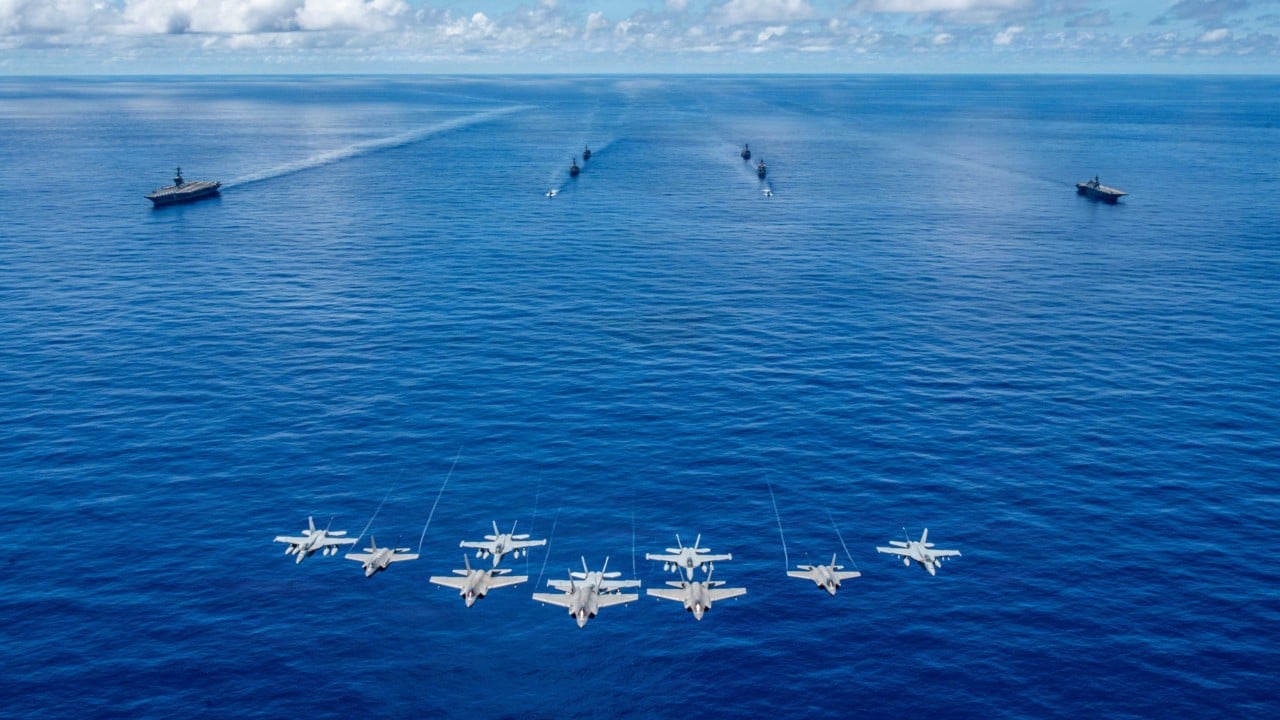
The operational architecture of maritime security in the Western Pacific is undergoing a structural shift from episodic, bilateral training to continuous, multilateral coalition integration. Media accounts frequently characterize these activities as reactive displays of political willpower designed to signal resolve to Beijing. That framing misses the mechanical reality. Naval and multi-domain maneuvers—such as the regional iterations of Exercise Sama Sama, Balikatan, and the expansive Rim of the Pacific (RIMPAC) frameworks—are optimization trials for a complex, multi-national logistics and fire-control network.
The strategic imperative driving the United States and its partners is not the theater of "flexing muscle," but rather the execution of integrated deterrence. This concept relies on two core variables: interoperability metrics and the distribution of missile strike architectures across the first island chain. To evaluate the true strategic efficacy of these multi-front drills, the operational mechanics must be isolated from the political rhetoric.
The Three Pillars of Interoperability Optimization
True coalition warfare cannot be established during active hostilities. It requires the pre-coordination of communication arrays, ammunition compatibility, and command-and-control hierarchies. The current allied exercise regime is built upon three distinct operational pillars designed to establish this baseline before a crisis occurs.
Tactical Data Link Unification
The primary bottleneck in any multilateral naval operation is sensor-to-shooter data transmission. When warships from the United States, Japan, France, Australia, Canada, and the United Kingdom operate in proximity, their native combat systems must achieve zero-latency communication.
Exercises function as live-environment stress tests for Link 16 and emerging multi-domain data networks. The objective is to ensure that an Arleigh Burke-class destroyer can seamlessly ingest targeting tracking data produced by a Japanese Maritime Self-Defense Force P-1 maritime patrol aircraft or a Canadian Halifax-class frigate, converting that data into a fire-control solution without human-in-the-loop translation delays.
Cross-Deck Ammunition and Logistics Interchangeability
A coalition's endurance is directly bound to its logistically sustainable lifespan. Recent drills have shifted focus toward cross-decking operations, where MH-60R helicopters and fixed-wing assets utilize the flight decks and replenishment-at-sea systems of partner nations. This expands the theater's overall combat radius by creating redundant replenishment nodes. If a single nation's logistical pipeline is disrupted by long-range precision strikes, partner infrastructure can absorb the operational load.
LMD-Based Command Hierarchies
The transition from a hub-and-spoke alliance model to a combined task force requires localized mission command delegation (LMD). Under this framework, tactical command of specific warfare areas—such as anti-submarine warfare (ASW) or anti-surface warfare (ASUW)—is distributed among allied commanders based on asset capability rather than nationality. During localized maneuvers off the coast of Luzon, tactical control of air defense sectors frequently switches between U.S. Navy Seventh Fleet elements and Philippine or Japanese command structures to eliminate single points of failure in the command architecture.
The Cost Function of Distributed Precision Strike Architecture
The geographic concentration of allied forces in the First Island Chain creates a high-density target environment for China’s People's Liberation Army Rocket Force (PLARF). To counter the vulnerability of large, concentrated installations like Kadena Air Base or Guam, the United States is deploying land-based, mobile missile systems. The deployment of the Typhon Mid-Range Capability (MRC) and the Navy Marine Expeditionary Ship Interdiction System (NMESIS) fundamentally alters the regional cost function of aggression.
The operational calculus can be structured through a basic cost-benefit equation for an adversarial offensive:
$$Net\ Benefit = V_{Target} - (C_{Attack} + C_{Retaliation})$$
Where $V_{Target}$ is the strategic value of an contested territory, $C_{Attack}$ represents the kinetic expenditure required to neutralize allied defenses, and $C_{Retaliation}$ is the cost inflicted by allied counter-strikes.
Land-based distributed systems alter this equation by simultaneously inflating $C_{Attack}$ and $C_{Retaliation}$:
- Target Multiplicity ($C_{Attack}$ Inflation): Unlike fixed runways or anchored supercarriers, mobile missile batteries utilizing the Typhon system (capable of firing Tomahawk cruise missiles up to 1,600 kilometers) can rapidly relocate along the road networks of Luzon or Kagoshima Prefecture. To confidently neutralize these distributed, low-signature targets, an adversary must expend a highly disproportionate volume of its short- and medium-range ballistic missile inventory.
- Kinetic Reach Enhancement ($C_{Retaliation}$ Inflation): By placing mid-range strike options inside the first island chain during exercises like Valiant Shield and Orient Shield, the alliance establishes land-based, persistent coverage over the Taiwan Strait and the Eastern Chinese seaboard. This removes the requirement for carrier strike groups to operate within the immediate lethal envelope of anti-ship ballistic missiles to deliver retaliatory kinetic effects.
The Automation Shift: Relocating Strategic Risk via Autonomous Systems
Faced with structural limitations in crew recruitment, surface hull counts, and active-duty deployments, the U.S. military and its allies are shifting a growing percentage of their reconnaissance load to unmanned architectures. During high-end maritime exercises, large uncrewed aerial vehicles (UAVs) such as the MQ-4C Triton and MQ-9 Reaper account for approximately 30 percent of close-in aerial reconnaissance operations directed toward monitoring opposing fleet movements.
While automation solves the immediate operational problem of asset scarcity, it introduces a distinct friction point into the strategic stability model. The human risk component acts as a natural speed brake on tactical escalation. When a manned reconnaissance aircraft is intercepted, the immediate threat to human life enforces a high threshold of caution on both the intercepting pilot and the home command structure.
With autonomous platforms, this threshold drops significantly. The historical record indicates that states are far more willing to kinetically engage or electronically blind an uncrewed system, viewing the action as a low-consequence method of signaling displeasure. However, the data gathered by these automated systems is directly integrated into live, AI-assisted operational decision-making matrices used during exercises like Talisman Sabre. If an autonomous sensor is blinded or destroyed, the automated command loops may misinterpret the loss as the opening salvo of a broader kinetic campaign, compressing the human decision window and accelerating the transition from localized friction to structural conflict.
Institutional Limitations of the Coalition Exercise Framework
Despite the high density of assets deployed across RIMPAC and Sama Sama frameworks, the allied strategy possesses three structural vulnerabilities that prevent it from acting as an absolute deterrent.
The Political-Legal Friction of Visiting Forces Agreements
The operational utility of land-based distributed systems is entirely dependent on sovereign access. While nations like Japan and the Philippines have signed Visiting Forces Agreements (VFAs) allowing the temporary transit and training of foreign troops, these agreements do not guarantee combat access during an active conflict. The sovereign host retains absolute veto power over whether strikes can be launched from its soil, introducing a variable of strategic ambiguity that an adversary can exploit via diplomatic and economic coercion.
The Industrial Attrition Deficit
Allied exercises demonstrate high-end tactical proficiency but assume a compressed timeline. In a prolonged conventional conflict involving high-intensity precision strikes, the consumption rate of advanced munitions—such as the Long Range Anti-Ship Missile (LRASM) and the Standard Missile 6 (SM-6)—would outpace current Western industrial manufacturing capacities within weeks. The exercises demonstrate the capacity to fire these weapons via unified data links, but they cannot simulate the industrial depth required to replenish empty magazines under active theater interdiction.
Grey-Zone Asymmetry
The allied coalition is designed around high-end, conventional warfighting scenarios: anti-submarine screens, amphibious landings, and long-range precision missile strikes. However, the day-to-day friction in the South China Sea occurs below the threshold of conventional military engagement. The deployment of the Chinese Coast Guard and maritime militia fleets utilizing water cannons, hull-bumping tactics, and acoustic intimidation devices at features like Scarborough Shoal undermines standard military deterrence. A billion-dollar guided-missile destroyer cannot easily deploy its primary weapon systems to counter a fishing trawler or a civilian supply vessel without triggering an asymmetric escalatory crisis that the alliance's legal frameworks are unequipped to handle.
Strategic Realignment Requirements
To convert the tactical lessons of multi-front exercises into an enduring strategic posture, the alliance must shift from temporary deployment training to a permanent, hardened infrastructure model. The practice of introducing cutting-edge platforms like the Typhon missile system for short-term exercises before withdrawing them creates a dangerous operational vacuum that opposing forces naturally fill with increased grey-zone pressure.
The optimal strategic play requires three concrete steps:
- Establish permanent, hardened storage facilities for precision munitions within the territory of VFA partners to eliminate the vulnerability of trans-Pacific logistics chains during the opening 72 hours of a crisis.
- Transition uncrewed aerial reconnaissance data streams into an unclassified, real-time regional maritime domain awareness platform accessible by civilian coast guards, stripping the anonymity from grey-zone actors.
- Formalize a unified, multilateral rules-of-engagement matrix for non-kinetic provocations, ensuring that an attack on a partner's regional fisheries vessel triggers a synchronized, economic and diplomatic coalition response rather than isolated military posturing.
For a deeper look into the evolving maritime strategy of the Western Pacific and the tactical deployments of uncrewed surface vessels, analyze the visual breakdown of fleet movements and littoral combat scenarios presented in this U.S. Navy Seventh Fleet Operational Analysis. This assessment details the tactical coordination required between carrier strike groups and allied regional commands during multi-front training maneuvers.