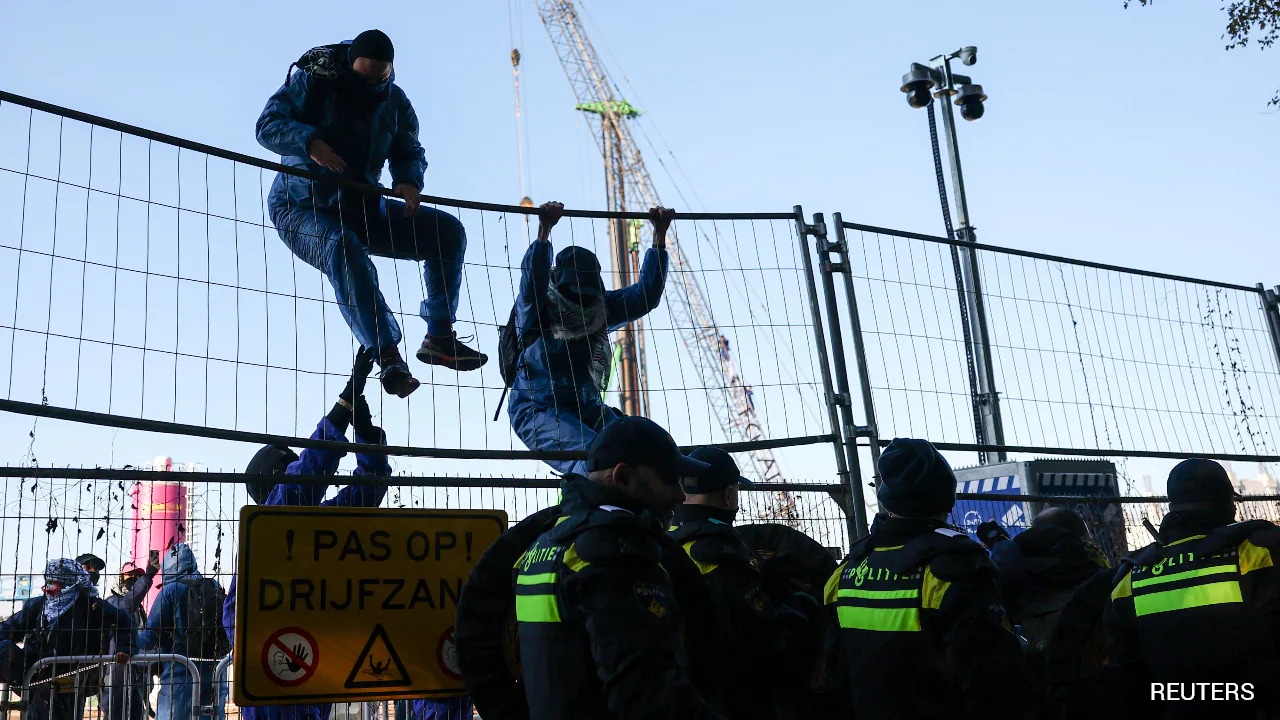
The physical occupation of Microsoft’s planned data center site in Noord-Holland—often grouped into the broader Amsterdam metropolitan market—exposes a fundamental collision between digital infrastructure expansion and physical resource limits. Standard media coverage frames this event as a localized environmental protest against a tech giant. That framing misses the structural reality. The blockade is the acute symptom of a chronic failure in industrial policy, grid capacity allocation, and regional spatial planning across the Netherlands.
To understand why a hyperscale construction site became a flashpoint for direct action, analysts must examine the underlying resource competition. Hyperscale data centers do not merely consume electricity and water; they monopolize scarce transmission capacity and prime agricultural land in one of Europe’s most densely populated and grid-congested regions. When regulatory frameworks fail to price these externalities accurately, civil resistance fills the vacuum.
The Structural Drivers of the Amsterdam Blockade
The Amsterdam-Noord-Holland corridor sits at the center of the FLAP-D market (Frankfurt, London, Amsterdam, Paris, Dublin), Europe’s primary data center hub. Geographic proximity to transatlantic subsea cable landings and the Amsterdam Internet Exchange (AMS-IX) makes the region mathematically optimal for low-latency cloud computing.
This optimization creates a severe localized concentration problem. While the economic benefits of cloud infrastructure diffuse globally across enterprise users, the physical costs concentrate entirely within a few Dutch municipalities, notably Hollands Kroon in the Wieringermeer polder, roughly 50 kilometers north of Amsterdam.
The resistance at the Microsoft site operates on three distinct vectors of friction:
- Electrical Grid Cannibalization: The Dutch high-voltage and medium-voltage transmission networks face severe congestion. TenneT, the national transmission system operator, and regional operators like Liander have repeatedly warned of multi-year waiting lists for industrial and residential grid connections. A single hyperscale campus requires hundreds of megawatts of continuous, baseload power—equivalent to the consumption of a mid-sized city. Local residents and small businesses facing connection delays view hyperscale allocations as direct expropriation of public infrastructure capacity.
- Water Resource Asymmetry: Modern data centers rely heavily on evaporative cooling systems to manage thermal loads efficiently. During peak summer temperatures, water consumption spikes precisely when Dutch regional water boards impose agricultural irrigation bans to prevent soil subsidence and saltwater intrusion. Although Microsoft and other operators have shifted toward closed-loop cooling and non-potable water sources in newer designs, public trust eroded after initial permitting disclosures revealed massive discrepancies between projected and actual water draw at existing Wieringermeer facilities.
- Land Use and Spatial Justice: The Netherlands operates under acute spatial scarcity, compounded by a national nitrogen crisis that restricts housing construction and forces the buyout of livestock farms. Allocating dozens of hectares of fertile polder land to windowless server warehouses—which generate minimal permanent local employment per square meter compared to traditional industry or agriculture—triggers immediate political backlash.
The Cost Function of Hyperscale Permitting
Standard corporate site selection models treat regulatory approval as a binary milestone and public opposition as a public relations expense. In the Dutch market, this model is broken. The true cost function of deploying hyperscale capacity in Western Europe must incorporate unpriced social and infrastructural externalities.
When a municipality like Hollands Kroon grants building permits for a 40-to-80-hectare data center campus, it effectively subsidizes the operator by providing access to depreciated grid infrastructure and underpriced land. The local tax revenue generated by the facility rarely offsets the capital expenditure required to reinforce the regional power grid or upgrade local water treatment capacity.
This creates a classic principal-agent problem. Local municipal councils, incentivized by short-term land sale revenues and headline investment figures, approve zoning changes. Meanwhile, the national grid operator, provincial authorities, and local residents bear the long-term operational deficits.
Direct action—such as protesters occupying construction equipment, erecting blockades, and halting earthworks—forces those externalities back onto the corporate balance sheet. The financial impact on the operator manifests through three mechanisms:
- Schedule Slippage and Capital Lockup: Hyperscale construction operates on strict critical-path schedules tied to server rack delivery and cloud region availability zones. Every day a site is blockaded delays revenue generation on hundreds of millions of euros in deployed capital while fixed contractor overhead continues to accrue.
- Security and Hardening Overhead: Post-occupation, sites require permanent perimeter fortification, 24/7 private security patrols, and continuous coordination with national law enforcement, permanently elevating operational expenditure (OpEx).
- Regulatory Contagion: High-profile occupations force national politicians to intervene to restore public order. In the Netherlands, this pressure directly accelerated the Dutch government's implementation of a national moratorium on new hyperscale data centers exceeding 10 hectares and 70 megawatts, restricting future builds almost exclusively to designated zones in Eemshaven and Wieringermeer under strict new criteria.
Evaluating the Renewable Energy Accounting Fallacy
A central point of contention at the Amsterdam-area protest involves corporate sustainability claims. Hyperscalers routinely announce that their facilities run on 100 percent renewable energy. Protesters and energy analysts reject this framing because it relies on annual volumetric matching rather than hourly temporal matching.
Under annual matching, a data center operator purchases Power Purchase Agreements (PPAs) from a wind farm in the North Sea. Over a 365-day period, the total megawatt-hours generated by the wind farm equal the total megawatt-hours consumed by the data center. On paper, the facility is carbon-neutral.
In physical reality, the electrical grid requires instantaneous balance between supply and demand every second. When North Sea wind generation drops during a winter Dunkelflaute (periods of low wind and low solar output), the data center does not power down. It draws continuous baseload electricity from the Dutch grid, which during those hours is balanced by gas-fired peaker plants and imported coal power.
Furthermore, because hyperscalers lock up long-term corporate PPAs with new renewable developments, those clean electrons are removed from the general pool available to decarbonize Dutch residential heating and heavy industry. The data center achieves accounting neutrality while slowing the systemic decarbonization of the host nation's grid.
Operational Failures in Stakeholder Engagement
The escalation to physical site occupation demonstrates a breakdown in early-stage risk management. Hyperscale developers typically execute site acquisition through shell companies and non-disclosure agreements (NDAs) to prevent land speculation and competitor intelligence gathering.
While commercially logical, stealth acquisition is operationally catastrophic in high-trust consensus democracies like the Netherlands. The Dutch polder model of governance relies on early, transparent consultation among government, industry, and civil society before irreversible decisions are finalized.
By bypassing regional stakeholder alignment until after zoning variances were secured, the development process alienated provincial authorities, environmental NGOs, and agricultural cooperatives simultaneously. Once construction began, legal appeals were largely exhausted, leaving extrajudicial disruption as the primary remaining tool for opposition groups.
Tactical Framework for Infrastructure Deployment
To deploy capital-intensive digital infrastructure in grid-constrained, politically sensitive markets without triggering debilitating civil resistance, infrastructure operators must overhaul their site selection and community integration protocols.
Phase 1: Grid-First Site Selection
Stop selecting sites based solely on fiber latency and land cost. Mandate a pre-acquisition grid impact assessment conducted independently of municipal boosters.
- Co-locate with curtailment: Target industrial zones where renewable generation frequently exceeds transmission capacity, allowing the data center to absorb curtailed wind or solar power rather than competing for congested baseload lines.
- Behind-the-meter generation: Require on-site generation or dedicated private wire connections to renewable assets, minimizing draw from the public distribution network.
Phase 2: Circular Resource Integration
Eliminate unilateral resource extraction from local watersheds and energy grids.
- Mandatory district heating integration: Design cooling loops specifically to export low-grade waste heat (typically 25°C to 40°C) directly into municipal district heating networks or adjacent commercial greenhouses. In the Netherlands, horticulture operations in North Holland require massive thermal inputs; failing to engineer physical heat-transfer infrastructure from day one is an inexcusable design flaw.
- Zero-evaporation cooling architectures: Standardize on closed-loop liquid cooling and dry coolers that eliminate potable and surface water consumption during peak summer months, even at the expense of a marginal increase in Power Usage Effectiveness (PUE).
Phase 3: Temporal Carbon Matching
Transition procurement from annual PPA bundling to 24/7 Carbon-Free Energy (CFE) hourly matching.
- Grid-interactive load shifting: Deploy software orchestration to shift non-latency-sensitive compute workloads (such as AI model training and batch processing) across geographic regions in real time, following renewable generation surpluses and reducing load during local grid stress events.
- On-site battery storage: Install utility-scale battery energy storage systems (BESS) at the substation level to provide frequency regulation and peak-shaving services back to TenneT, converting the data center from a grid liability into a grid stabilization asset.
Limitations of Technical Mitigation
Operators must recognize the hard boundaries of engineering solutions. Technical upgrades—such as closed-loop cooling, waste-heat recovery, and battery storage—solve environmental and grid-engineering objections, yet they do not resolve ideological opposition to corporate consolidation or data extractivism.
Waste-heat export networks require tens of millions of euros in insulated pipeline infrastructure and long-term off-take agreements from municipalities that often move slower than tech construction cycles. If a municipality fails to build the receiving heat network, the data center's heat-exchanger valves sit idle while public criticism persists.
Similarly, 24/7 hourly carbon matching significantly increases energy procurement costs and requires deep liquidity in local clean-energy markets that does not yet exist across all European grids.
Strategic Forecast and Final Play
The occupation of Microsoft’s Noord-Holland site marks the end of frictionless hyperscale expansion in Western Europe. The era in which cloud providers could treat municipal permits as a mandate to monopolize regional power and water resources is permanently closed.
Infrastructure developers and enterprise cloud buyers must immediately re-architect their European capacity roadmaps around three realities:
- The Tier-1 FLAP-D markets are functionally capped for traditional builds. Expect permanent, strict permitting caps across the Netherlands, Ireland, and Germany. Future capacity in Amsterdam will come primarily from brownfield retrofits—replacing older, inefficient enterprise colocation facilities with high-density liquid-cooled hardware—rather than greenfield polder expansion.
- Capital will migrate to the European periphery. Hyperscale development will accelerate in the Nordics (Sweden, Norway, Finland) and Iberia (Spain, Portugal), where hydroelectric, wind, and solar surpluses align with low population density and permissive grid interconnection queues.
- Energy co-investment becomes mandatory. Cloud operators can no longer act merely as off-takers of existing grid capacity. To secure future operating licenses in regulated European jurisdictions, hyperscalers must directly co-finance new renewable generation, high-voltage transmission upgrades, and municipal thermal networks as a prerequisite to breaking ground.