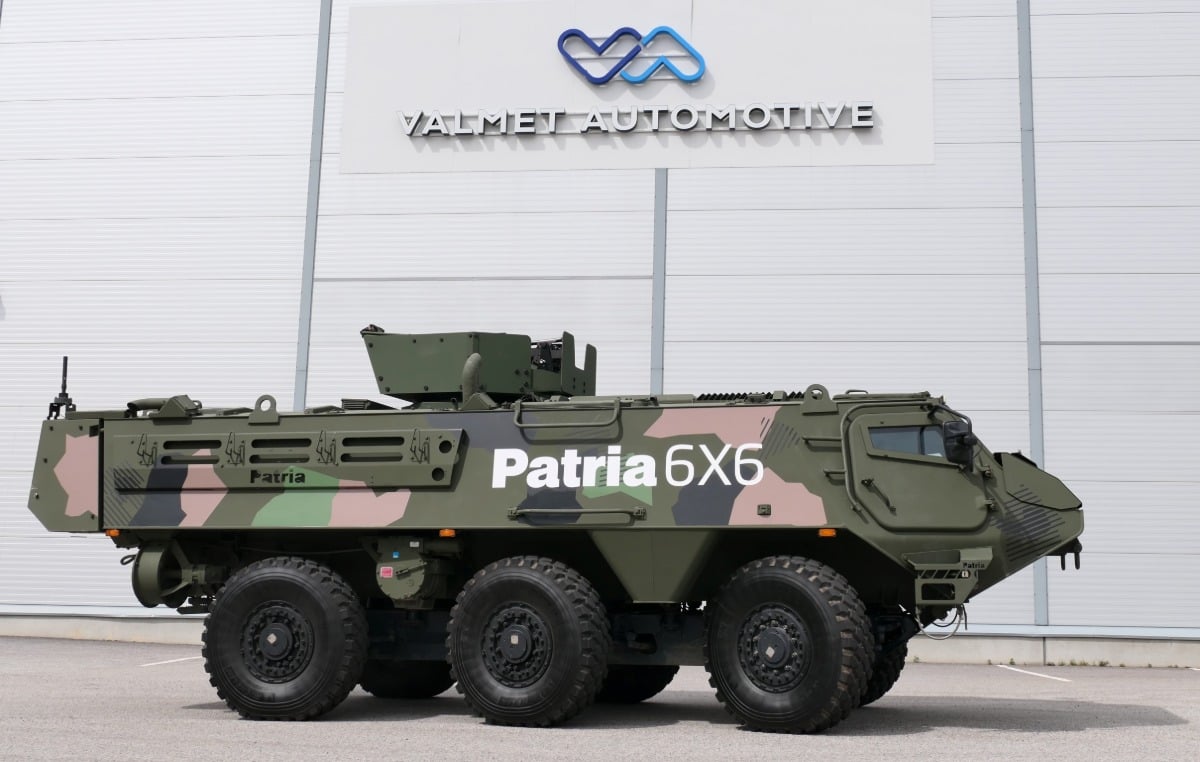
The traditional defence procurement cycle is fundamentally incompatible with contemporary state-level rearmament timelines. When European states attempt to scale protected mobility platforms organically, they face a structural bottleneck: greenfield factory development requires 36 to 48 months of capital deployment before the first hull rolls off the line. This operational friction is being bypassed through a distinct industrial model: the rapid insertion of military technology platforms into highly automated, legacy automotive production lines.
The multi-year manufacturing agreement between Patria and Valmet Automotive at the Uusikaupunki facility in Finland isolates the exact mechanics required to scale armoured vehicle output without the capital expenditure or time lag of building proprietary factories. By expanding the initial December 2025 technology transfer agreement into a multi-year mass production mandate, the partnership establishes a baseline capacity of hundreds of Patria 6x6 vehicles per year by early 2027. This framework serves as an operational blueprint for industrial defense strategies facing severe capacity shortages across NATO.
The Tri-Axiom Framework of Advanced Defence Tech Transfer
To transfer complex military platforms to a third-party contract manufacturer without degrading structural integrity or quality standards, industrial planners must manage three distinct, intersecting operational pillars.
+-------------------------------------------------------+
|          THE TRI-AXIOM TECH TRANSFER FRAMEWORK        |
+-------------------------------------------------------+
                           |
      +--------------------+--------------------+
      |                    |                    |
      v                    v                    v
[ Pillar 1 ]         [ Pillar 2 ]         [ Pillar 3 ]
Manufacturing        Supply Chain         Sovereign
Congruence           Multiplication       Resilience
(Automotive Tooling  (Localized Sub-     (Distributed Nodes
to Armoured Hulls)    contractor Depth)    for Supply Security)
1. Manufacturing Congruence
The Uusikaupunki plant built over 1.9 million premium passenger vehicles for brands like Porsche and Mercedes-Benz. The core capability being leveraged is not specific sector knowledge, but systemic manufacturing competence: statistical process control, high-tolerance robotics management, and rapid assembly-line reconfiguration.
The primary friction point in this pillar lies in the weight and metallurgical divergence between passenger vehicles and armoured hulls. Automotive lines are optimized for thin-gauge sheet metal stamping and spot welding. Armoured vehicles, such as the Patria 6x6, require heavy ballistic steel plate manipulation, multi-pass MIG welding, and structural reinforcement for blast attenuation. The speed of the Patria-Valmet ramp-up demonstrates that the underlying algorithmic logistics—specifically, Just-In-Time component sequencing and cellular manufacturing layouts—are highly transferable, even when the physical tooling must be heavily ruggedized.
2. Supply Chain Multiplication
Ramping production capacity within a single facility is useless if the tier-1 and tier-2 supplier networks remain bottlenecked. The Patria-Valmet model addresses this through an explicit socio-economic calculation: every 100 vehicles produced generates long-term employment for approximately 240 personnel within the broader domestic subcontractor network.
This regional industrial concentration creates an operational buffer. By distributing specialized component manufacturing—such as heavy axles, specialized wiring harnesses, and ballistic glass—across an integrated regional engineering cluster, the prime contractor mitigates single-point-of-failure risks. The proximity of the Uusikaupunki port further reduces transit frictions for critical components that cannot be sourced domestically.
3. Sovereign Resilience
Organic growth within a prime contractor’s proprietary facilities creates highly concentrated, vulnerable nodes. In modern warfare, central manufacturing hubs present clear strategic vulnerabilities. The technology transfer model treats industrial capability as an exportable software stack. By certifying Valmet Automotive as an independent, full-rate production node, Patria decouples its market scale from its physical footprint in Hämeenlinna. This distributed manufacturing architecture guarantees security of supply; if one node faces kinetic or cyber disruption, parallel facilities can absorb the production load via pre-configured tooling layouts.
The Industrial Cost and Capacity Function
The decision to utilize contract manufacturing instead of expanding internal capacity is governed by a strict optimization function. A prime defense contractor's capital allocation can be modeled by evaluating the velocity of capacity generation against the degradation of gross margins via partner revenue sharing.
        Internal Expansion vs. Contract Manufacturing

Capacity ^
         |                                 / [Contract Manufacturing]
         |                                /  (Rapid ramp, lower capital risk)
         |                               /
         |                              /
         |                             /
         |                            /
         |  _________________________/
         | |
         | | [Internal Expansion]
         | | (High CapEx lag time)
         +----------------------------------------------------> Time
Internal facility expansion introduces a massive step-function in fixed overhead costs. Amortizing a new heavy fabrication facility requires guaranteed long-term procurement volumes from sovereign clients—a condition rarely met due to fluctuating political landscapes and volatile budget cycles. Contract manufacturing converts these fixed capital expenses into variable operational expenses. Valmet Automotive bears the structural maintenance costs of the Uusikaupunki footprint, while Patria buys capacity on a per-unit or per-block contractual basis.
The structural limitation of this approach is the dilution of proprietary manufacturing trade secrets. To achieve full capacity by 2027, Patria must transfer detailed weld schedules, geometric dimensioning and tolerancing schematics, and system integration sequences to Valmet personnel. While protected by strict industrial security protocols and state-level clearance frameworks, every external node added to a defense program increases the long-term attack surface for industrial espionage.
The Cross-Sector Re-Industrialization Playbook
The integration of automotive assembly assets into state-level defense strategies outlines a definitive shift in how western nations must approach rearmament. The assumption that military hardware must be built exclusively by legacy defense firms results in low-volume, high-unit-cost systems that fail the attrition realities of modern conventional conflict.
+--------------------------------------------------------------------------+
|                  CROSS-SECTOR DETAILED VALUE CHAIN                       |
+--------------------------------------------------------------------------+

  Automotive Inputs                   Operational Synthesis                 Defense Output
  [High-Speed Logistics] -----------> (Just-In-Time Line Sequencing) ---->  [Patria 6x6 Platform]
  [Advanced Automation] ------------> (Cellular Heavy Weld Re-Tooling) --->  [Scalable Hull Output]
  [Rigorous Quality Control] --------> (Statistical Process Verification) -->  [STANAG-Compliant Armor]

+--------------------------------------------------------------------------+
The tactical requirement for defense ministries and prime contractors globally is to map domestic non-defense industrial capacity against their immediate military shortfalls. Facilities currently optimizing low-margin commercial transport assets possess the exact automated infrastructure required to execute heavy platform assembly. The strategic deployment of technology transfer agreements minimizes infrastructure deployment timelines and establishes highly scalable manufacturing ecosystems capable of rapid output adjustments during geopolitical crises.