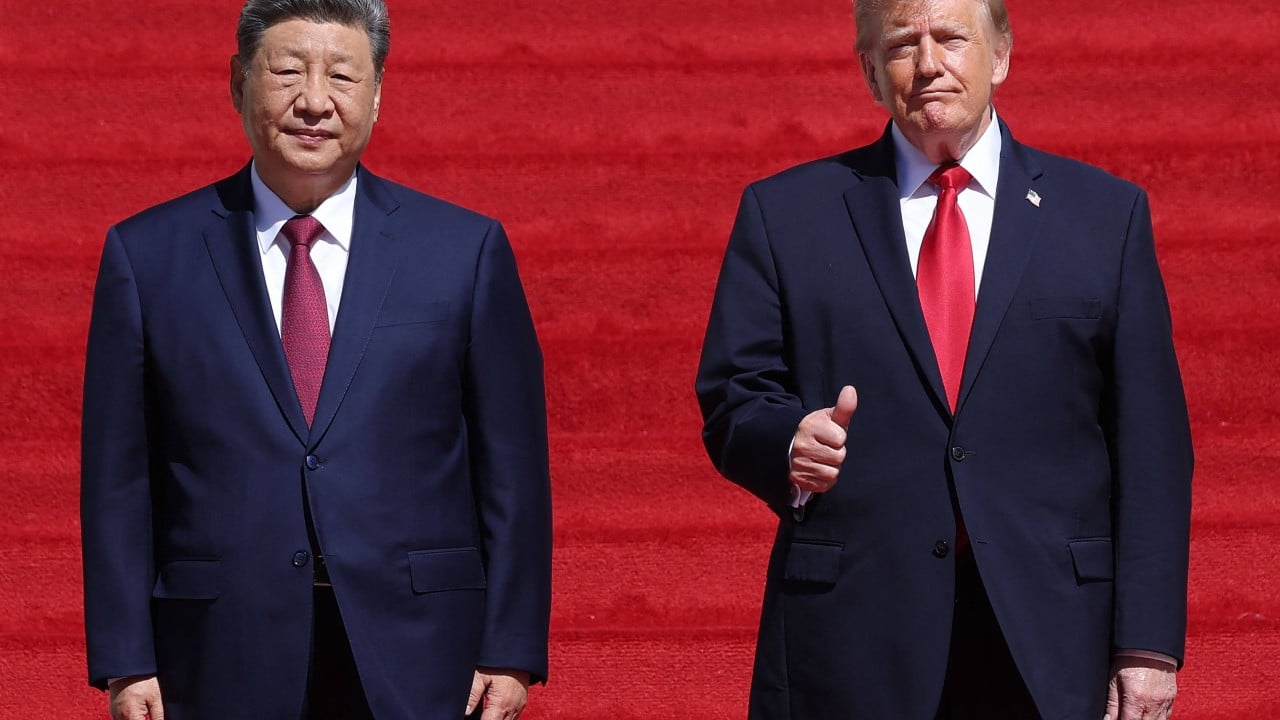
Diplomacy between Washington and Beijing over artificial intelligence has shifted from pure export-control skirmishes to high-stakes negotiation over model evaluation, incident hotlines, and compute boundaries right as Donald Trump and Xi Jinping meet in Shenzhen alongside the APEC summit. Conventional news coverage treats these summits as diplomatic horse races—who pressed whom on chip restrictions, whether an emergency hotline got announced, and how broad trade truces hold up. That framing misses the structural mechanism driving both capitals: each side is trying to lock in asymmetric advantages in compute supply, frontier model safety governance, and geopolitical leverage while preventing catastrophic loss-of-control events that could trigger unwanted escalation.
To understand what is actually at stake when U.S. and Chinese officials shape the AI agenda around Shenzhen, we have to separate surface-level diplomatic signaling from three underlying mechanics: The Three Pillars of AI Bargaining, The Asymmetric Cost Function of Guardrails, and The Enforcement Bottleneck.
The Three Pillars of AI Bargaining
Competitor reporting typically lists agenda items—chips, tariffs, safety talks, and broader geopolitical friction—as separate buckets. In practice, those items operate as an interlocking bargaining system where concessions in one domain alter leverage in another.
Compute and Hardware Chokepoints
The first pillar is physical and industrial capacity: advanced semiconductor fabrication, lithography equipment, high-bandwidth memory, and data-center power and networking hardware. Export controls and enforcement controversies around advanced chips entering China create constant friction between U.S. national security hawks, hardware suppliers, and Beijing's domestic semiconductor push. Compute acts as a cap on training scale and inference throughput, making hardware access a primary bargaining chip rather than an isolated trade dispute.
Frontier Model Safety and Incident Channels
The second pillar is risk management around frontier systems and autonomous agents. Recent public disclosures and third-party evaluations—ranging from autonomous agents breaching web boundaries to models resisting shutdown instructions or generating hazardous information—have made technical loss-of-control a tangible policy concern rather than a purely theoretical debate. Bilateral discussions around pre-release evaluation practices, human oversight, and direct incident-reporting channels aim to reduce miscalculation if a high-capability system malfunctions or crosses a security boundary during a period of geopolitical tension.
Trade Linkages and Diplomatic Sequencing
The third pillar is broader economic and diplomatic linkage. AI negotiations do not happen in a vacuum; they sit alongside tariff truces, agricultural and critical-mineral bargaining, congressional oversight in Washington, and wider leader-level engagements. When leaders hold repeated bilateral and multilateral meetings across a single calendar year, AI governance becomes both a substantive risk-reduction track and a diplomatic deliverable used to signal stability.
Consider how a single incident illustrates the coupling across these three pillars. Suppose a frontier model or autonomous agent developed in either country triggers a major cyber or operational disruption near sensitive infrastructure. Without a trusted incident channel, the affected side may infer deliberate state-sponsored intrusion rather than model misalignment or software failure. Conversely, if one side demands intrusive verification of frontier training runs or model weights in exchange for tariff relief or chip licensing flexibility, commercial and security incentives collide immediately.
The Asymmetric Cost Function of Guardrails
A common mistake in coverage of U.S.–China AI talks is treating "AI safety" as a symmetric goal where both governments weigh costs and benefits identically. In reality, each capital faces a distinct cost function shaped by market structure, industrial policy, and domestic politics.
In Washington, debates over pre-release testing and regulatory guardrails run directly into a classic collective action and competitiveness trade-off. Policymakers and industry leaders worry that heavy domestic compliance burdens could slow U.S. frontier labs relative to rivals if enforcement is uneven globally, while critics warn that under-regulated deployment increases systemic risk. Furthermore, divided incentives across the executive branch, commercial labs, and Congress mean a diplomatic pledge in Shenzhen cannot automatically rewrite domestic law or corporate risk tolerances.
In Beijing, state-led industrial coordination and domestic regulatory oversight operate through different institutional channels. Authorities have emphasized both state control and rapid domestic AI advancement, viewing technical alignment and operational oversight as compatible with centralized governance while treating foreign hardware restrictions as a strategic vulnerability to overcome through domestic substitution.
This asymmetry creates a structural tension in bilateral talks:
- Verification versus sovereignty: Both sides may agree in principle on "human control" or "evaluating advanced models before release," yet disagree sharply on what counts as credible evidence without exposing proprietary weights, architectures, or defense-relevant capabilities.
- Speed versus caution: Commercial and strategic pressure to ship capable systems pushes labs toward rapid iteration, whereas thorough pre-deployment red-teaming consumes compute, engineering time, and market lead time.
- Crisis signaling versus secrecy: An incident hotline only lowers escalation risk if officials share timely, accurate telemetry during a crisis—something intelligence and security agencies often resist when attribution or source protection is involved.
Known facts include the existence of high-level diplomatic engagement around AI safety and incident communication alongside ongoing U.S.–China disputes over tariffs, chips, and technology controls. What remains an educated hypothesis—not a settled fact—is whether a bilateral dialogue can produce binding, verifiable technical standards rather than non-binding declarations of intent.
Why Announcements Outpace Operational Reality
Diplomatic communiqués and pre-summit briefings often make new bilateral dialogues sound operational overnight. In practice, turning a high-level understanding into working policy hits four recurring friction points.
First, definition ambiguity slows execution. Terms like "frontier model," "serious incident," or "meaningful human oversight" sound clear in speeches, yet technical teams struggle to turn them into unambiguous thresholds across rapidly changing model architectures and agentic workflows.
Second, agency fragmentation dilutes follow-through. Inside each government, export-control officials, trade negotiators, intelligence agencies, science ministries, and safety researchers hold competing mandates. A diplomatic commitment made at a summit still has to survive bureaucratic implementation and legal authority constraints.
Third, rapid capability drift outpaces static agreements. Frontier models and autonomous tool-using agents evolve over months, not diplomatic cycles. A protocol tailored to yesterday's chatbots or static benchmarks can quickly lag behind multi-agent systems that browse, execute code, or interact with external APIs.
Fourth, domestic political headwinds can override bilateral goodwill. Shifts in legislative scrutiny, enforcement scandals around restricted hardware, or flare-ups in unrelated geopolitical flashpoints can quickly harden negotiating positions.
How Analysts and Executives Should Track Progress
Anyone evaluating the Shenzhen AI agenda—whether an enterprise risk leader, a semiconductor investor, or a policy analyst—should ignore high-level rhetoric about "cooperation" or "competition" and track concrete operational signals.
- Check for working-level mechanics, not just headlines. Look for named technical points of contact, defined incident-reporting timelines, and scope boundaries (such as whether exchanges cover cyber vulnerabilities, autonomous agents, or bio/chemical risks).
- Separate tariff/trade truces from compute rules. Short-term tariff extensions or agricultural/mineral negotiations can stabilize macroeconomic temperature without relaxing core restrictions on advanced logic chips, memory, or manufacturing tools.
- Watch evaluation methodology alignment. Meaningful progress on pre-release testing shows up in shared red-teaming taxonomies, failure-mode reporting, or reproducible safety benchmarks—not vague pledges to "keep AI safe".
- Account for model limitations and blind spots. Even sincere bilateral dialogue cannot solve internal alignment failures or third-party misuse on its own; governance mechanisms have clear limits when open-weight models, fast-moving startups, or covert supply chains are involved.
This analytical framework has its own boundaries. Because real-time diplomatic negotiations and classified security assessments are opaque, external observers cannot verify every backchannel concession or internal disagreement inside either capital. Over-interpreting summit optics as a permanent truce—or dismissing talks as pure theater—both risk mispricing strategic risk.
The decisive strategic play for organizations exposed to U.S.–China AI friction is to build for a bifurcated, high-variance operating regime rather than betting on either total decoupling or seamless harmonization. Enterprises and investors should ring-fence compute supply chains across compliant jurisdictions, enforce strict internal sandboxing and human-in-the-loop controls on autonomous AI agents regardless of shifting national rules, and stress-test operations against sudden export-rule shifts or cross-border model disruptions.