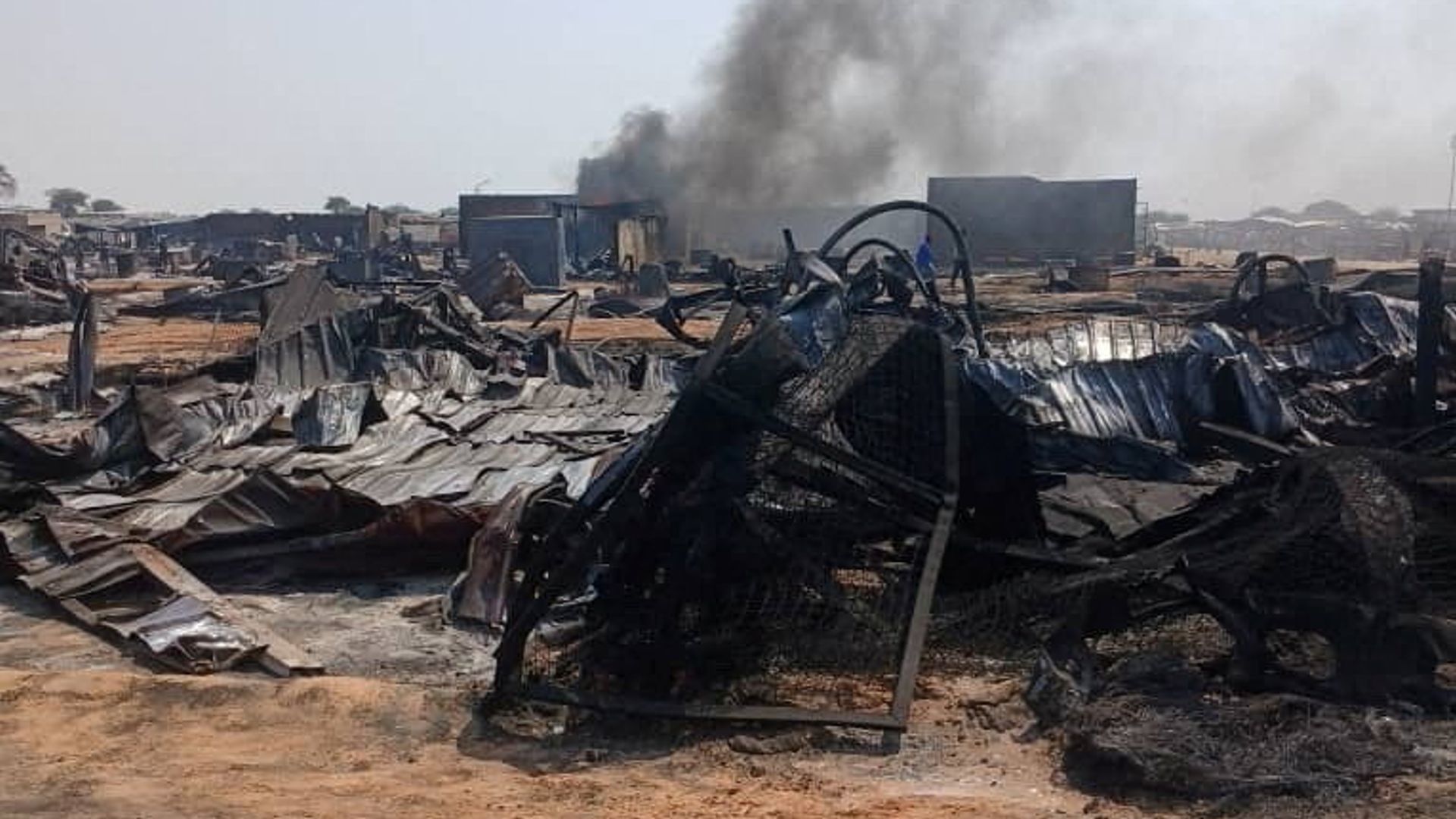
Standard reporting on the drone strike at Abyei's Amiet Market treats the event as an isolated mass-casualty incident: at least 153 people dead, a fuel depot hit, local officials blaming Sudan's military, and diplomatic protests from Juba. That framing misses the structural inflection point. When unmanned aerial vehicles strike a commercial hub in a contested border zone, casualty totals measure the immediate human shock while overlooking how drone warfare alters supply corridors, jurisdiction, and escalation dynamics between Sudan's armed forces, the paramilitary Rapid Support Forces (RSF), and South Sudan.
An analytical breakdown of the October 2026 strike exposes three distinct layers beneath the headline toll: a target-infrastructure collision between fuel logistics and civilian commerce, a jurisdictional stress test across a disputed enclave, and an operational shift from heavy conventional firepower toward long-range unmanned strikes.
Deconstructing Standard Coverage and Its Analytical Blind Spots
Conventional wire dispatches follow a predictable sequence. They report the rising death toll—jumping from 73 to at least 153—cite caretaker information minister Yohana Akol Ngor and medical responders such as Médecins Sans Frontières, note Sudan's military denial of targeting civilians alongside claims of striking fuel smugglers or RSF elements, and record diplomatic summonses or United Nations warnings.
Three structural flaws limit that narrative:
- Equating death tolls with strategic intent: A high fatality count at a midday market proves severe blast and fire effects, especially when fuel ignites, but it does not by itself establish whether the strike aimed at a specific depot, an armed convoy, or a crowded public space.
- Treating Abyei as a static backdrop: Abyei is not a neutral spectator to Sudan's wider war; it sits along the border with Kordofan, hosts contested claims between Ngok Dinka and Misseriya groups, experiences intercommunal friction involving neighboring Twic Dinka communities, and has faced warnings from the United Nations Interim Security Force for Abyei (UNISFA) over RSF presence raising escalation risks.
- Isolating one strike from a broader UAV shift: Treating the Amiet Market hit as a standalone tragedy obscures a multi-year evolution in which drones reach deeper into markets, transport hubs, and infrastructure nodes previously insulated from direct frontline clashes.
The Dual-Use Target Trap: Fuel Logistics Inside Civilian Markets
The clearest causal mechanism in the Amiet Market attack lies in the co-location of commercial trade and fuel storage. In conflict zones with fractured formal distribution networks, fuel depots frequently operate adjacent to busy markets because transport, generators, and local commerce converge in the same physical footprint.
When a drone munition strikes near or inside a fuel depot during peak market hours, two compounding damage mechanisms activate:
- Kinetic and thermal amplification: An initial strike or munition impact ignites flammable fuel stocks, turning localized blast trauma into a persistent fire that hampers rescue operations and complicates victim identification.
- Asymmetric attribution: Military actors can claim a legitimate logistics or smuggling target—asserting that RSF fighters or fuel smugglers were present—while local authorities and humanitarian responders document mass civilian deaths and displacement, estimated around 8,000 people.
From an analytical standpoint, independent verification remains constrained on the ground, so analysts must separate known facts from educated hypotheses:
- Known facts: A drone strike hit the Amiet Market area in Abyei in mid-October 2026 around midday, igniting a fuel-related fire that burned into the following day, killing at least 153 people according to local officials, prompting medical aid responses, triggering displacement, and drawing condemnation from Juba and the United Nations.
- Educated hypotheses: Strikes on fuel and transport nodes in border markets aim to disrupt belligerent supply chains and deter cross-border logistics, yet co-location with dense civilian crowds produces catastrophic secondary casualties and heightens the risk of drawing South Sudan deeper into diplomatic or security confrontation.
Jurisdictional Friction in a Contested Border Zone
Abyei's contested legal and administrative status magnifies every kinetic shock. Claimed by both Sudan and South Sudan following South Sudan's 2011 independence, the oil-rich border territory operates under overlapping political sensitivities and peacekeeping oversight rather than unambiguous sovereign control.
A strike inside or adjacent to Abyei alters incentives across three actors simultaneously. First, South Sudan's government faces domestic and regional pressure when violence spills into a disputed border area and claims lives tied to its neighborhood, prompting formal diplomatic pushback such as summoning Sudan's envoy. Second, armed groups operating near Kordofan and along porous border corridors face pressure on informal fuel and commercial lifelines. Third, local communities already strained by land and grazing disputes—such as tensions involving Ngok Dinka, Misseriya, and Twic Dinka groups—absorb economic shock as markets shutter and displaced residents seek shelter.
This creates a spillover bottleneck: even when a strike is framed by a belligerent as part of its war against a rival force, the resulting displacement, market closure, and diplomatic friction spill directly across contested boundary lines.
How Drone Warfare Reshapes the Cost Function of Conflict
Over more than three years of fighting between Sudan's military and the RSF, armed drones have changed the cost-per-strike and reach calculus compared with traditional manned aircraft or ground advances. Unmanned systems allow belligerents to project lethal force into contested border markets, transport nodes, and utility infrastructure at lower pilot risk and longer standoff distances than conventional frontline maneuvers.
In classical attrition models, combatants concentrate force where ground fronts meet. Drone proliferation shifts the geometry toward distributed interdiction: hitting fuel depots, markets, and transit hubs to degrade an opponent's economic and logistical base while imposing psychological and humanitarian costs across a wider map. The operational consequence is visible in how civilian life fractures—not only through immediate fatalities, but through halted trade, strained hospitals, and recurring displacement.
Operational Playbook for Monitoring Border Drone Strikes
Analysts, humanitarian coordinators, and risk teams tracking strikes in contested corridors like Abyei can apply a structured four-step verification and impact protocol rather than relying on initial headline tallies:
- Separate toll velocity from final count: Track revisions across days as fires subside and search efforts continue, recognizing early figures often rise sharply before stabilizing.
- Map exact infrastructure proximity: Determine whether the impact occurred directly on a commercial stall, a fuel depot, or a transit junction, since fuel ignition changes both casualty patterns and supply impacts.
- Audit competing claims against independent evidence: Compare official military denials or target assertions against local authority reports, humanitarian assessments, and UN statements without treating unverified claims as settled fact.
- Measure second-order market and displacement effects: Monitor displacement numbers, hospital strain, and cross-border diplomatic actions alongside fatalities to gauge whether a strike triggers wider escalation.
Every analytical framework carries constraints. In active conflict zones with restricted access, telecommunications disruptions, and contested narratives, exact munitions types, target coordinates, and combatant-versus-civilian ratios often remain incomplete. Treating a single strike as proof of a master plan overstates certainty, just as treating it as a random accident ignores observable logistics patterns around fuel and border trade.
Strategic Recommendation
Decision-makers assessing border stability around Abyei should treat fuel and transport hubs inside contested markets as primary flashpoints for future escalation and prioritize pre-positioned emergency burn/trauma supplies, rapid displacement tracking, and verifiable de-escalation channels between Khartoum, Juba, and peacekeeping monitors. Diplomatic protests alone will not curb drone interdiction along porous border economies unless paired with concrete mechanisms that separate civilian market lifelines from fuel-smuggling and military logistics corridors.