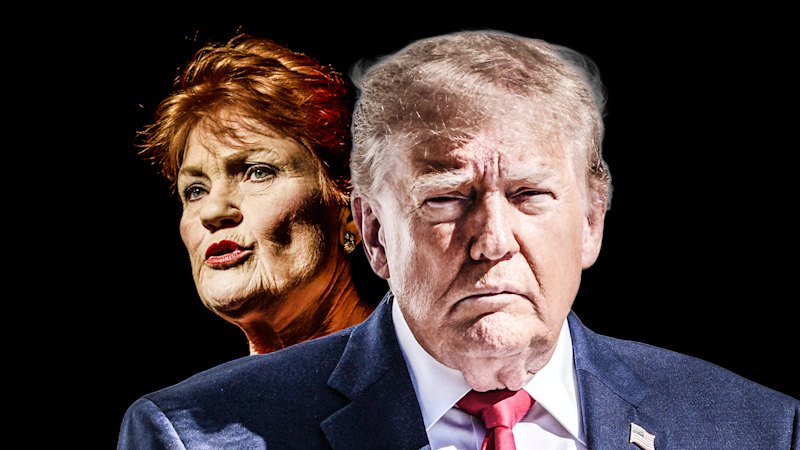
Political commentators love a clean breakup story. When a local politician distances themselves from a national figure—or when a prominent brand name gets quietly dropped from a local campaign or business venture—pundits immediately declare the death of a movement.
That narrative is comforting, simple, and completely misunderstands how political branding actually works.
Critics who frame Donald Trump’s political operation as a failing "franchise" where local operators are "dumping the brand" are projecting traditional corporate retail logic onto an asymmetric political ecosystem. In traditional franchising, a parent company sells a standardized product, enforces strict operational uniformity, and relies on local franchisees to maintain brand equity. If McDonald's corporate reputation tanks, local owners suffer uniformly and might wish they could peel the golden arches off the roof.
Political movements do not operate like fast-food chains. Treating them as if they do is the lazy consensus of modern political analysis.
The Myth of the "Local Franchisee"
When pundits describe local politicians, state-level operatives, or international licensing partners as "franchisees" abandoning a "false idol," they assume a top-down dependency that rarely exists in practice.
In reality, political alignment is transactional and cyclical, not contractual. Local candidates and regional power brokers routinely rent national rhetoric when it drives primary turnout, then pivot toward localized, pragmatic messaging during general elections or off-cycle governance. Political scientists refer to this as strategic localization—a standard survival mechanism in representative democracies, not an ideological mutiny.
Consider the mechanics of brand licensing in both business and politics:
- Corporate Franchising: Requires capital lock-in, multi-year binding contracts, supply chain dependency, and strict brand compliance. Exiting is expensive and legally fraught.
- Political Brand Alignment: Requires zero capital lock-in, operates on a cycle-by-cycle basis, and allows immediate rhetorical pivoting without legal penalty.
When a local candidate stops plastering a national leader's face on their mailers, they are rarely staging a moral rebellion. They are reading district-level polling data. In a primary election, proximity to a polarizing national figure acts as a high-yield customer acquisition tool. In a swing-district general election, that same proximity becomes a high-cost liability. Dropping the branding is basic market segmentation.
What Pundits Miss About Brand Equity
The deeper flaw in the "dumping the brand" thesis lies in how observers measure brand value. Commentators often look at elite media coverage, corporate sponsorships, or defections among establishment politicians as the primary metrics of a political brand's health.
That is looking at the wrong balance sheet.
In high-polarization environments, traditional brand erosion—losing mainstream institutional support or seeing local elites step back—often coincides with increased consolidation among core supporters. Sociologists and political economists have long documented how external criticism and elite defections can strengthen in-group cohesion, a dynamic closely related to costly signaling. When a movement sheds fair-weather allies or local opportunists, remaining adherents frequently view the contraction not as a failure, but as a purification of the brand.
Imagine a scenario where a regional political figure publicly distances themselves from a national movement's figurehead to win a moderate suburban seat. Pundits write headlines about the national brand collapsing. Meanwhile, the national figure raises millions in small-dollar donations the very next day precisely because their core base views the local politician's retreat as proof that the establishment cannot be trusted. Both actors get what they need from the exact same news cycle.
The Real Economics of Political Licensing
Even when looking strictly at commercial real estate and actual brand licensing—where the Trump Organization historically licensed its name to developers globally—the "dumping the brand" narrative misses the underlying financial mechanics.
In real estate licensing deals, developers pay upfront fees and ongoing royalties to use a recognizable name to accelerate pre-construction condo sales or command higher room rates. Once a building is sold out, or once local market demographics shift, the developer's financial incentive changes completely. Paying ongoing licensing fees for a finished asset yields diminishing returns regardless of who is in the White House.
Furthermore, licensing agreements frequently include morals clauses or performance triggers that allow either party to renegotiate when market conditions shift. When a licensee removes a name from a building or a campaign, they are executing an exit clause based on unit economics, not delivering a sweeping ideological verdict on the licensor's legacy.
The Questions Voters and Analysts Should Actually Ask
Instead of asking whether local operators are "dumping" a national political brand, observers should examine the structural incentives driving those decisions:
- Are voter coalitions actually shifting, or are candidates merely changing their packaging? A candidate who drops national branding while voting identically to the national platform has not abandoned the movement; they have simply localized their marketing.
- Who controls the fundraising infrastructure? In modern politics, brand power follows small-dollar donor lists and media attention, not endorsements from local officials.
- What is the cost of independence? Local figures who publicly break with a dominant party brand rarely build a sustainable third-lane coalition; more often, they face primary challenges from candidates willing to embrace the national label without reservation.
The Downside of the Contrarian View
Viewing political movements purely through the lens of transactional market segmentation has a clear blind spot: it can underestimate genuine ideological fatigue.
Not every local retreat is a clever general-election pivot. Brands do experience real, irreversible exhaustion when their core message stops solving the immediate economic or social anxieties of voters. If enough local operators quietly walk away because the national brand actively depresses turnout among reliable voters, what starts as tactical distancing can harden into permanent structural decline. Ignoring voter fatigue in favor of pure cynicism is just as flawed as mistaking a tactical pivot for a total collapse.
Stop Confusing Marketing Pivots With Structural Collapse
Political brands do not die when local politicians change their yard signs. They die when the underlying grievances that created the brand disappear or get absorbed by a more effective competitor.
Until the underlying voter demand changes, local actors will continue to rent, rebrand, and quietly shelve national political labels whenever the local math demands it—and pundits will keep mistaking routine campaign maintenance for a revolution.