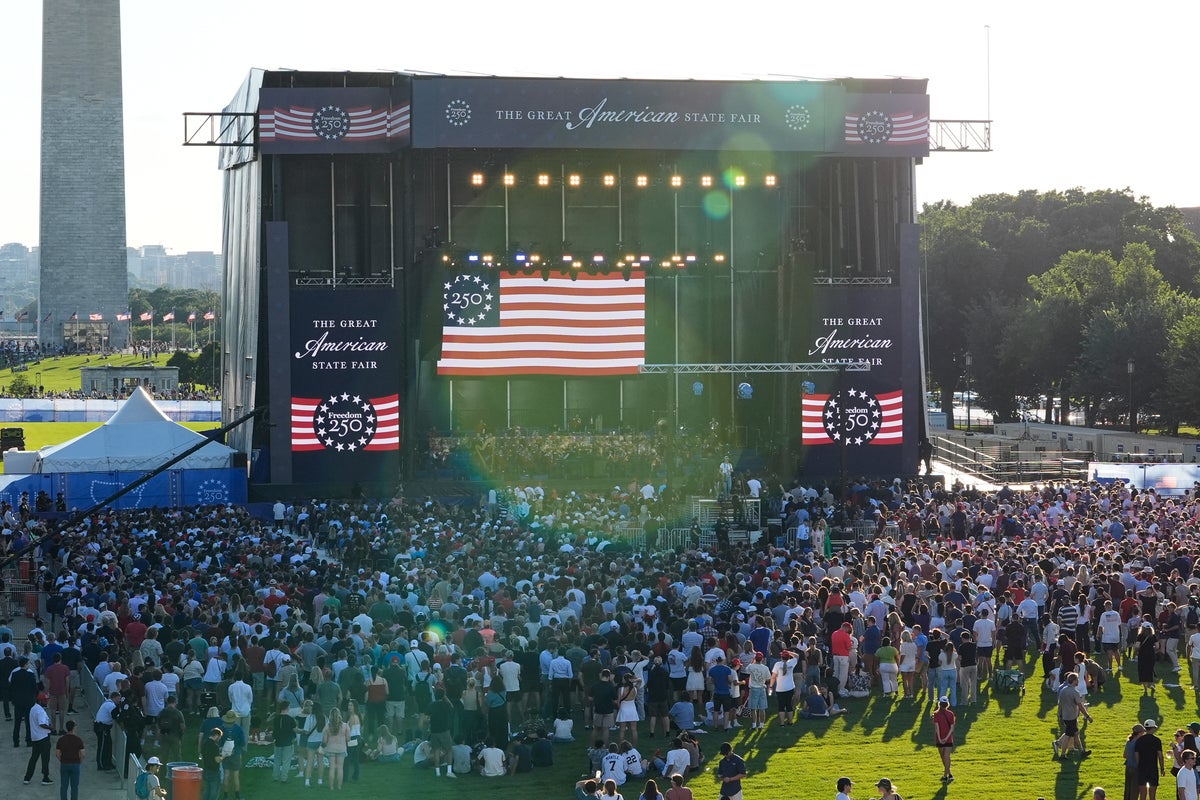
The National Mall was supposed to play host to a nonpartisan birthday bash. Instead, the kickoff for America's 250th anniversary looked identical to a Saturday night campaign stop in Ohio or Florida.
On Wednesday night, President Donald Trump stood before a massive stage decorated with American flags at one end and a mock White House exterior at the other. He spent his time rattling off administration victories, declaring that the country is finally back from the dead. It was loud, it was flashy, and it completely bypassed the neutral historical celebration organizers originally promised. If you found value in this post, you should check out: this related article.
If you are trying to understand why a milestone anniversary turned into a partisan battleground so quickly, you have to look at the weeks of behind-the-scenes friction that led up to this moment.
The Empty Stage and the Performers Who Walked Away
The original lineup for the opening night of the Great American State Fair looked like a classic, broad-appeal summer concert series. Organizers had booked mainstream acts like Martina McBride, the Commodores, and Young MC to headline the festivities. For another look on this event, see the recent update from Reuters.
They all backed out.
As rumors swirled about the highly politicized direction of the Freedom 250 events, these artists quietly canceled their appearances to avoid being used as props. Rather than letting the stage sit empty, Trump stepped directly into the void. He actively hyped his own ability to command an audience, stepping in to replace the musical headliners with a classic rally format.
Instead of pop and country chart-toppers, the crowd heard opera singer Christopher Macchio and MAGA staple Lee Greenwood, who belted out "God Bless the USA" to an audience wearing flag-themed overalls, skirts, and bright red caps. Alexis Wilkins, the girlfriend of FBI Director Kash Patel, sang the national anthem.
The shift from a cultural festival to an administration showcase was immediate. Transportation Secretary Sean Duffy even took the microphone to slam the musicians who boycotted the event, going so far as to call Trump the greatest president since George Washington.
High Stakes and Low Approval Ratings
This spectacle isn't happening in a vacuum. The November midterm elections are looming, and the administration is facing intense public pressure. According to recent polling from the Associated Press-NORC Center for Public Affairs Research, Trump's approval rating sits at a low 37%. Only 33% of U.S. adults approve of his economic leadership, while his handling of immigration rests at 40%.
The rally was a calculated effort to shift the national narrative. Trump worked hard to convince voters that the deeply unpopular war with Iran is firmly in the rearview mirror, pointing to easing oil prices and the gradual reopening of the Strait of Hormuz following an interim deal with Tehran.
For the attendees who traveled hundreds of miles to be there, the message hit home perfectly. Supporters like Karen and Brian Ontrap drove more than 500 miles from northwest Ohio with their kids to see the capital and support the president. For them, and for the roughly 70% of Republicans who tell pollsters they feel proud of the country's upcoming milestone, the event felt exactly like what they wanted.
But for critics, the entire setup looked like an expensive vanity project.
A Fight Over History and Taxpayer Dollars
Democrats and local officials are already pushing back against how the national park space is being utilized. Critics like Representative Jared Huffman of California argue that the Trump-affiliated group organizing the 250th anniversary is redrafting American history to fit a specific political agenda while selling special interest access.
There are also physical arguments happening on the Mall itself. Opponents have pointed to botched repairs on the Lincoln Memorial Reflecting Pool—which recently suffered an unsightly algae outbreak—as evidence that taxpayer money is being diverted into cosmetic, rushed projects meant for television cameras rather than long-term preservation. Trump, meanwhile, spent part of his speech bragging about the cosmetic upgrades he has forced across Washington, including plans for a massive triumphal arch in front of Arlington Cemetery.
The polarization extends far beyond the politicians. While older Americans and Republicans express high levels of excitement for the semiquincentennial celebrations, polling shows that independent and younger voters feel deeply conflicted or indifferent about the milestone.
What to Expect Next on the National Mall
The opening night rally is just the beginning of a massive, multi-week takeover of Washington's historic center. If you are planning to visit the National Mall during the festival, the space has been transformed into a sprawling fairground that looks wildly different from typical summer tourism seasons.
- The Great American State Fair: Running through July, the event features a giant, neon-lit Ferris wheel operating directly in front of the U.S. Capitol.
- The Rodeo Takeover: For the first time in over four decades, a full presidential rodeo is coming to the capital. Organized by the Cervi Championship Rodeo, the event will feature trick riding, cattle drives, and traditional Mexican charro performances on the grass of the Mall.
- The Patriot Games: A youth competition where high school students will face physical and mental challenges to compete for $125,000 scholarship prizes.
- The Fourth of July: The administration is promising a massive Independence Day celebration featuring a campaign-style rally and what they claim will be the largest fireworks display in American history, complete with a flyover of the new Air Force One.
If you plan to attend any of these upcoming events, expect heavy security screenings, cordoned-off sections of the Mall stretching from the Capitol to the Lincoln Memorial, and massive crowds. Be prepared for long lines at food stalls serving up standard fair food like turkey legs, sausages, and burgers, and make sure to monitor local transit alerts as road closures around the District will fluctuate daily through the peak of the July holidays.