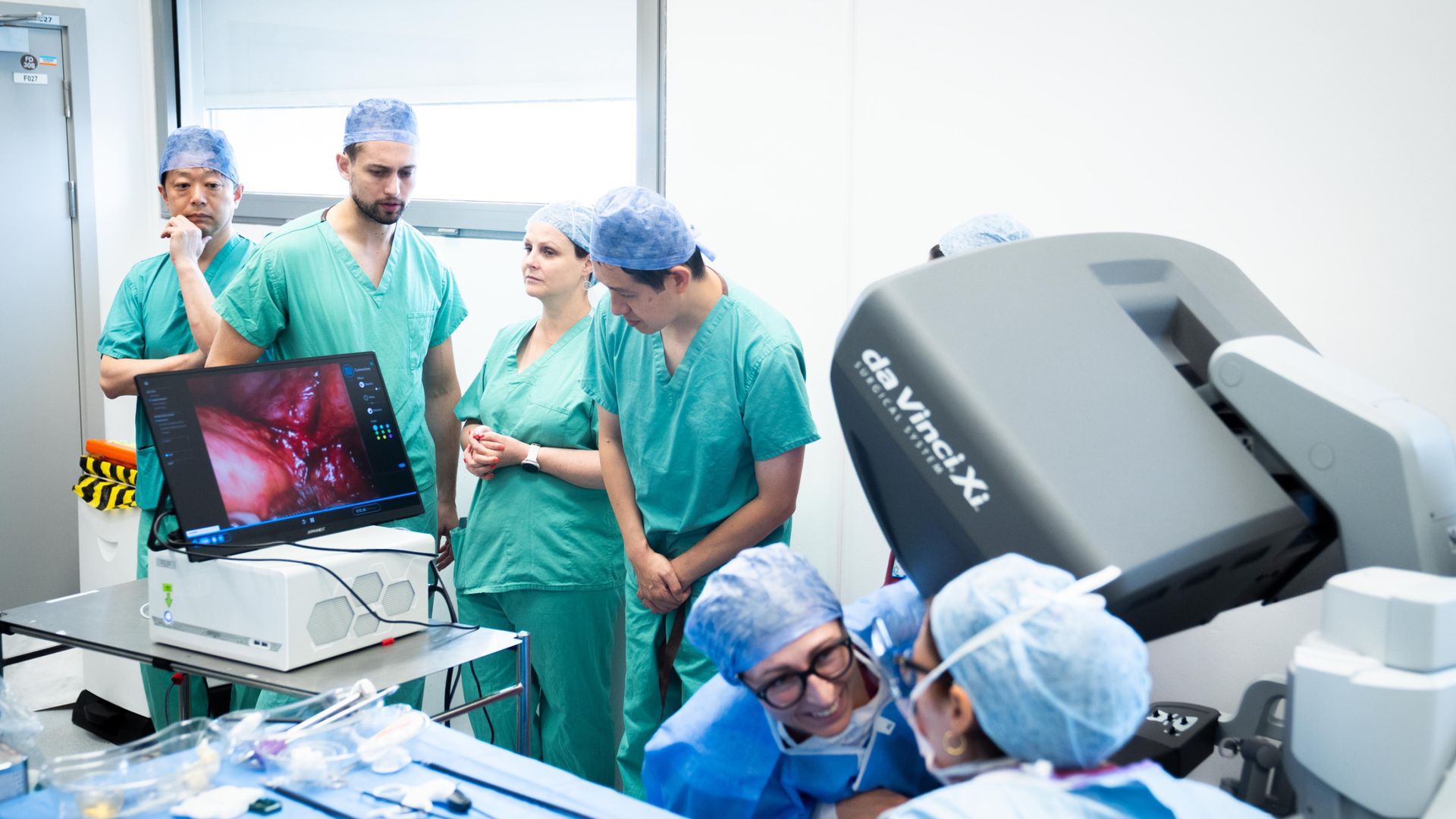
You are lying on an operating table. A surgeon is about to slice into your abdomen to remove a diseased piece of bowel. It is a routine procedure, but in medicine, "routine" still carries terrifying variables. A millimeter to the left, and a hidden nerve is severed. A slight miscalculation, and critical connective tissue is mangled. Human eyes, no matter how highly trained, have physical limitations.
But during a recent procedure at St Mark's Hospital in London, the surgeon had an unfair advantage.
A new artificial intelligence system called Eureka just made its UK debut, acting as a real-time navigation assistant during a live operation. It does not hold the scalpel. It does not make decisions for the doctor. Instead, it turns the surgical monitor into a high-definition, color-coded map. Connective tissue flashes turquoise. Critical nerves pulse in vivid green.
This is not a futuristic concept or a lab trial. It just happened on a patient in her 60s undergoing a bowel resection. It marks the first time this specific technology has been used anywhere in the world outside of Japan.
The Death of the Medical Guessing Game
For decades, surgical training has relied on a sort of geometric intuition. You look at the blood, the fat, and the tissue, and you know where structures should be based on textbook anatomy. But every human body is a custom build. Scar tissue from past surgeries, inflammation, and anatomical anomalies can turn a straightforward operation into a guessing game.
The Eureka system changes the math entirely. Developed by doctors in Japan, the portable AI unit was fed thousands of hours of surgical video. Human specialists meticulously labeled every artery, nerve, and tissue layer across those millions of frames. The result? An algorithm that recognizes internal human anatomy faster and more accurately than a distracted or fatigued human eye.
Consultant surgeon Mr. Kapil Sahnan, who led the historic NHS operation, compared the shift to how we travel. Our parents used paper maps to plan routes. Today, we open Google Maps or Waze. We expect real-time updates on traffic, hazards, and turns. Eureka is Waze for the human abdomen.
The system integrates directly with existing laparoscopic or robotic setups, like the DaVinci surgical robot. As the camera feeds live video from inside the patient onto the operating room monitors, the AI applies a pulsing or constant color overlay. It shows the hidden structures before the surgeon even touches them.
Moving Past Post-Op Regret
Medical tech companies have tinkered with video analysis for a while. Systems like Medtronic’s Touch Surgery ecosystem have allowed doctors to upload recordings of their operations to analyze performance afterward. That is great for schooling residents or fixing repetitive mistakes, but it does nothing for the patient currently asleep on the table. Post-op analysis is essentially an autopsy of what went wrong.
Real-time decision support is where the industry has struggled. The human body moves. Lungs expand, blood flows, and tissue shifts when touched by instruments. An AI cannot just look at a static image; it has to calculate fluid dynamics and shifting geometry on the fly.
The Eureka system achieves this with zero perceptible latency. If a surgeon is dissecting a tumor near a major blood vessel, the AI keeps the warning colors locked onto the danger zones even as the tissue distorts.
This level of precision matters because of one major variable: time under anesthesia. Shorter, cleaner operations mean less tissue trauma, less blood loss, and radically faster recovery times. When a surgeon does not have to pause to confirm if a specific strand of tissue is a nerve or useless fat, the entire operating room moves faster.
The Reality Check Behind the Hype
Let's tone down the tech optimism for a second. This was one successful surgery on one patient in northwest London. It is a massive milestone, but the NHS is not about to buy ten thousand of these units tomorrow.
The immediate hurdle is validation. The medical community is notoriously skeptical of new software, and rightly so. Mr. Sahnan noted that the immediate next step is proving that this tool actively improves patient outcomes over large sample sizes. We need data showing fewer complications, lower readmission rates, and concrete proof that the color-coding reduces human error.
There is also the risk of automation bias. If young surgeons grow up relying on bright green highlights to find a nerve, what happens when a system glitches or the hospital power blinks? Medical training must evolve to treat AI as a secondary confirmation tool, not a primary crutch.
Then there is the logistical nightmare of NHS procurement. Getting a portable AI unit approved, funded, and distributed across cash-strapped trusts takes years.
Your Next Steps as a Healthcare Consumer
The integration of live AI into the operating theater is moving from experimental anomaly to standard practice. If you or a loved one face an upcoming complex laparoscopic or robotic procedure, you should active participate in the tech discussion with your surgical team.
- Ask about real-time visualization tools: When interviewing your surgeon, ask if their trust or hospital utilizes advanced visualization overlays or real-time digital assistance.
- Inquire about robotic experience: If your procedure uses platforms like the DaVinci robot, ask how many cases the surgeon has completed with digital assists.
- Track NHS trust rollouts: Keep tabs on leading digital health trusts like London North West University Healthcare. They generally get first access to pilot programs long before regional hospitals.
The goal is not to have a robot replace your doctor. The goal is to ensure your doctor has the best possible vision when navigating your internal anatomy.
This historic surgery at St Mark's proves that real-time AI guidance is no longer a concept confined to research papers. It is active, it works, and it is saving lives by simply turning on the lights inside the human body.