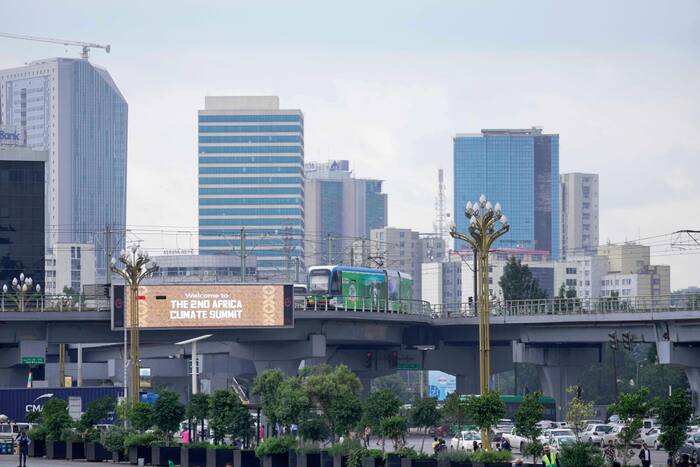
Strategic equilibrium within asymmetric civil conflicts rarely degrades along a linear trajectory. Instead, it undergoes punctuated shifts driven by technological democratization and intelligence failures. The occurrence of explosions across the Ethiopian capital of Addis Ababa, preceded immediately by a national intelligence decree banning unauthorized unmanned aerial vehicle operations, illustrates a fundamental transformation in East African security architecture. This development signals the transition of localized northern insurgencies into a multi-domain theater encompassing urban power centers.
The Mechanics of Asymmetric Deterrence
State security apparatuses maintain a structural advantage in conventional force projection, command hierarchies, and heavy hardware. However, low-cost commercial and adapted aerial platforms have systematically eroded the protective moat traditionally enjoyed by centralized capitals.
The defensive calculus governing Addis Ababa shifted rapidly upon the empirical confirmation that opposition coalitions possessed or were acquiring localized aerial strike capabilities. When a government implements a blanket ban on localized aerial assets, it reveals two distinct operational vulnerabilities:
- Information Asymmetry: Intelligence services recognize a threat vector but cannot reliably discern malicious payloads from civilian or commercial telemetry until interception or impact occurs.
- Spatial Overextension: Defending a sprawling urban center against micro-airborne threats requires a dense, highly coordinated counter-unmanned aerial systems grid that most developing state militaries cannot uniformly deploy across every square kilometer.
The timing of the explosions, arriving hours after the National Intelligence and Security Service prohibition, indicates a reactive rather than preemptive security posture. Preemption requires proactive intelligence penetration of insurgent supply chains; reaction implies that the threat vector was detected only at or near the point of launch or delivery.
Economic and Logistical Ripple Effects
The escalation in the capital cannot be decoupled from the ongoing friction in the northern Tigray region and adjacent corridors. Modern civil conflict imposes severe friction on macroeconomic stability, manifesting as structural bottlenecks that compound daily.
Logistical disruption operates through three primary vectors:
- Transport Corridor Constriction: Secondary and primary supply lines feeding central markets experience military interdiction, causing immediate inventory depletion for staple goods.
- Currency and Liquidity Pressure: Capital flight and hoarding accelerate inflation, forcing black-market premiums on essential commodities such as fuel.
- Risk Premium Inflation: Commercial actors factor political instability into distribution costs, shifting the financial burden directly onto urban working populations who experience degraded purchasing power.
When conflict migrates from peripheral zones to the political core, investor confidence contracts, forcing the central bank to prioritize currency defense over developmental expenditure. This reallocation of fiscal resources further degrades the state's capacity to subsidize basic urban needs, amplifying social friction.
Strategic Forecasting and Systemic Vulnerability
The integration of remote-piloted technologies into opposition arsenals fundamentally alters the negotiation threshold between belligerents. Central governments historically rely on the insulation of the capital to project strength and maintain administrative continuity. When that insulation is breached, the political cost of protracted military campaigns rises sharply.
The trajectory of the current crisis depends on the efficacy of federal counter-infiltration measures within metropolitan manufacturing and transit hubs. If state authorities successfully sever the supply chains feeding localized aerial components, the tactical advantage reverts to conventional mechanized superiority. Conversely, if opposition forces demonstrate sustained capability to project force into the administrative center without proportional attrition, the government faces a difficult choice between prolonged urban fortification and negotiated decentralization.
Projections indicate that urban security protocols in Addis Ababa will remain at an elevated posture, characterized by stringent airspace monitoring, identity verification checkpoints, and intensified counter-intelligence sweeps. The ultimate variable is not the technological sophistication of the opposing platforms, but the resilience of urban supply chains under persistent psychological and physical strain.