Smell the damp wool, the stale pipe tobacco, and the copper tang of fear.
It is the winter of 1916. Inside a cramped, candle-lit cabaret basement in Zurich, a group of young artists, poets, and draft-dodgers are shouting over the sound of artillery rumbling miles away across the Swiss border. They are terrified. They are exhausted. The entire continent of Europe is systematically tearing itself apart over an imperial squabble, turning generations of young men into churned-up mud. Reason has failed. Politics has failed. Language itself has failed, corrupted by statesmen who use words like glory and duty to justify slaughter. Building on this theme, you can also read: The Final Frame and the Ghost of Summerisle.
So, what do these young radicals do? They invent a movement called Dada.
They do not write polite essays protesting the war. Instead, they hit back with total, weaponized nonsense. They read poems made entirely of random consonant sounds. They exhibit bicycle wheels mounted on kitchen stools. They treat logic as the enemy because logic built the trenches. They weaponize absurdity to mock a world that has lost its mind. Observers at Variety have also weighed in on this trend.
Fast forward a century.
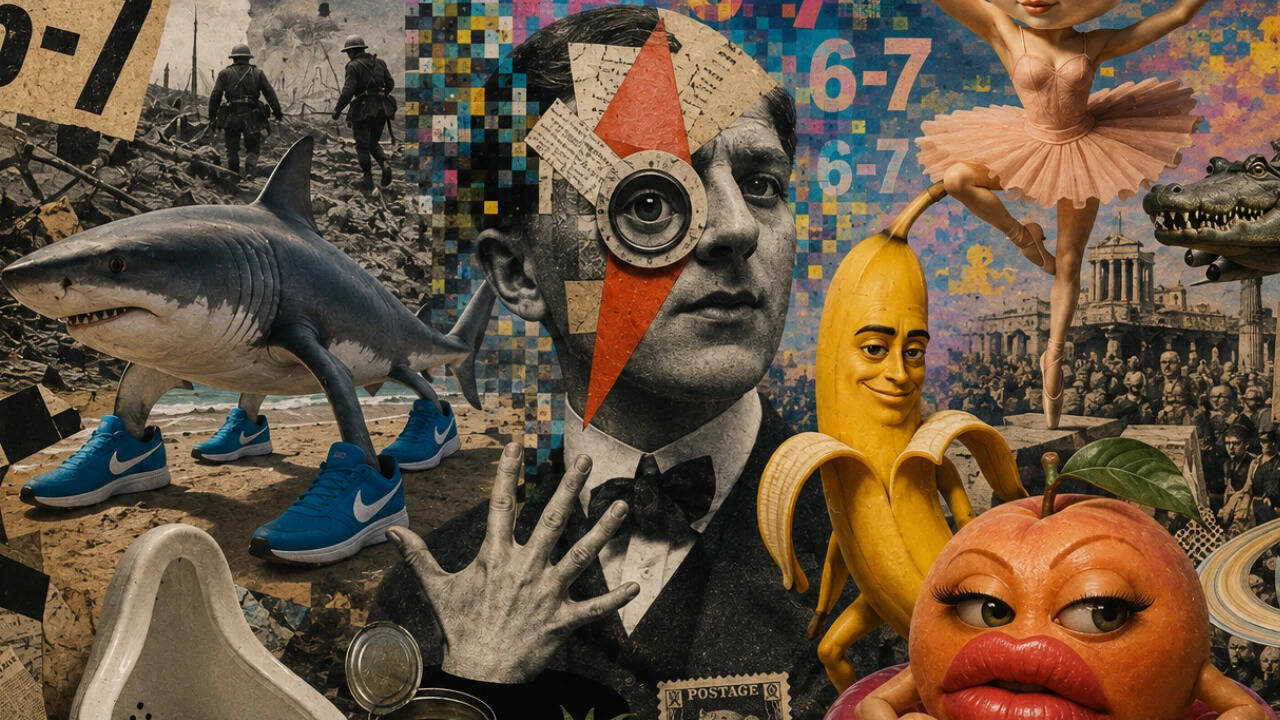
Imagine a teenager sitting in a dimly lit bedroom at three in the morning, bathed in the blue glow of a smartphone screen. They are scrolling through TikTok or an anonymous image board, watching a video of a completely distorted, ear-rape-audio-boosted cartoon cat spinning violently to a hyperpop remix while a caption flashes gibberish: "6-7."
It makes no sense. It defies every rule of traditional comedy. There is no setup, no punchline, no coherent narrative. It is pure, unfiltered chaos. And yet, millions of people instantly understand the shared inside joke.
Look closely. You are witnessing the exact same psychological survival mechanism deployed in Zurich a hundred years ago. Internet absurdism is not a glitch in modern culture. It is Dada’s direct, breathing heir.
When Reality Breaks Down
To understand why young people constantly retreat into incomprehensible humor, you have to look at what they are inheriting.
History teaches us that nihilism and surrealism are never born in a vacuum. They are always children of crisis. When the grand narratives of society—institutions, economies, futures—begin to fracture, people stop taking seriousness seriously.
Consider a hypothetical twenty-two-year-old named Leo, staring down a reality of housing crises, constant algorithmic surveillance, climate dread, and a global news cycle that feels like an ongoing disaster movie. When the macro-world is entirely absurd, polite discourse feels useless. How do you satirize a world that is already a parody of itself?
You can't. You can only out-absurd it.
This is where the parallel between the historical avant-garde and modern meme culture becomes striking. In 1916, Tristan Tzara and Hugo Ball took the building blocks of poetry—words, syntax, grammar—and smashed them against a wall because normal language was complicit in the carnage of the Somme and Verdun.
Today, digital natives take the building blocks of the internet—memes, video formats, audio clips, corporate branding—and shred them through layers of irony until meaning dissolves entirely.
When a meme drops all pretense of sense, it creates a secret club. If you get it, you survive the psychic weight of the room. If you don't, you are just an outsider trying to parse static.
The Mechanics of Digital Dada
We often mischaracterize internet nonsense as sheer stupidity. That is a mistake.
Deconstructing a deeply layered shitpost requires an intuitive understanding of semiotics, cultural touchstones, and ironic distance that would make a postmodern literary critic dizzy. It is a hyper-sophisticated language built entirely on negation.
Take the phenomenon of "6-7" and similar hyper-niche internet slang. To an adult observer, it looks like linguistic decay. To the user, it is a shibboleth. It is a way of saying, We know the system is broken, we know the future is uncertain, and instead of crying about it, we are going to laugh at the very concept of meaning.
The original Dadaists did this with visual art and performance. Marcel Duchamp took a standard porcelain urinal, signed it with a fake name, and called it art. He called it a readymade. He was mocking the pretension of the art establishment while simultaneously pointing out that context is everything.
Internet culture does this every single day with digital readymades. A corporate logo for a fast-food chain or an insurance company is yanked out of its capitalist context, distorted in a video-editing app, paired with chaotic electronic music, and transformed into a surrealist masterpiece of anti-advertising.
It is the same gesture. Duchamp turned a bathroom fixture into a rebellion. Today’s creators turn corporate detritus into digital folk art.
The Comfort of the Void
There is a profound vulnerability hiding underneath the flashing lights and obnoxious volume of modern digital absurdity.
Sincerity is terrifying. When you care about something openly in public view, you leave yourself exposed to cynicism, exploitation, and disappointment. Irony acts as emotional body armor. If nothing matters, nothing can hurt you.
When you spend your formative years watching adults bicker over collapsing ecosystems, housing markets, and endless geopolitical conflicts while telling you to just study hard and get a good job, a deep-seated disconnect forms. The old rules don't match the new terrain.
So you throw out the map.
You build a clubhouse out of garbage code, weird sound effects, and inside jokes that nobody over thirty can comprehend. You laugh because the alternative is looking too closely at the darkness outside the window.
The artists of the Cabaret Voltaire knew this feeling intimately. They sat in their damp Zurich basement, painting their faces, banging on drums, and reciting nonsense verse while empires crumbled outside. They weren't just trying to shock the bourgeoisie. They were comforting each other. They were finding warmth in the coldest century Europe had ever known.
Next time you see a piece of internet culture so utterly bizarre, fragmented, and inexplicable that it makes your head spin, do not dismiss it as empty noise.
Listen closer.
Hear the echoes of the trenches in the static. Recognize the frantic, beautiful, resilient human impulse to laugh in the face of ruin, to take the shattered pieces of a broken language, and to build something entirely, gloriously new out of the wreckage.