The modern political apparatus treats human beings like inkblots. You look at a person, you project your deepest anxieties or grandest theories onto them, and then you write a thesis explaining why their choice of lunch is a calculated maneuver to alter the course of Western civilization.
But sometimes, a dress is just a dress. And sometimes, the price tag on that dress is a punchline that brings the whole high-minded theater crashing down to earth.
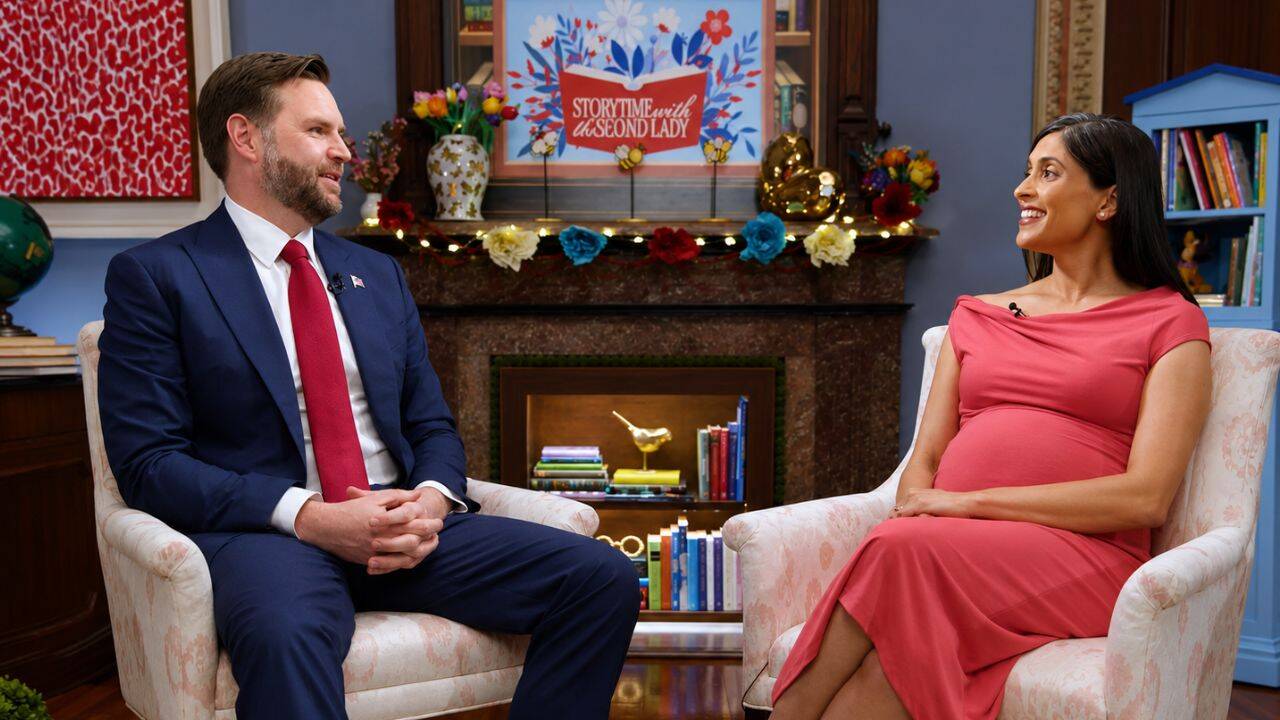
Consider the case of Usha Vance, the United States Second Lady, currently expecting her fourth child. On a recent episode of her digital show, Storytime with the Second Lady, she sat before the cameras to read a children's book. She was wearing a coral, asymmetrical-shoulder maternity dress. It was bright, it was casual, and it clung to a very prominent baby bump.
To the untrained eye, it was simply an expectant mother choosing a comfortable, colorful outfit for a Father's Day broadcast alongside her husband, Vice President JD Vance.
To the cultural desk at The New York Times, however, it was a tactical manifestation of the pronatalist movement.
In a sweeping fashion critique titled "The Politics and Power of the Pregnancy Image," fashion director Vanessa Friedman argued that the visible pregnancies of high-profile women in the administration—including White House Press Secretary Karoline Leavitt and Katie Miller—formed a deliberate, "paradigm-shifting" visual campaign. The essay suggested these women were using their changing bodies to humanize the executive branch and give literal shape to a specific family and fertility platform. It was an intellectual exercise in reading between the lines, transforming a wardrobe choice into an ideological manifesto.
The theory was elegant. The prose was sharp. The only problem was the retail value of the fabric.
The Price of Symbolism
When the analytical dust settled, Usha Vance didn't respond with a press release or a defensive policy statement. She responded with a screenshot.
Taking to X, the Second Lady posted the official digital receipt from Old Navy. The Occasion Maternity Assymmetrical Shoulder Maxi Dress originally carried a retail price of $49.99. But after a clearance markdown to $12.49, followed by an additional $3.74 promo code deduction, the final cost of the heavily analyzed political garment was revealed.
It cost $8.75.
"Now that we know the political significance of my $8.75 coral maternity dress from Old Navy," she wrote with unmistakable irony, "can't wait to hear what the New York Times has to say about my elastic-waistband pants and compression socks!"
The response was swift, cutting through the dense layer of academic analysis with the sharp edge of everyday reality. In a media environment that often treats every public figure as a hyper-curated avatar, the sudden insertion of a clearance-rack promo code felt less like a political strategy and more like a universal human experience. Anyone who has ever aggressively stacked coupons at an online checkout recognized the victory.
A New Candidate for Fiscal Policy
The comedy of the situation wasn't lost on the Vice President. Spotting the receipt online, JD Vance jumped into the fray with a public endorsement of his wife's shopping habits, reframing the internet-breaking bargain as the ultimate job interview.
"She bought a $50 dress for $8.75," he joked on social media. "America: meet your next director of the federal budget!"
The quip landed cleanly because it tapped into a broader, deeply felt cultural frustration. While Washington battles over trillions of dollars in abstract national debt, the average American household is navigating the very real, very stressful mechanics of the weekly grocery bill. Inflation has turned everyday budgeting into an extreme sport. In that context, the image of a Second Lady hunting for discounts strikes a completely different chord than a stylized fashion spread.
The humor hides a deeper friction. There is a massive, growing disconnect between the elite cultural commentators who analyze Washington and the people who actually live in the rest of the country. To the commentator, a dress must be an intentional statement on traditionalism and fertility. To the woman wearing it, it is a piece of clothing that fits a changing body, costs less than a fast-food meal, and didn't require a trip to a boutique designer.
The Human Element Over the Avatar
This entire episode highlights a recurring flaw in how we consume modern news. We have become so addicted to hunting for hidden subtext that we have forgotten how to read the text itself. We assume that wealth and power erase the basic, mundane habits of ordinary life.
But habits run deep. Long before she was the Second Lady, Usha Vance was a clerk, a corporate litigator, and a student navigating the financial realities that face every young professional. The instinct to click on the clearance tab or wait for a promo code doesn't magically disappear when your husband takes an oath of office.
There is an undeniable vulnerability in showing the receipt. It exposes the mundane logistics behind the political curtain. It proves that despite the security detail, the motorcades, and the intense media scrutiny, the daily reality of expecting a fourth child still involves compression socks, elastic waistbands, and hunting for deals online.
The New York Times piece tried to paint a picture of idealized, calculated womanhood. But the receipt painted a picture of something far more relatable: a mother of three, staring at her laptop, refusing to pay fifty bucks for a dress she will only wear for a few months.
The culture wars will continue to rage over abstract symbols, grand strategies, and rhetorical battles. Commentators will keep looking at inkblots and seeing whatever political monsters or angels they want to find. But for one brief moment, the entire conversation was grounded by the simple, unpretentious reality of an $8.75 price tag, leaving an indelible image of a family budget victory that resonated far louder than any political platform ever could.