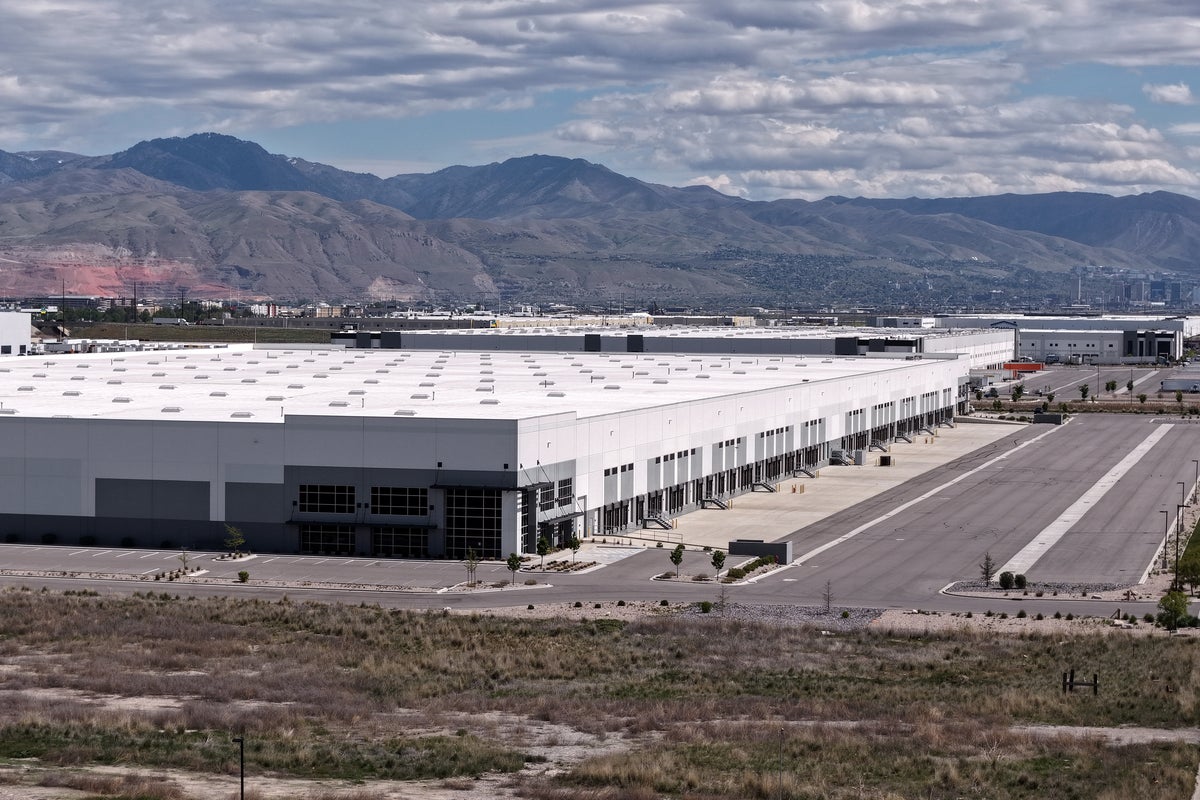
The Department of Homeland Security is currently untangling a multi-billion dollar knot of real estate deals that look less like a national security strategy and more like a fire sale for industrial junk. At the center of this mess is a $38.3 billion program designed to turn massive, windowless commercial warehouses into "mega-centers" for immigrant detention. While the ambition was to create a logistical chain for mass deportations modeled after Amazon’s distribution network, the reality has devolved into a sprawling federal audit, a series of scuttled contracts, and the professional undoing of former DHS Secretary Kristi Noem.
The DHS Office of Inspector General confirmed this week that it has launched a formal audit into the "Detention Reengineering Initiative." This is not just a routine check of the books. Investigators are looking at how the agency managed to spend over $1 billion on just 11 properties—many purchased at significantly higher rates than the surrounding market value—before the program was abruptly paused by Noem’s successor, Markwayne Mullin.
Logistics Without a Blueprint
The core premise of the program was simple but fundamentally flawed. To facilitate the administration's goal of unprecedented deportation numbers, ICE needed "beds." But building traditional detention centers takes years of environmental impact studies, local zoning battles, and specialized construction. The Noem-era solution was to bypass the wait by buying existing "big box" warehouses and retrofitting them.
The strategy aimed for 92,600 new beds across the country. Eight of these sites were designated as "mega-centers," designed to hold between 7,000 and 10,000 people each. For context, the largest existing ICE facility currently holds about 5,000.
There is a reason why private industry doesn't house thousands of people in structures designed for palettes of electronics. Warehouses lack the plumbing for thousands of toilets. They lack the HVAC capacity to circulate breathable air for a concentrated population. They are often located in industrial zones where the local sewage and water infrastructure is already at its limit.
In Social Circle, Georgia, the local mayor took the extraordinary step of cutting off water access to a proposed site to prevent the federal government from moving forward. It was a clear signal that the "Amazon Prime for people" model didn't account for the most basic human requirements.
The Paper Trail of "Urgency"
The Inspector General’s probe is particularly focused on how these contracts were awarded. Under Noem’s leadership, ICE frequently invoked an "unusual and compelling urgency" justification. This allowed the agency to sidestep the open bidding process that usually governs federal spending.
By the time Noem was removed from her post in March 2026, ICE had awarded nearly $241 million in these urgent contracts. Some of that money went to defense contractors with no prior experience in immigration detention. In one instance, a $113 million contract was awarded to a firm called KVG LLC to convert a Maryland warehouse, despite the company having no track record in this specialized field.
Real estate analytics from CoStar suggest the government paid between $35 million and $145 million for individual vacant warehouses in states like Arizona, Texas, and Michigan. In several cases, the price paid per square foot far exceeded what private investors were paying for similar assets in the same zip codes.
The question investigators are now asking is whether the "urgency" was a legitimate operational need or a convenient cover to funnel taxpayer money to specific firms without public scrutiny.
Infrastructure Versus Ideology
When Markwayne Mullin took the helm of DHS, he brought a background that Noem lacked. Mullin, who ran a large-scale plumbing and construction business before entering politics, immediately questioned the feasibility of the warehouse conversions. During his confirmation, he noted that most municipalities simply do not have the utility capacity to support 10,000 people living inside a single industrial shell.
This shift highlights a growing divide between the ideological push for mass detention and the physical reality of civil engineering. You cannot simply wish a sewage system into existence because a policy memo says it is necessary.
The program also faced a "landlord revolt." Major real estate holders, including firms like Majestic Realty Co., pulled out of deals after massive public pressure and threats of boycotts. In Texas, a planned 9,500-person facility was scuttled because the owners refused to be associated with the "warehousing" of human beings.
Financial Fallout and the Road Ahead
The $38 billion figure was intended to cover the acquisition, retrofitting, and long-term operation of these sites over a decade. However, with the pause in place, the government is left holding at least 11 properties that it may not be able to use for their intended purpose.
If these warehouses cannot be converted due to local opposition or structural impossibility, the government will likely have to sell them back into the private market. Given that they were purchased at a premium during a period of high demand for industrial space, the taxpayer is looking at a substantial loss.
Beyond the real estate, there is the human cost. The 2025-2026 period saw a spike in deaths within ICE custody. Internal reports suggest that the rush to expand capacity led to a breakdown in medical payment systems and basic sanitation standards.
The investigation by the DHS watchdog is the first step in a long process of accountability. It remains to be seen if the "Detention Reengineering Initiative" will be completely scrapped or if it will be scaled back into a more traditional, and more expensive, construction program. For now, the "mega-centers" stand empty—expensive monuments to a logistical plan that ignored the laws of physics and the realities of local governance.
Fixing the immigration system requires more than just square footage. It requires a level of planning that treats infrastructure as a constraint, not a suggestion.