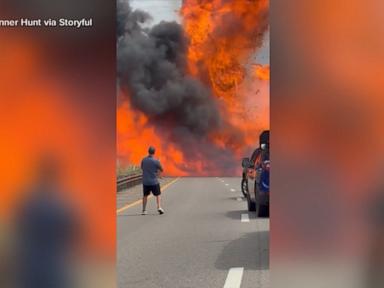
The asphalt on State Route 87 does not just absorb the Arizona heat; it radiates it back like a physical force. Anyone who has driven the stretch near Sunflower, about thirteen miles out from Bush Highway, knows the shimmering mirage that dances on the horizon during midsummer. It is a beautiful, brutal stretch of geography. On a Wednesday afternoon, it became the stage for a terrifying demonstration of how quickly modern convenience can dissolve into chaos.
Imagine the standard rhythm of a summer road trip. The steady drone of tires, the rhythmic hum of the air conditioner fighting a losing battle against the outside atmosphere, and perhaps the relaxed comfort of driving a recreational vehicle. It feels safe. It feels entirely contained.
Then, the engine sputters.
When the Machinery Turns
By three in the afternoon, the heat is at its most oppressive. For one traveler along State Route 87, a routine journey transformed into an emergency when their vehicle began to fail. It was an RV—a rolling home, filled with personal belongings, memories, and propane. Within minutes, the engine compartment was no longer just running hot; it was actively burning.
Black, oily smoke began rolling from beneath the hood. The vehicle was pulled over hastily to the shoulder, the dry brush of the Tonto National Forest resting mere inches from the tires.
A passing driver slowed down, holding up a smartphone to record the escalating disaster. The footage captured the final moments of a machine's life. The smoke grew thicker, choking out the desert sky, until a sudden, violent eruption tore through the frame.
Boom.
The vehicle exploded. A massive fireball expanded outward, shattering the chassis and raining burning debris into the parched vegetation lining the highway. The surrounding desert, already baked to a crisp by weeks of intense sunshine, did not just catch fire. It seemed to accept the flame willingly.
The Friction of Two Extremes
What followed was a masterclass in emergency response, but also a stark reminder of our vulnerability. The Arizona Department of Transportation moved swiftly. Both directions of State Route 87 were shut down instantly, cutting off a vital artery for hundreds of travelers. Commuters were stranded on the asphalt, watching the smoke rise from the horizon, waiting out the two hours it would take to regain control of the blacktop.
The fire, dubbed the Round Valley Fire, consumed thirty acres in what felt like the blink of an eye.
To understand why a simple mechanical failure can trigger a thirty-acre wildfire, consider the state of the landscape. The desert in late June is not merely dry; it is primed. The grasses and shrubs that flourish during the wetter months become fine fuels. They require very little energy to ignite. A single spark from an unmaintained brake pad, a discarded cigarette, or, in this extreme case, a catastrophic vehicle explosion is all it takes.
Four engines rushed to the scene. Two interagency hotshot crews—the elite vanguard of wildland firefighting—were deployed alongside multiple aircraft dropping retardant to paint a red line between the flames and the rest of the forest. By five in the evening, the highway reopened. By six-thirty, the blackened earth stood out as a dark scar against the desert landscape, with fire crews still patrolling the smoking perimeter.
The Invisible Stakes of the Highway
The true story of the Round Valley Fire is not found in the statistics of acres burned or the hours a road was closed. The story lies in the terrifyingly narrow gap between a minor mechanical issue and an ecological crisis.
Every year, millions of us pack into our vehicles, turn on the ignition, and drive through some of the most volatile environments on Earth without a second thought. We trust our hoses not to crack. We trust our fluids not to leak. We assume the metal box keeping us cool will hold together.
But machines fail. When they fail in a grocery store parking lot, it is an inconvenience. When they fail on an isolated highway surrounded by parched public lands, they become a detonator.
Consider the reality facing the driver of that RV. In a matter of minutes, a summer excursion evaporated into a total loss of property, a harrowing escape from a blast wave, and the realization that their vehicle had just ignited a wildfire. That is a heavy psychological weight to carry from a Wednesday drive.
The incident occurred just as neighboring regions, including areas around the Apache-Sitgreaves National Forest, prepared to elevate to Stage 2 fire restrictions. These measures restrict internal combustion engines to clear, protected areas and mandate spark-arresting devices. The timing is not coincidental. The margins for error have completely vanished.
The black scar along State Route 87 will eventually fade as nature recovers, but the lesson remains written in the charred remains of the roadside brush. We share these landscapes with forces far greater than our machinery. Every trip into the desert is a negotiation with the heat, the dryness, and the unpredictable nature of the gear we rely on. Staying safe requires more than just keeping our eyes on the road; it demands that we respect the volatile world rushing past our windows.