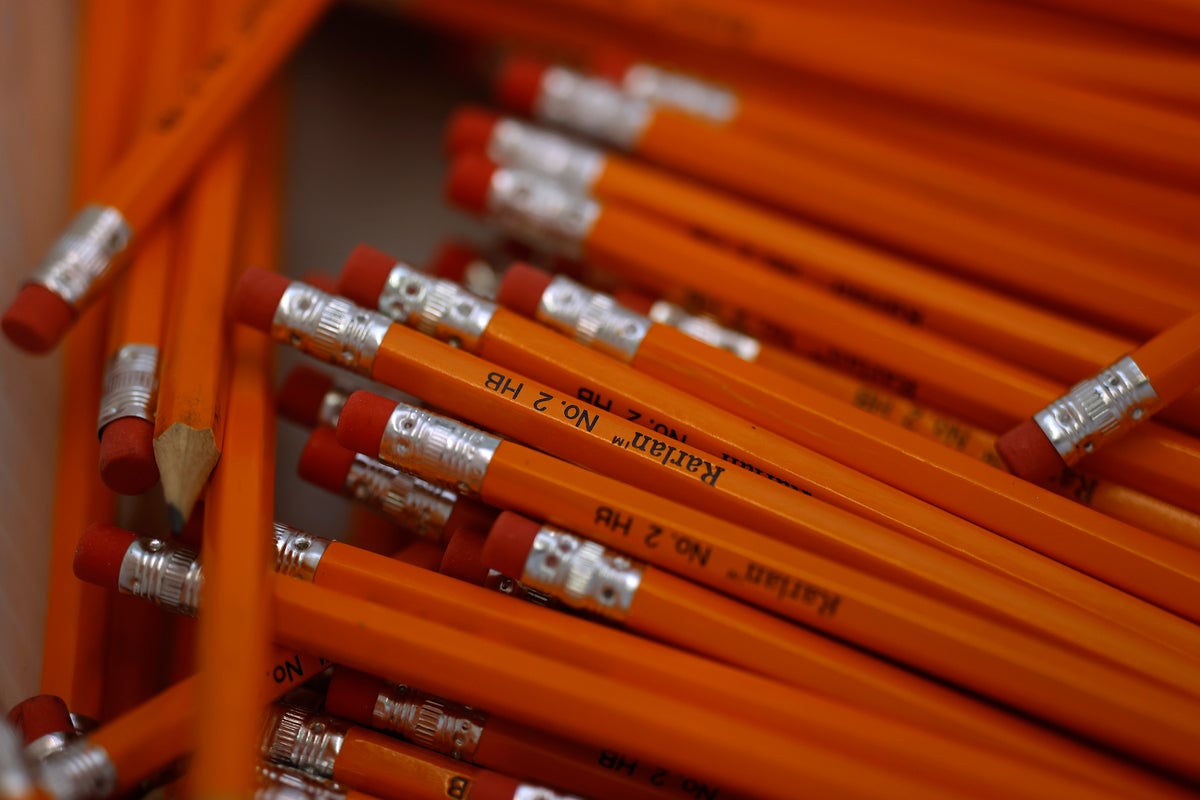
You’ve held a No. 2 pencil thousands of times. You filled in Scantron bubbles with it. You chewed on the eraser during difficult math tests. But do you actually know why that specific yellow wooden stick dominates classrooms and offices across the country?
Most people think it's some deep government conspiracy or a random accident of history. It's neither. The No. 2 pencil became the default standard because of a very specific manufacturing sweet spot, standardized testing evolution, and the brilliant marketing of a few massive stationery companies. For a different view, read: this related article.
Let's clear up the confusion right now. You don't need a degree in industrial design to understand the pencil grading scale, but you do need to know that the number doesn't mean what you think it means.
The Real Meaning Behind the Number
Graphite is slippery and soft. Clay is hard and brittle. Mix them together, fire them in a kiln, and you get a pencil core. Similar analysis on this trend has been shared by Cosmopolitan.
American pencil manufacturers created a grading scale to help consumers understand how dark or light a mark would be. While European brands use letters like B for black and H for hard, American companies went with numbers.
- No. 1 is soft, dark, and smudges easily.
- No. 2 sits right in the middle as a medium-soft grade.
- No. 3 is hard and leaves a lighter, fainter line.
- No. 4 is very hard and scratchy.
If you use a No. 1, your notes smear across the page. If you use a No. 3 or No. 4, you have to press down so hard you rip the paper. The No. 2 pencil hit the exact balance. It was dark enough to read easily, durable enough not to snap every two minutes, and soft enough to erase without tearing the notebook page to shreds.
That pragmatic middle ground is why teachers fell in love with it.
How Standardized Testing Sealed the Fate
The real reason the No. 2 pencil achieved legendary status isn't just writing comfort. It's technology. Specifically, the technology of grading multiple-choice exams at scale.
Back in the 1930s, IBM introduced test-scoring machines. These early computers didn't read ink. They relied on electrical conductivity. When graphite marks were made on a standardized test paper, an electrical current passed through the graphite to measure the resistance.
If a student used a pencil that was too hard—like a No. 3 or No. 4—the graphite content was too low. The machine couldn't detect the electrical current, and the student's correct answers were graded as blank. If they used a pencil that was too soft—like a No. 1—the graphite deposited too much conductive residue, causing false positives and jamming the optical sensors.
The No. 2 pencil was the exact composition that IBM machines needed to read tests reliably without short-circuiting or missing marks.
Once testing companies codified this rule into their exam instructions, schools had no choice. They bought them by the pallet. Millions of students picked them up every single spring.
The Strange Obsession with Yellow Paint
Have you ever wondered why almost every traditional wooden pencil is painted yellow?
It wasn't always this way. In the nineteenth century, high-quality graphite came from mines in China and Siberia. American pencil makers wanted to signal to buyers that their product contained the finest foreign materials.
In the late 1800s, the L.&C. Hardtmuth Company introduced the Koh-i-Noor pencil, named after a famous diamond. They painted it bright yellow to evoke the royalty of the Far East and set it apart from the plain, natural wood finishes of the era.
Competitors copied the idea instantly. Soon, yellow became the universal shorthand for a pencil. Even today, when synthetic materials and modern plastics dominate manufacturing, most wooden pencils still wear that iconic coat of yellow paint. It's pure psychological branding that stuck around for over a century.
Common Mistakes People Make When Buying Pencils
Buying writing instruments seems simple. You grab a pack off the shelf and walk away. Yet, most people buy the wrong stuff because they fall for cheap packaging tricks.
Here is what you actually need to watch out for:
- Buying dyed poplar instead of cedar: Cheap pencils are made from splintery wood that cracks when you try to sharpen them. Look for genuine incense-cedar, which sharpens to a clean, smooth point.
- Ignoring the core centering: If the lead is off-center inside the wood, the tip will snap off every single time you put it in a hand sharpener. Premium brands center the graphite securely.
- Trusting cheap erasers: A lot of budget pencils feature glued-on rubber plugs that harden into plastic after a few weeks. They smear graphite instead of erasing it. If you care about fixing mistakes, buy a separate block eraser.
What You Should Use Instead
The No. 2 wooden classic is great for nostalgic journaling and taking standardized tests, but it has flaws. The core wears down fast, requiring constant trips to the wall sharpener.
If you're writing all day, upgrade to a mechanical pencil with a 0.5mm or 0.7mm lead. You get consistent line width without losing time to the sharpener.
If you prefer the feel of wood, look for artist-grade HB pencils from companies like Blackwing or Mitsubishi . They use premium Japanese graphite that glides across paper with zero friction.
The humble yellow pencil built American education. It survived the digital transition, computer labs, and tablet classrooms. Respect the tool, but don't be afraid to branch out.
Grab a sharp blade, pare down the wood, and write something real today.