You probably think of Ice Age cave art as something exclusively French or Spanish. You picture the sprawling, vivid galleries of Lascaux or Altamira. For a long time, mainstream archaeology kinda agreed. Britain was viewed as a cold, brutal northern wasteland where early humans were too busy struggling for survival to care about aesthetics.
That narrative is officially dead.
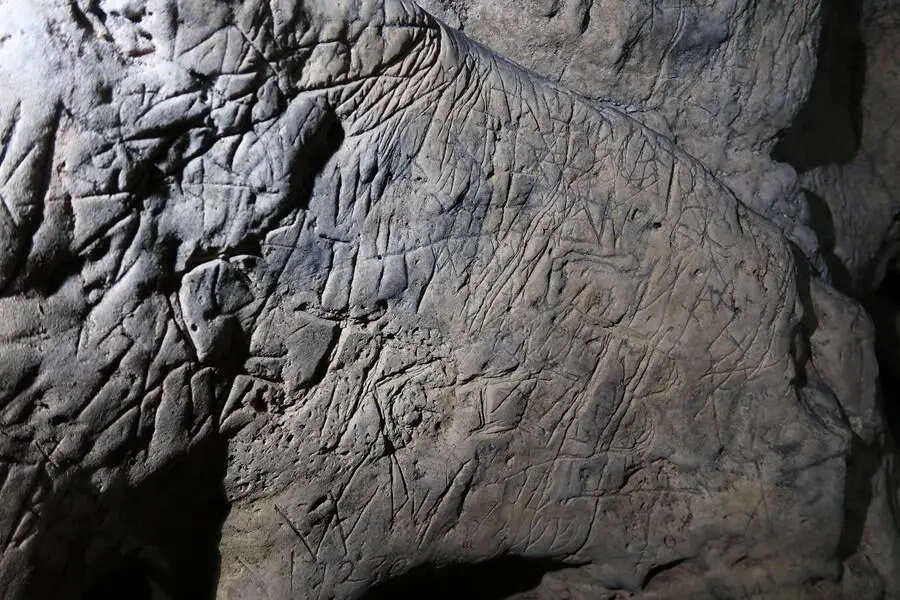
Scientific verification confirms that a series of faint, easily overlooked markings inside Church Hole and Robin Hood caves at Creswell Crags are the real deal. They represent the oldest known prehistoric cave art ever found in Britain. Dating back between 13,000 and 15,000 years, these engravings prove that ancient Brits possessed the exact same cultural sophistication, symbolic thinking, and creative drive as their continental neighbours.
The Scratches That Rewrote a Nation’s Past
For decades, people walked right past these markings. The limestone gorge straddling the Derbyshire and Nottinghamshire border is famous for its history, but the walls themselves hid secrets in plain sight. When a team of researchers first noticed the etchings in 2003, skepticism ran high. Skeptics figured they were natural scratches from animal claws, recent graffiti, or geology doing its thing.
It took years of intense digital analysis, close-range photogrammetry, and Reflectance Transformation Imaging (RTI) to settle the debate. The latest multi-year reviews prove human intent. These aren't random scrapes. They are deliberate, stylized carvings executed with precise techniques.
The artists were Magdalenian hunter-gatherers, migrating north as the massive glaciers began their long retreat. They found shelter in these limestone fissures, but they also brought their culture with them.
What the Ancient Artists Actually Carved
Don't expect vibrant, multi-coloured charcoal paintings when you visit. The art at Creswell Crags is understated, heavily eroded, and etched directly into the bedrock. In some spots, a thin glaze of calcium carbonate flowstone grew right over the top of the carvings, sealing them in time.
The range of imagery discovered across the panels is fascinating.
- The Stag: A clearly defined male red deer, which stands as one of the most recognizable pieces of the entire collection.
- Bison and Aurochs: Depictions of massive, powerful beasts that roamed the post-glacial tundra.
- Stylized Birds and Females: Long-necked, elongated forms that researchers interpret as either water birds like the ibis, or highly abstract female figures.
- Abstract Symbols: Downward-pointing triangles, often interpreted by archaeologists as vulvae or fertility symbols.
Understanding how these images look in person requires a shift in perspective. Our ancestors didn't have floodlights. They carved these figures deep inside dark chambers where daylight couldn't reach. Experts believe the art was meant to be viewed exclusively by the flickering, dancing light of animal-fat lamps or torches. Under moving flames, the shallow grooves on the uneven rock surfaces would seem to shift, giving life and motion to the animals. It wasn't simple home decor; it was immersive storytelling.
How Science Proved the Skeptics Wrong
Dating rock art is a nightmare for archaeologists. Without charcoal or organic pigments, traditional radiocarbon dating is useless. You can't date a groove cut into stone.
To solve this, scientists turned to uranium-series disequilibrium dating. They targeted the tiny layers of flowstone that naturally formed on top of the carvings. Because this mineral crust contains trace amounts of uranium that decay into thorium over time, scientists can measure the ratio to find out exactly when the stone formed.
The testing yielded a minimum age of roughly 13,000 years. Because the flowstone formed over the art, the actual engravings must be even older. This matches up perfectly with the flint tool types and butchered horse teeth found embedded in the cave floors.
Moving Past the Primitive Caveman Myth
The confirmation of the Derbyshire art shatters an old, lazy stereotype. It shows that Ice Age Britain wasn't some culturally isolated backwater. The people moving through the East Midlands were part of a vast, interconnected network of European hunter-gatherers who shared identical artistic traditions, belief systems, and technical skills across thousands of miles.
They weren't just primitive brutes reacting to their environment. They were modifying their spaces, leaving permanent cultural markers, and projecting their internal worldview onto the landscape.
Plan Your Visit to the Ice Age
If you want to see this history yourself instead of reading about it online, you can actually book a slot. Creswell Crags operates guided Rock Art Tours that take you straight into Church Hole Cave to view the engravings under expert guidance.
- Location: Use the satnav postcode S80 3LH. The site is a short drive from Chesterfield or Worksop, and the nearest train station at Creswell is about a mile away.
- What to bring: Sturdy footwear is non-negotiable. The cave floors are damp, uneven, and naturally slippery.
- The Museum: Check out the on-site visitor centre before your cave tour. It holds genuine Ice Age tools and the famous "Ochre Horse"—a separate, incredibly detailed 13,000-year-old carving of a horse's head etched onto a fragment of rib bone discovered at the site in the 19th century.
Skip the generic tourist spots this weekend. Walk into the limestone gorge, step inside the shadows of Church Hole, and look at the very first marks left behind by Britain's earliest creatives.